October 6, 2026 | The Artemis family visits friends
Artemis Accords signatories come to Germany
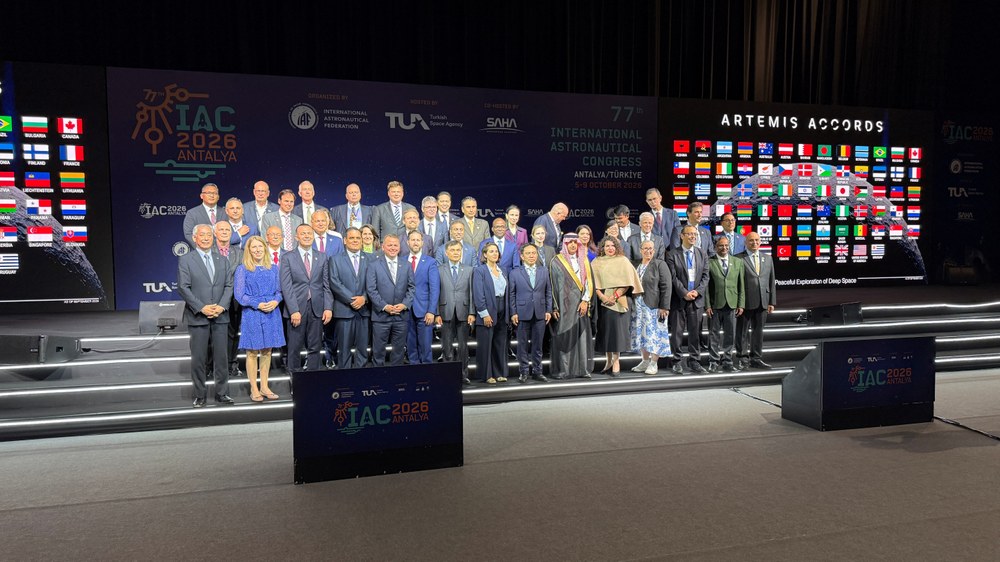
Representatives of the Artemis Accords signatory states
In May 2027, senior members of the Artemis family will come to Germany for the ‘Artemis Accords Workshop’, to foster exchange among the participating states. This was announced at the Artemis Accords Principals' Meeting at the 77th International Astronautical Congress 2026 in Antalya (Türkiye). Germany is the fifth country, after Poland (2023), Canada (2024), the United Arab Emirates (2025) and Peru (2026), to have the opportunity to host this important international event.
The Artemis Accords form the basis for political cooperation between the signatories in the peaceful, responsible and sustainable exploration of space within the framework of the Artemis programme. They reaffirm the validity of the universal international legal framework created by the 1967 Outer Space Treaty and seek to promote its further development through a comprehensive multilateral approach. Germany signed the Accords in 2023.
Image: 2/2, Credit:
NASA
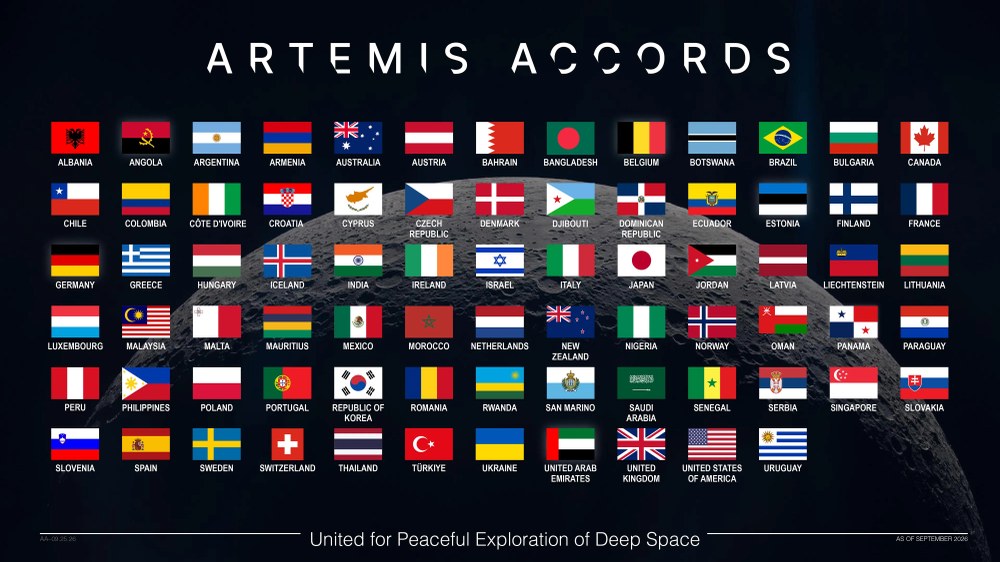
The German Space Agency at DLR is inviting the 76 Artemis Accords signatory states to Germany in May 2027.
They aim to further expand the peaceful, safe, transparent and sustainable exploration of space.
On 14 September 2023 in Washington, Germany – represented by the German Space Agency at DLR – became the 29th country to sign the Artemis Accords.
Focus: Space, space exploration, international cooperation
How should states explore celestial bodies such as the Moon and Mars in a peaceful, safe, transparent and sustainable manner, and in this spirit carry out resource-related activities, share scientific data and shape information exchange and international coordination? These and many other questions are addressed in what are known as the Artemis Accords. These multilateral political principles for civil activities on other celestial bodies were put forward by the United States together with seven other signatories in October 2020. On 14 September 2023 in Washington, Germany – represented by the German Space Agency at the German Aerospace Center (Deutsches Zentrum für Luft- und Raumfahrt; DLR) – signed the Artemis Accords, becoming the 29th of what are now 76 states. In May 2027, senior members of this Artemis family will come to Germany for the 'Artemis Accords Workshop', to deepen transnational dialogue on the implementation of the principles, expanding the global network, increasing international understanding and visibility, and strengthening the commitment to multilateralism. Germany is the fifth country, after Poland (2023), Canada (2024), the United Arab Emirates (2025) and Peru (2026), to have the opportunity to host this important international event. This was announced at the Artemis Accords Principals' Meeting at the 77th International Astronautical Congress (IAC) 2026 in Antalya (Türkiye).
"Space must be accessible to all – and that requires shared values and rules. With the Artemis Accords, Germany is committed to exploring space in a peaceful, safe, transparent and sustainable manner. We are deliberately bringing our strengths in science into the international Artemis Accords family and making it clear that exploration in space is hugely important for our future. That is why in 2027 we are inviting all 76 signatory states to Germany for the Artemis Accords Workshop, to strengthen international collaboration and international law, and to focus on the importance of the scientific use of the Moon for the benefit of all humankind," said Dorothee Bär, Federal Minister of Research, Technology and Space, on the occasion of the announcement.
"Germany has traditionally been strong in the exploration and study of our universe. From this position also comes the responsibility to ensure the exploration of other celestial bodies is conducted peacefully, safely, sustainably and transparently. We committed to this by signing the Artemis Accords in September 2023, and in doing so gave fresh impetus to the shared, collaborative effort to carry out space exploration programmes. We are fulfilling this responsibility and are delighted to be able to contribute in this way to raising international cooperation in exploration to a new level," said Walther Pelzer, member of the DLR Executive Board and director general of the German Space Agency at DLR, on the occasion of the announcement at IAC 2026.
Germany as international bridge-builder strengthens multilateralism
The Artemis Accords form a basis for political cooperation between the signatories in the peaceful, responsible and sustainable exploration of space within the framework of the Artemis programme, and are, by their nature, not legally binding. They reaffirm the validity of the universal international legal framework created by the 1967 Outer Space Treaty and seek to promote its further development through a comprehensive multilateral approach. Germany, represented by the German Space Agency at DLR, has established itself as an international bridge-builder among the signatories by leading the 'Artemis Accords and COPUOS' workstream (COPUOS being the United Nations Committee on the Peaceful Uses of Outer Space). This supports the further development of the international legal framework for activities on celestial bodies, for the use of space resources and for information exchange. In the spirit of space diplomacy, the aim is to share the experience gained from cooperation between the Artemis Accords signatories with the international community, to reflect developments in COPUOS in the signatories' cooperation, and to strengthen dialogue between established and emerging spacefaring nations, regardless of whether they have signed the Accords.
The world visits Germany
The number of Accords signatories has now risen to 76, underlining the growing global commitment to the responsible and cooperative exploration of space. Transnational cooperation is a driving force of innovation and economic growth in a global space ecosystem, in the common interest of humankind. The inclusion of emerging spacefaring nations and developing countries with varying capacities is an important element that continues to influence access to space activities and the benefits that result from them. The German Space Agency at DLR works actively within the Artemis Accords and in COPUOS (including in the Space for Development Initiative), together with collaborators from different regions, to involve and cooperate with emerging spacefaring nations and developing countries. This commitment will also be reflected in the organisation of the interactive workshop, in which different perspectives from around the world will contribute to capacity building, knowledge exchange and stronger collaboration towards a peaceful, sustainable and inclusive global space ecosystem.
Enhancing research
In addition to strengthening international collaboration and international law, Germany will also focus on the importance of the scientific use of the Moon for the benefit of all humankind. This allows Germany to contribute its strengths in science and to show the importance of research in exploration. The workshop could thus produce concrete outcomes that the signatories can use operationally. Synergies and joint research projects can also be identified in the process.