DESTINY+ Dust Analyzer – understanding the formation of the Solar System through cosmic dust
May 28, 2026 | Handover of the DDA dust telescope to Japanese space agency JAXA
DESTINY+ Dust Analyzer – understanding the formation of the Solar System through cosmic dust
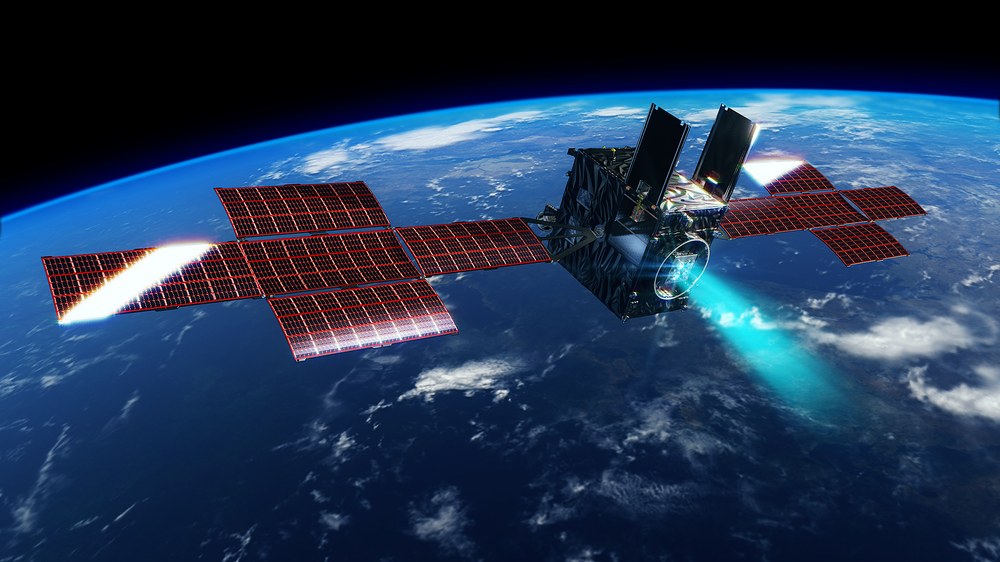
The DESTINY+ asteroid probe
The Japanese space probe DESTINY+ is scheduled to launch in 2028 on a mission to the asteroid Phaethon. The mission's goal is to investigate fundamental questions about the formation of celestial bodies in our Solar System. The DESTINY+ Dust Analyzer (DDA), developed and built in Germany, will investigate cosmic dust during the flight, providing insights into the formation of the Solar System.
Image: 1/4, Credit:
JAXA/Kashikagaku
The DESTINY+ Dust Analyzer (DDA)
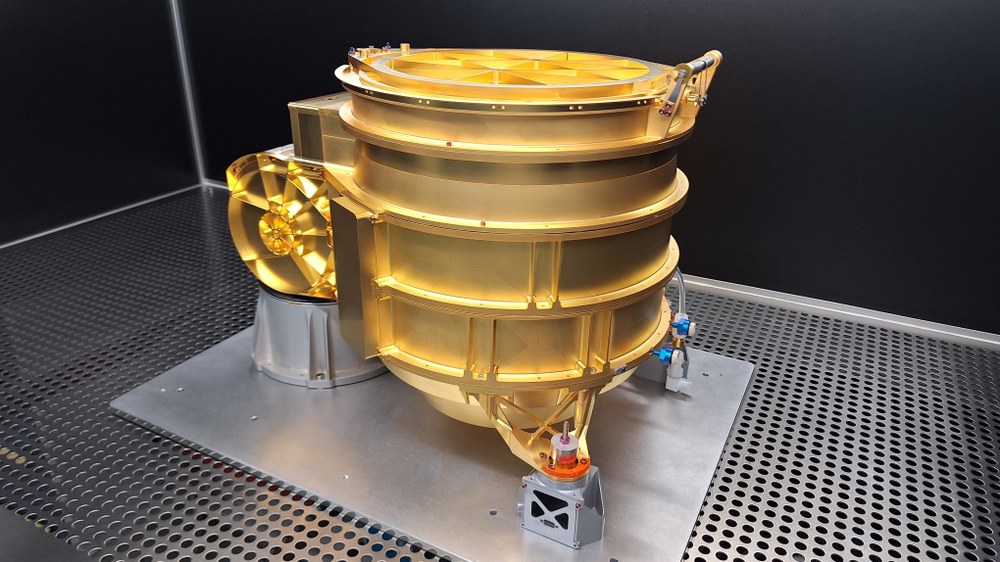
The DESTINY+ Dust Analyzer (DDA) is scheduled to launch in 2028 as part of the DESTINY+ mission of the Japanese space agency JAXA and will study cosmic dust. The analysis will provide valuable information about the formation of the Solar System and other planetary systems. The DDA was developed by the Institute of Space Systems (IRS) at the University of Stuttgart. Dust particles enter the instrument through the inlet grids – not visible here – beneath the upper cover. Within the grids, the dust particles are sorted and their direction determined. Below this is an ion detector for measuring the mass of the particles. On the left, in the shape of a snail shell, is a two-axis mechanism for orienting the instrument.
Image: 2/4, Credit:
Institute of Space Systems (IRS), University of Stuttgart
The asteroid Phaethon
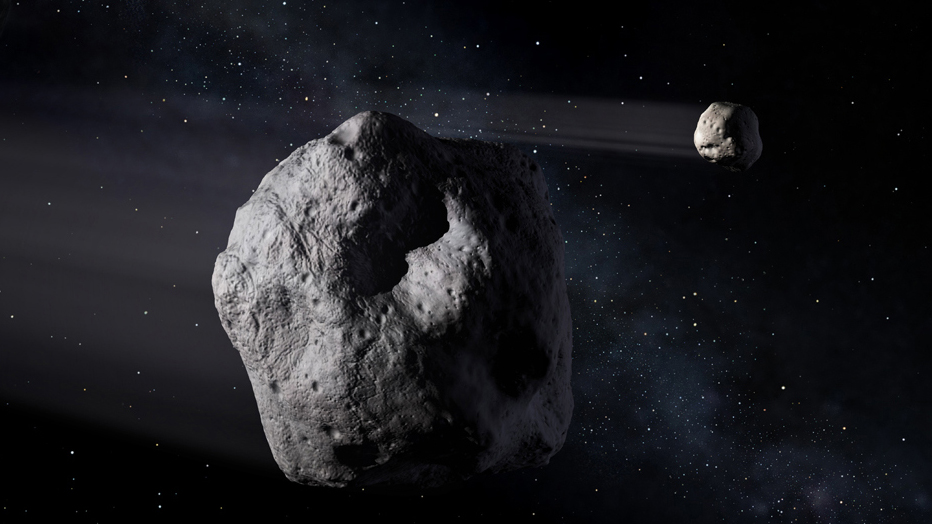
The asteroid Phaethon is considered to be the source of the Geminid meteor shower, visible every December. It passes very close to the Sun, causing its surface to heat up to temperatures exceeding 700 degrees Celsius. This heat releases increased amounts of dust particles. However, since Phaethon – unlike comets – is composed of solid rock, it shouldn't be able to eject dust. DESTINY+ is intended to help understand the mechanism underlying this unusual dust emission. Furthermore, with a diameter of nearly six kilometres, Phaethon is one of the largest known near-Earth asteroids. An Earth impact by such a large object would have devastating consequences. Therefore, detailed knowledge about this type of celestial body is of paramount importance.
Image: 4/4, Credit:
ESA/P. Carril
The Japan Aerospace Exploration Agency's (JAXA) DESTINY+ mission will explore the asteroids Phaethon and Apophis; launch is scheduled for 2028.
During the flight, the DESTINY+ Dust Analyzer (DDA) will study cosmic dust, providing insights into the formation of the Solar System.
The DDA has now been handed over to JAXA.
The German Space Agency at DLR funded the DDA.
Focus: Spaceflight, space exploration
Cosmic dust is distributed throughout our Solar System. Analysing it provides insights into the formation and early evolution of the Solar System and other star systems. This may also help answer the question of whether life or its building blocks might have arrived on Earth from other celestial bodies. The DESTINY+ Dust Analyzer (DDA) is scheduled to launch in 2028 on the DESTINY+ mission of the Japanese space agency (JAXA) and will study cosmic dust. The instrument has been handed over to JAXA and has arrived safely in Japan. It was funded by the German Space Agency at the German Aerospace Center (Deutsches Zentrum für Luft- und Raumfahrt; DLR) with federal government funding. The DDA was developed and built at the Institute of Space Systems (IRS) at the University of Stuttgart.
Insights into the formation of the Solar System
Cosmic dust consists of microscopically small particles found throughout the Solar System. They are composed of, among other things, silicates, carbon compounds and metals such as iron and nickel. These particles originate from collisions in the asteroid belt, the activity of comets, volcanic processes on celestial bodies and interstellar events like supernovae.
Analysing these dust particles provides valuable information about their origin and evolution. This allows researchers to draw conclusions about the formation of the Solar System and other planetary systems. There is also evidence suggesting that cosmic dust may have played a role in the origin of life on Earth.
The DDA dust telescope will be deployed aboard the DESTINY+ space probe and will be capable of determining both the chemical composition and the physical properties of individual dust particles. These include, among other things, the particles' mass, velocity, direction of travel and electric charge.
The DESTINY+ and RAMSES missions
The DESTINY+ mission will be launched in 2028 from the Tanegashima Space Center in Japan, sharing a ride with the RAMSES (Rapid Apophis Mission for SpacE Safety) mission. Both missions initially share the same target: the near-Earth asteroid Apophis, which will pass very close to Earth – but pass safely by – in 2029.
RAMSES will perform a rendezvous with Apophis, arriving at the asteroid some time after the DESTINY+ flyby. This earlier flyby will provide valuable information to prepare for RAMSES' arrival. Germany is also involved in this mission through its national space exploration programme [RJ3.1](Erforschung des Weltraums), contributing two instruments: the RAMSES Plasma Spectrometer (RPS) and the Magnetosphere-induced Apophis Response Investigation Experiment (MARIE) magnetometer.
Meanwhile, DESTINY+ will continue its journey to the asteroid Phaeton, which is of particular scientific interest. For example, it is believed to be the source of the Geminid meteor shower, which is visible every December. However, since Phaeton, unlike comets, is composed of solid rock, it should not in principle be able to eject dust. Comets have a high ice content, so cometary material sublimates near the Sun and forms a tail. DESTINY+ is intended to help understand the mechanism underlying this unusual dust ejection. Furthermore, with a diameter of nearly six kilometres, Phaeton is one of the largest known near-Earth asteroids. An Earth impact by such a large object would have devastating consequences, making detailed knowledge of these types of celestial bodies of great importance.
German technology for an international mission
The project is funded by the German Space Agency at DLR with federal funds and is being carried out in close cooperation with national and international research institutions, including the Max Planck Institute for Solar System Research in Göttingen, the Freie Universität Berlin, the Max Planck Institute for Nuclear Physics in Heidelberg and Japanese partner institutions.
With the handover of the DDA to JAXA, the next phase of the mission is now beginning: integrating the instrument into the spacecraft and preparing for launch. After launch, the DDA will be activated early on and will continuously collect data to enable the most comprehensive analysis possible of cosmic dust particles from various regions of the Solar System.