A second life for science – DLR opens one-of-a-kind MRO Living Lab in Hamburg
November 16, 2026
A second life for science – DLR opens one-of-a-kind MRO Living Lab in Hamburg
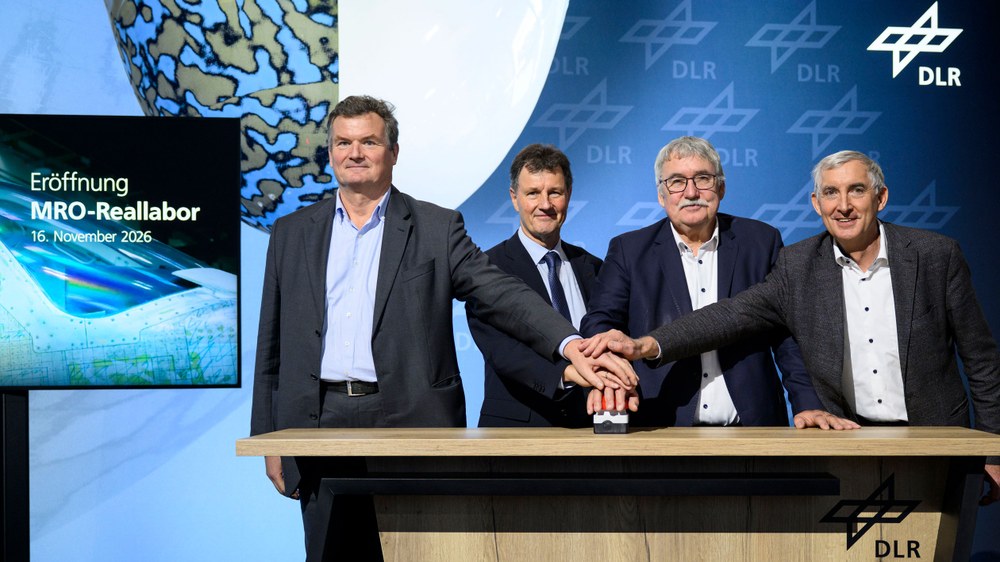
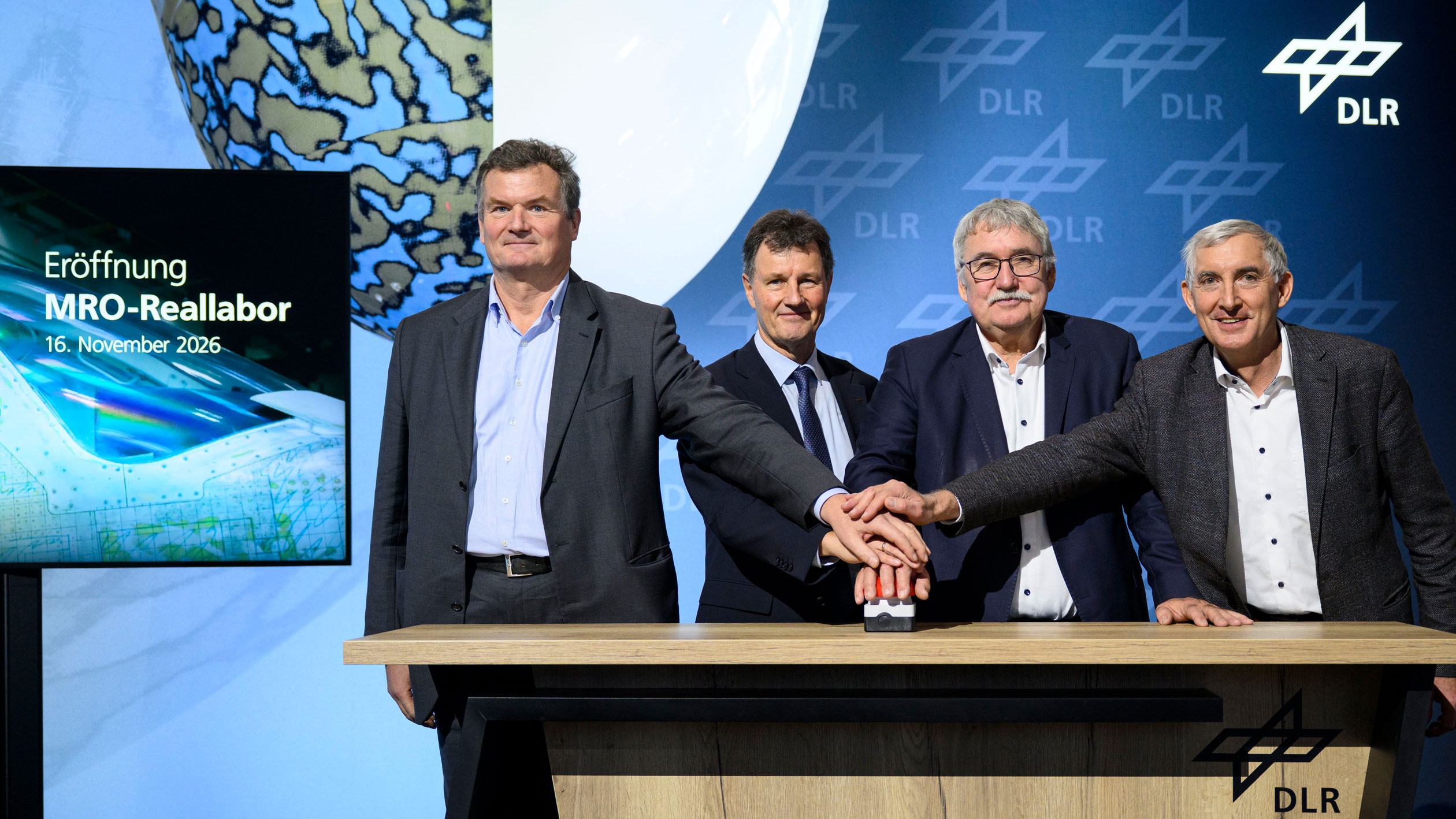
Opening of the DLR MRO Living Lab at the ZAL TechCenter in Hamburg
From left: Nicolas von Mende, CEO of Atlas Air Service AG; Markus Fischer, DLR Divisional Board Member for Aeronautics; Andreas Richter, Head of the Innovation, Industry and Clusters Department at Hamburg’s Ministry of Economics and Innovation; and Gerko Wende, Director of the DLR Institute of Maintenance, Repair and Overhaul.
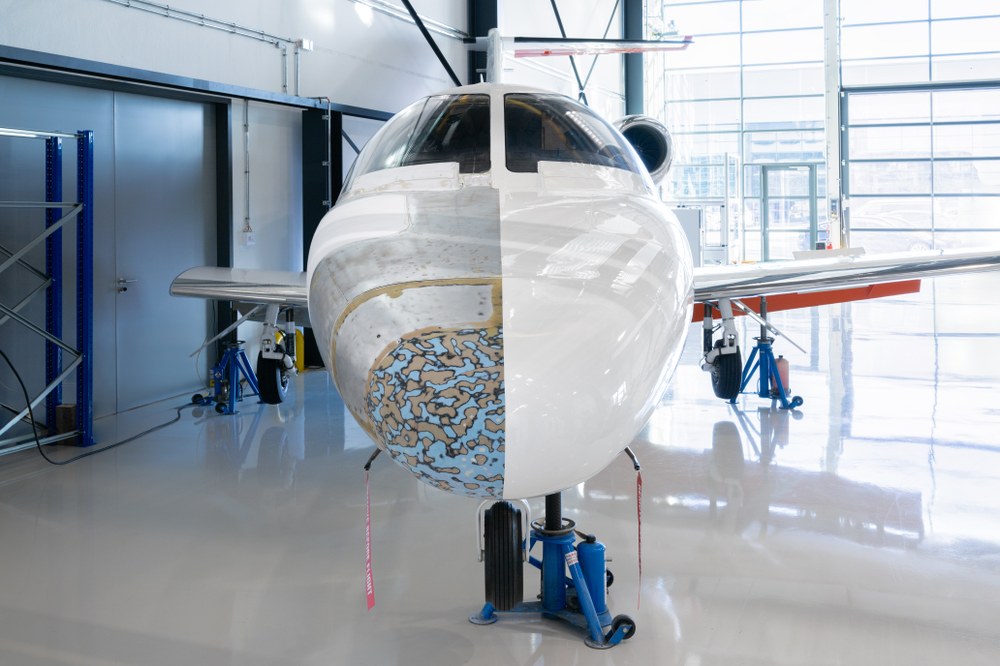
The Citation jet is painted only on the left side, which makes it possible to apply inspection and measurement methods that require an unpainted surface.
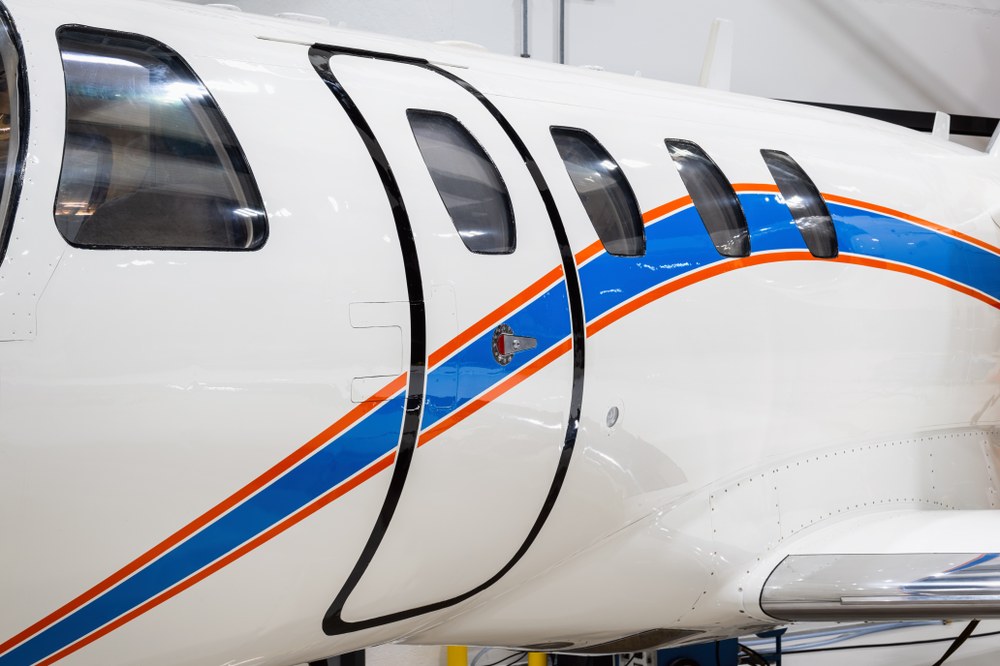
The left side of the MRO Living Lab is painted. This makes it possible to study the influence of the paint layers on inspection and diagnostic methods.
The new Living Lab has been officially inaugurated at the ZAL TechCenter at DLR’s Institute of Maintenance, Repair and Overhaul.
At its heart is a technically fully functional Cessna Citation CJ business jet, which can be used to research and validate new maintenance technologies and modification processes in a real-world environment.
The focus is on data-driven maintenance, robotics, human–machine interaction and faster technology transfer to the aviation industry.
Focus: Aviation, maintenance
An aircraft is developed over several years, built in a matter of months – and then often remains in service for up to 30 years. For it to fly safely, efficiently and in a resource-efficient manner over these decades, it needs modern maintenance, repair and overhall (MRO) processes. This is exactly where the new MRO Living Lab of the German Aerospace Center (Deutsches Zentrum für Luft- und Raumfahrt; DLR) comes in. The lab was opened today at DLR's Hamburg site, in the Center of Applied Aeronautical Research (Zentrum für Angewandte Luftfahrtforschung; ZAL). At the heart of this unique facility is a decommissioned business jet that remains technically fully functional.
"Anyone who wants to shape the aviation of tomorrow has to think about the entire life cycle of an aircraft – from development through to decades of operation. Our new MRO Living Lab at the DLR Institute of Maintenance, Repair and Overhaul is a unique research platform for this", says Anke Kaysser-Pyzalla, Chair of the DLR Executive Board. "By testing data-driven maintenance, human-centred work processes and new repair methods directly on an aircraft here in Hamburg, we are significantly accelerating technology transfer. This is how we are securing the leading international position of Germany as an aviation hub."
A 'hangar of the future' under realistic conditions
Germany ranks among the world leaders in MRO – complex work on engines, components and airframes is in demand worldwide from German service providers such as Hamburg-based Lufthansa Technik. To extend this technological lead, DLR is pursuing the 'Design for Operation' approach: future maintenance is factored in strategically right from the development phase of new aircraft technologies. In the new MRO Living Lab, this vision becomes a reality. As part of a 'hangar of the future', the full-scale demonstrator makes it possible to test new solutions under real workshop conditions. Four key research areas are at the centre:
Data-driven maintenance planning: prediction and optimisation of maintenance needs.
Human-centred, digital MRO workshop: collaboration between specialist staff and artificial intelligence (AI), as well as robotic and visual assistance systems.
New technologies and processes for maintenance and modification: research and validation of technologies and processes in the demanding environment of a small aircraft with tight installation spaces and compact system installations.
Sustainable supply chains: conserving resources across the entire life cycle with resilient material cycles.
Halved, painted and wired – a jet as a bespoke laboratory
So that the business jet, built in 1998, could begin a second life in science after the end of its active flying career, it underwent an extensive conversion. To fit into the laboratory hall, one wing and one horizontal stabiliser were removed; however, the controls for the flaps and ailerons were adapted so that they remain fully functional. Sensor data can be read out through a special measurement door on the right-hand side – even when the cabin is pressurised for tests. The most striking feature of the jet is its visual split into two halves: while the left side of the fuselage has a classic paint finish, the right side is completely raw and untreated. This allows researchers to compare directly how different surface conditions affect inspection and repair methods – particularly in non-destructive materials testing.
A bridge between research, teaching and industry
"Our Living Lab is the centrepiece of a total of four laboratories at the MRO Application Center", says Gerko Wende, Head of the DLR Institute of Maintenance, Repair and Overhaul. "It is available not only to researchers and students for research and teaching, but also specifically for cooperation projects with industry collaborators." The MRO Living Lab is embedded in the MRO Application Center of the DLR Institute of Maintenance, Repair and Overhaul. In addition to the Living Lab, this includes the Project Lab for robotic assistance systems, the Vision Lab for tracking and extended reality (XR) technologies and the Measurement Lab. Equipped with state-of-the-art technology ranging from robotics and 3D measurement to augmented reality and mobile sensor technology, the Application Center creates a wide range of opportunities for the digitalisation and automation of future maintenance.