'Dust devils' over Mamers Valles captured by the HRSC camera
June 17, 2026 | Mars Express mission
'Dust devils' over Mamers Valles captured by the HRSC camera
Outflow channels at the mouth of Mamers Valles on Mars
The Mamers Valles form a distinctive region of wide, channel-like valleys and trenches on Mars. At the end of a roughly 1000-kilometre course through the Arabia Terra highlands, at the transition to the lowlands, they form a deeply fractured landscape. Water, as well as ice that pushed its way down the valleys, left behind channels up to 25 kilometres wide. These are flanked by remnants of the highlands that were spared from erosion, with their mesas (table mountains) hinting at a once-continuous plateau.
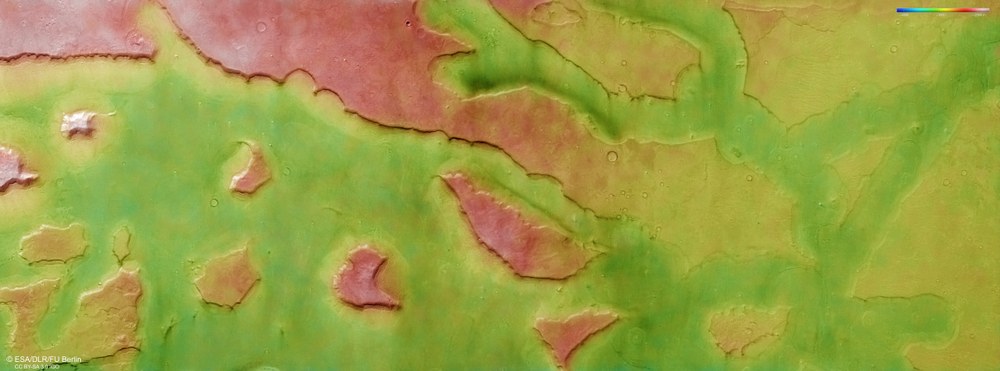
Topographic map of the Mamers Valles in the north of Arabia Terra
DLR's HRSC (High Resolution Stereo Camera) onboard Mars Express captures the Martian surface from multiple angles using nine sensors. From these, the DLR Institute of Space Research and the Planetary Science and Remote Sensing Group at the Freie Universität Berlin calculate digital terrain models. The colour scale in the top right of the image indicates elevation values. This reveals that water flowing with high energy from the Mamers Valles in the south (left in the image) has eroded channels roughly 1500 metres deep into the highlands at the transition to the northern lowlands. In doing so, the water left behind mesas (table mountains) on either side, which are remnants of the highlands.
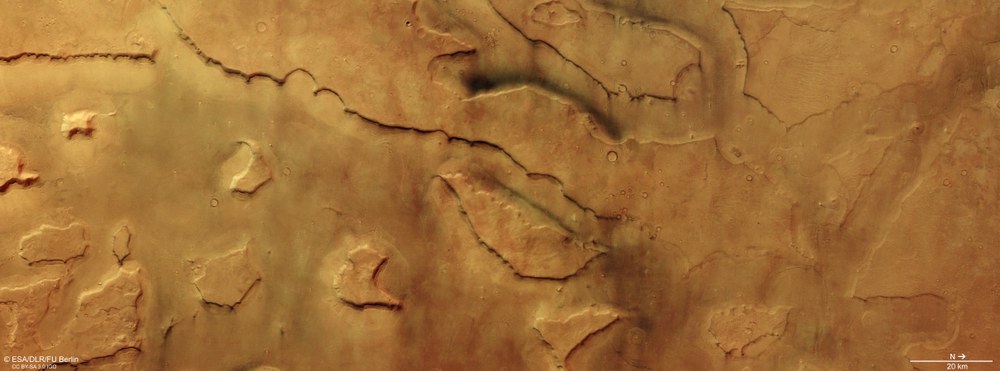
True-colour bird's-eye view of the northern part of the Mamers Valles on Mars
The mouth region of Mamers Valles lies at the transition from the Martian highlands to the planet's northern lowlands. Mars researchers also refer to this zone as the dichotomy boundary. The source region of the Mamers Valles lie approximately 1000 kilometres further south. In the mouth region, remnants of the highlands that have been largely spared by erosion stand as mesas. The image section extends approximately 240 kilometres in a north-south direction (due to the HRSC scanner imaging technique, north is on the right-hand side of the image) and 90 kilometres in an east-west direction.
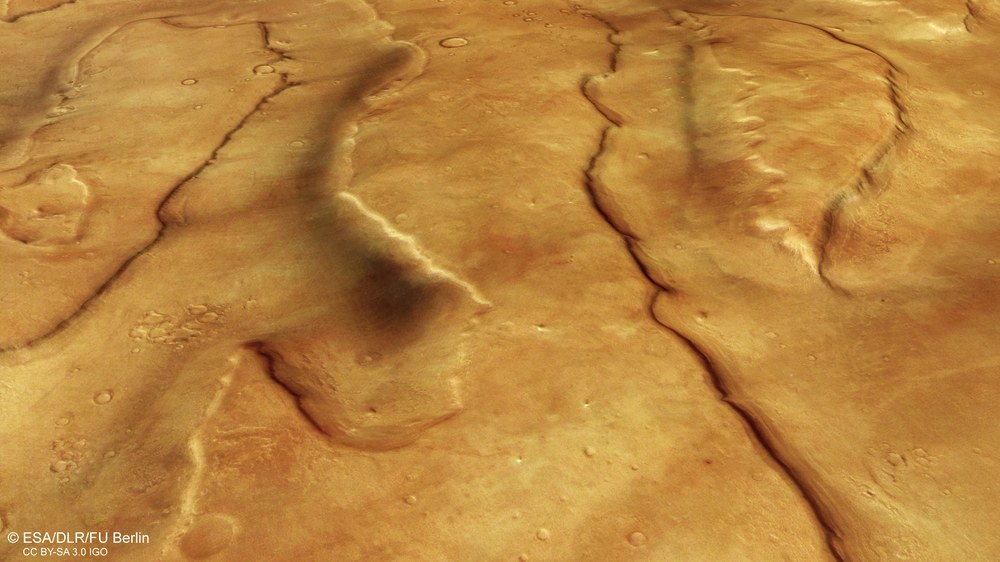
Images captured by the German HRSC stereo camera show dust devils in the Mamers Valles region of Mars.
These powerful, short-lived whirlwinds lift dust into the atmosphere in small vortices.
HRSC is a camera experiment developed by DLR and carried on board the European Mars Express mission.
Since January 2004, HRSC has been reliably sending images of Mars back to Earth, from which digital terrain models are generated.
The mission has recently been extended until 2029.
Focus: Space, exploration, Mars
New image data captured by the High Resolution Stereo Camera (HRSC) reveal part of Mamers Valles in the northern hemisphere of Mars. HRSC is a camera experiment developed by the German Aerospace Center (Deutsches Zentrum für Luft- und Raumfahrt; DLR) for the European Mars Express mission and has been sending images of Mars back to Earth since January 2004. Digital terrain models derived from this image data enable topographical mapping of the Red Planet and three-dimensional visualisation of its landscape. This information allows scientists to reconstruct geological processes from the early history of Mars in terms of their nature and chronology. On the dynamically changing Earth, such a glimpse into the planet's formative period is no longer possible.
Thanks to the longevity of the German-built HRSC, 99 percent of the Martian surface has now been mapped. Just a few days ago, the European Space Agency (ESA) extended the Mars Express mission until the end of 2029.
A labyrinth of mountains, cliffs and glaciers
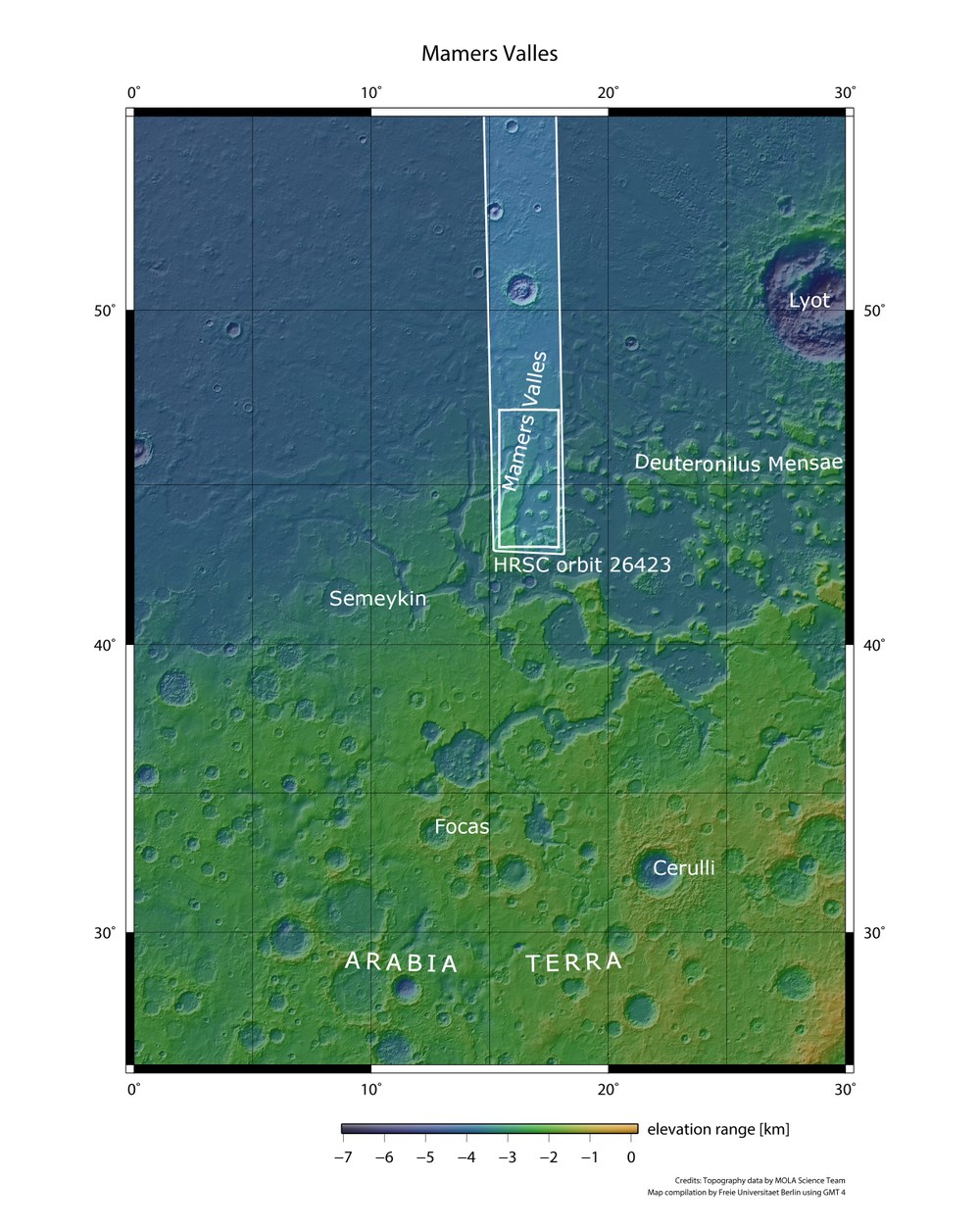
Topographical overview map of the Arabia Terra region of Mars, featuring the Mamers Valles
The trench-like channels of the Mamers Valles drainage system extend in a south-north direction over roughly 1000 kilometres, from the ancient highlands of Arabia Terra to the lower plains near Deuteronilus Mensae. In its middle sections, the valley is approximately 25 kilometres wide and up to 1.2 kilometres deep. The mouth region of the valley is known as 'fretted terrain': a fractured landscape featuring numerous deep and very wide, labyrinthine valleys, flat-topped mesas, steep cliffs and glacier-like deposits. The region formed approximately 3.8 billion years ago, when our neighbouring planet transitioned from a wetter, geologically more active world into a colder one.
Credit:
NASA/JPL (MOLA)/FU Berlin
The trench-like valleys of the Mamers Valles drainage system stretch approximately 1000 kilometres from south to north, cutting across from the ancient highlands of Arabia Terra to the lower plains near Deuteronilus Mensae (see the colour-coded context map on the left). In its middle sections, the valley is approximately 25 kilometres wide and up to 1.2 kilometres deep. The surrounding area is known as 'fretted terrain' – a fractured landscape featuring numerous deep, very wide, maze-like valleys, flat-topped mesas, steep cliffs and glacier-like deposits.
This region formed during the Late Noachian Period approximately 3.8 billion years ago, when our neighbouring planet transitioned from a wetter, geologically more active world to the colder one we know today. The name 'Mamers' originates from the Oscan language of pre-Roman Italy and means Mars. The area received its official name in 1976.
A glimpse into the past
Mamers Valles is of interest to planetary research because the valleys provide evidence of a variety of geological processes. Studying this region may help answer the question of how glacial processes – that is, the action of ice – have eroded parts of the Martian surface over billions of years.
The valley floor features long linear structures. These structures are glaciers covered in debris, similar to their counterparts on Earth. These linear structures formed as ice, mobilised by its own weight, slowly flowed down the slopes and became covered with rock and dust from the sides as it moved. Glacial ice is still present today in the deposits along the steep cliffs and slopes, protected by a layer of rock debris. Without this layer, the ice would immediately sublimate into the atmosphere due to the low atmospheric pressure on Mars.
An important atmospheric phenomenon
Diverse landforms on Mars – the mouth region of Mamers Valles
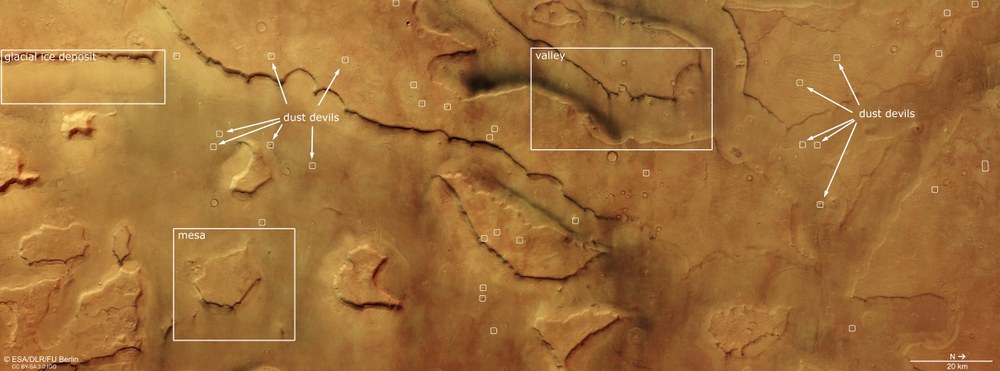
Although the mouth region of Mamers Valles lies at 45 degrees north latitude, ice deposits are still present there today. These are protected from sublimation by a layer of dust and debris known as glacial ice deposits. Typical of the transition from the Martian highlands in the south (on the left of the image) to the northern lowlands are mesas (table mountains) that have been spared from erosion by water and ice. The image resolution of the HRSC images, at 20 metres per pixel, allows a whole series of small dust devils to be identified. Some of these dust devils pick up dust at high speed and carry it across the Martian surface. Small boxes mark their positions at the time the image was taken. Water flowing down from the highlands has carved out deep outflow channels (valleys) up to 25 kilometres wide into the landscape.
Mars has a very thin atmosphere – only about one percent as dense as that of Earth. Nevertheless, atmospheric phenomena such as dust devils are frequently observed on the planet. In the scenes shown here, the HRSC captured numerous dust devils within a single image (highlighted by the small boxes in the annotated image). Although short-lived and localised, these dust devils can sweep across the Martian surface at speeds of 100 kilometres per hour or more. Dust devils typically form in the afternoon, when the Sun-heated surface warms the air above it, causing it to rise. These updrafts generate a vertical vortex that lifts dust and sand into the atmosphere. Dust devils therefore play a significant role in the distribution of dust across the Martian surface.
Martian dust devils can reach heights of up to eight kilometres, despite usually being less than 100 metres wide. They occur frequently in open plains such as those surrounding Mamers Valles, much like their terrestrial counterparts in arid desert regions. On Mars, however, they are often considerably larger, primarily due to the large temperature differences between day and night.
Image processing
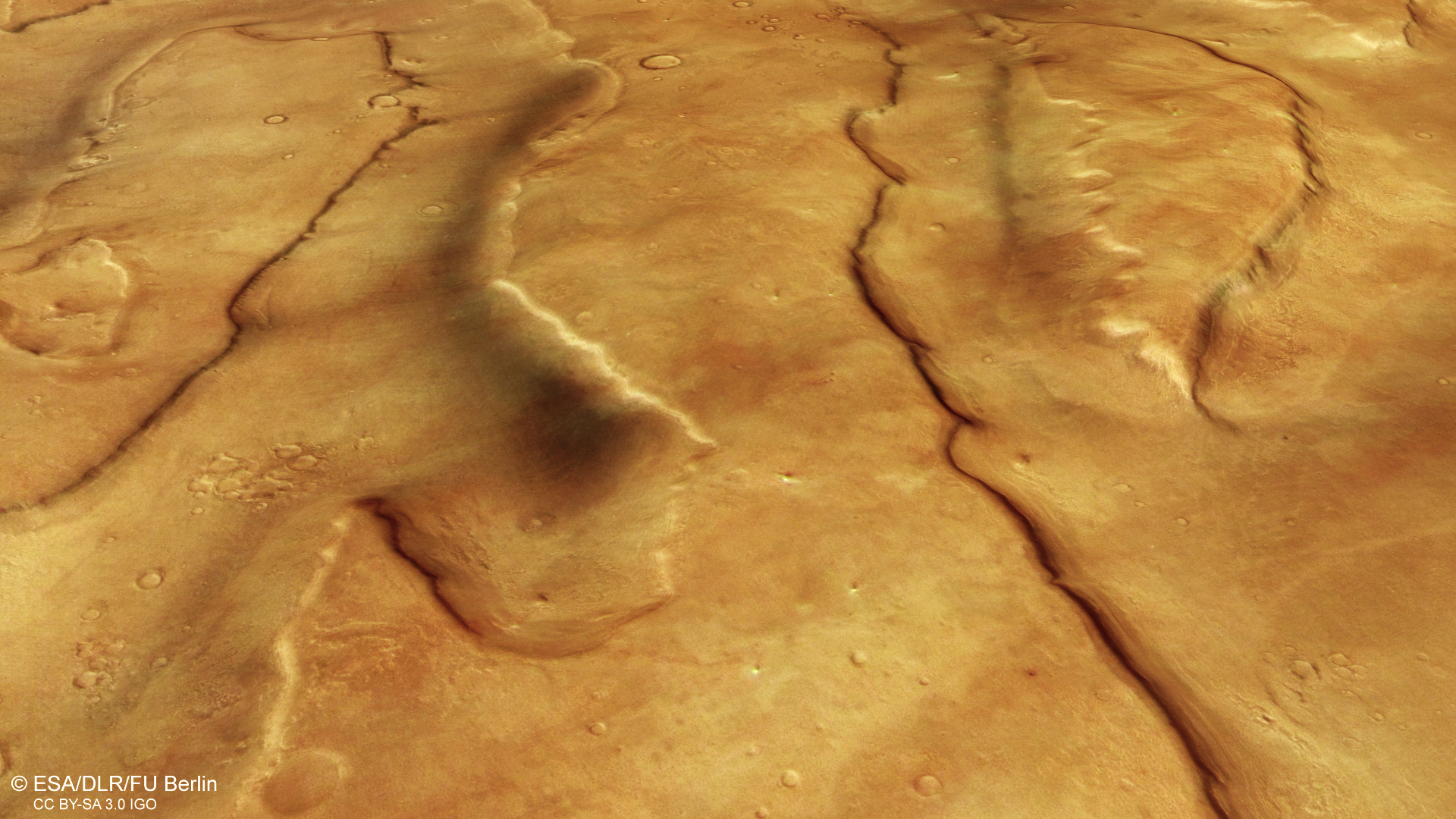
The images were acquired by the HRSC (High Resolution Stereo Camera) on 7 December 2024 during Mars Express orbit 26,423. The ground resolution is approximately 20 metres per pixel, and the image is centred at approximately 45 degrees north and 17 degrees east. The colour image was created using data from the nadir channel, which is aligned perpendicular to the Martian surface, as well as the colour channels of the HRSC. The oblique view was generated from the digital terrain model and data from the nadir and colour channels of the HRSC. The anaglyph image, which provides a three-dimensional impression of the landscape when viewed with red-blue or red-green glasses, was derived from the nadir channel and one stereo channel. The colour-coded topographic view is based on a digital terrain model of the region, from which the topography of the landscape can be derived.
The High Resolution Stereo Camera was developed at the German Aerospace Center (Deutsches Zentrum für Luft- und Raumfahrt; DLR) and built with industry contributors EADS Astrium – now Airbus, Lewicki Microelectronic and Jena-Optronik. The science team, led by Principal Investigator (PI) Daniela Tirsch, comprises 50 co-investigators from 35 institutions in 11 countries. The camera is operated by the DLR Institute of Space Research in Berlin-Adlershof.