November 16, 2026 | IGNITE-X mission in the exhaust plume
How low-sulphur fuels alter contrails
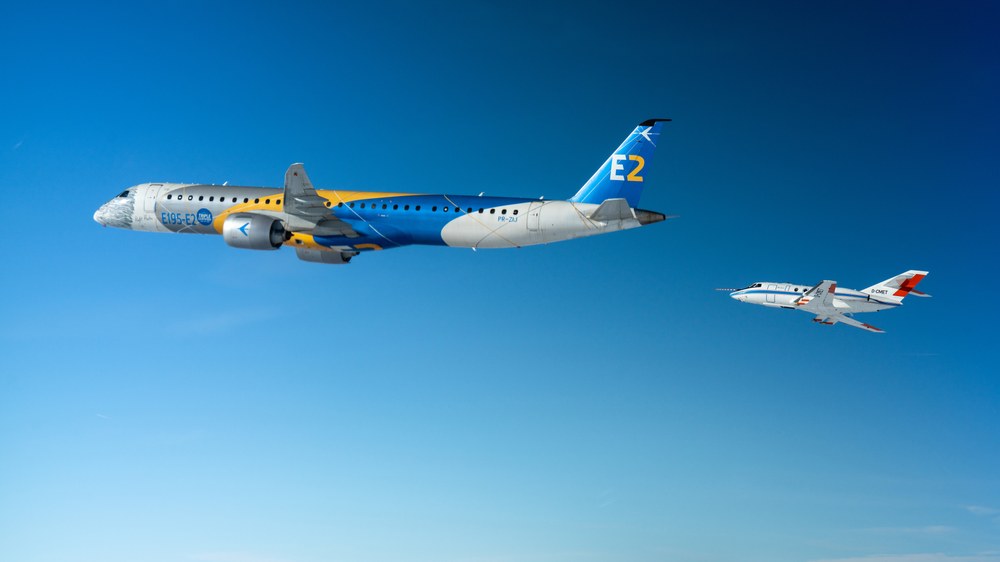
In-flight measurements – DLR's Falcon 20E research aircraft behind the Embraer E195-E2
DLR's Falcon 20E research aircraft flies directly behind Embraer's E195-E2 passenger aircraft to measure the engine emissions and the resulting contrails. The measurement flights over Germany were carried out in November 2026 as part of the International Ground and Inflight Turbine Emission Experiment (IGNITE-X), under the scientific leadership of the DLR Institute of Atmospheric Physics.
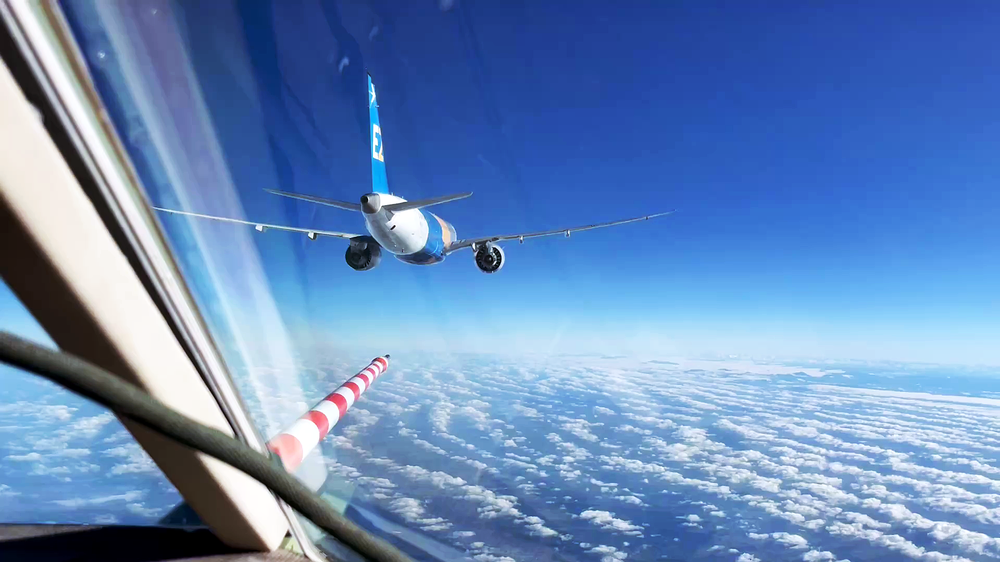
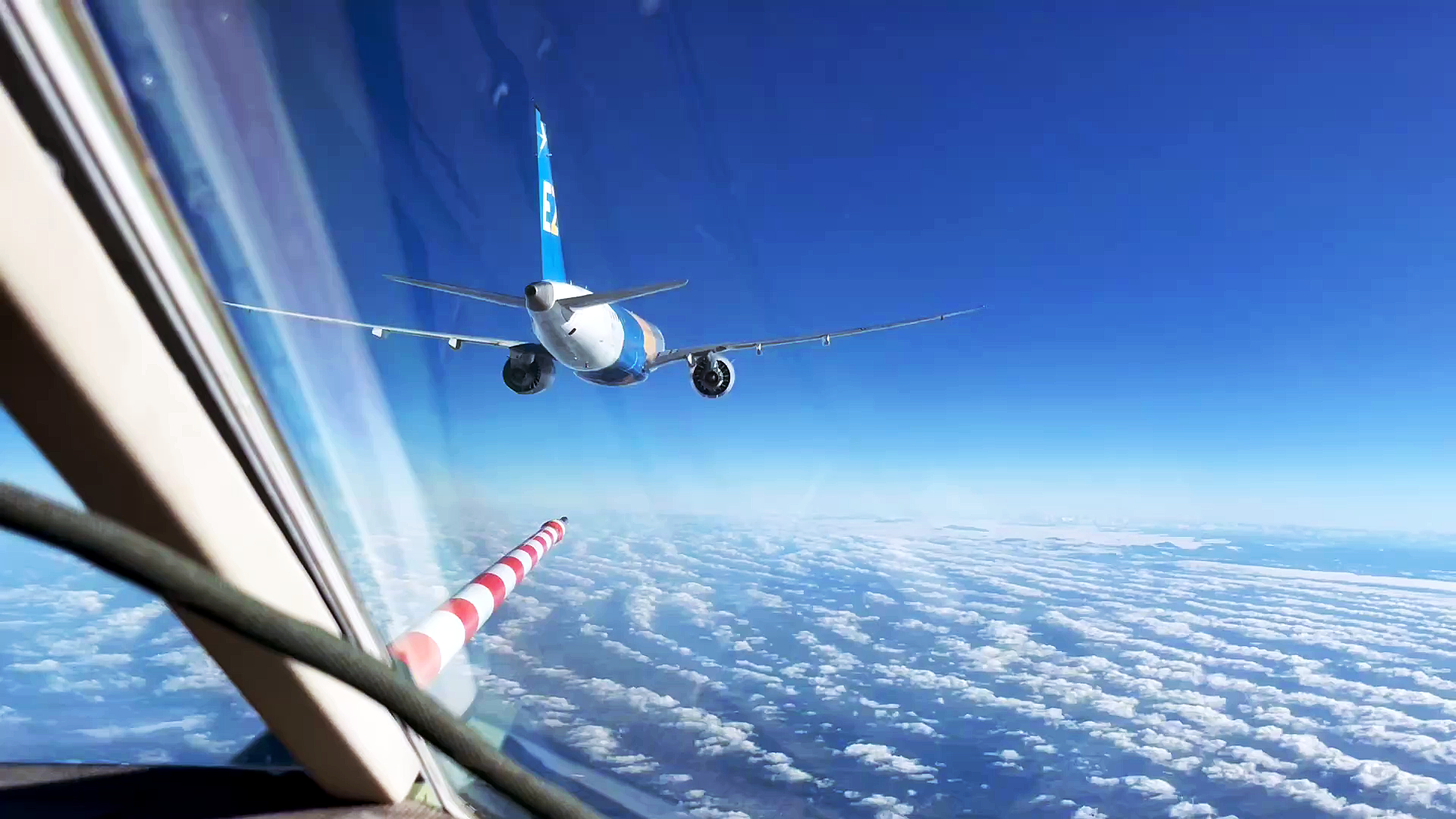
View from the cockpit of DLR's Falcon 20E research aircraft
For the in-flight measurements in the IGNITE-X project, DLR's Falcon 20E research aircraft approached the test aircraft to as close as 30 metres, flying directly into the exhaust plume of the Embraer E195-E2. To study the resulting contrails, the Falcon 20E also took measurements in the far field, at distances of between 10 and 30 kilometres.
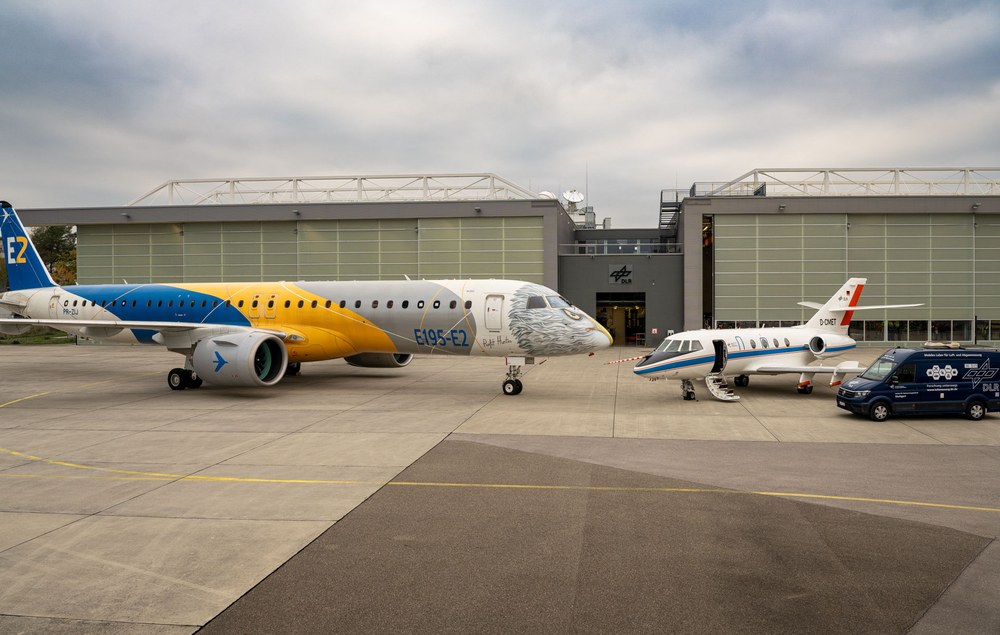
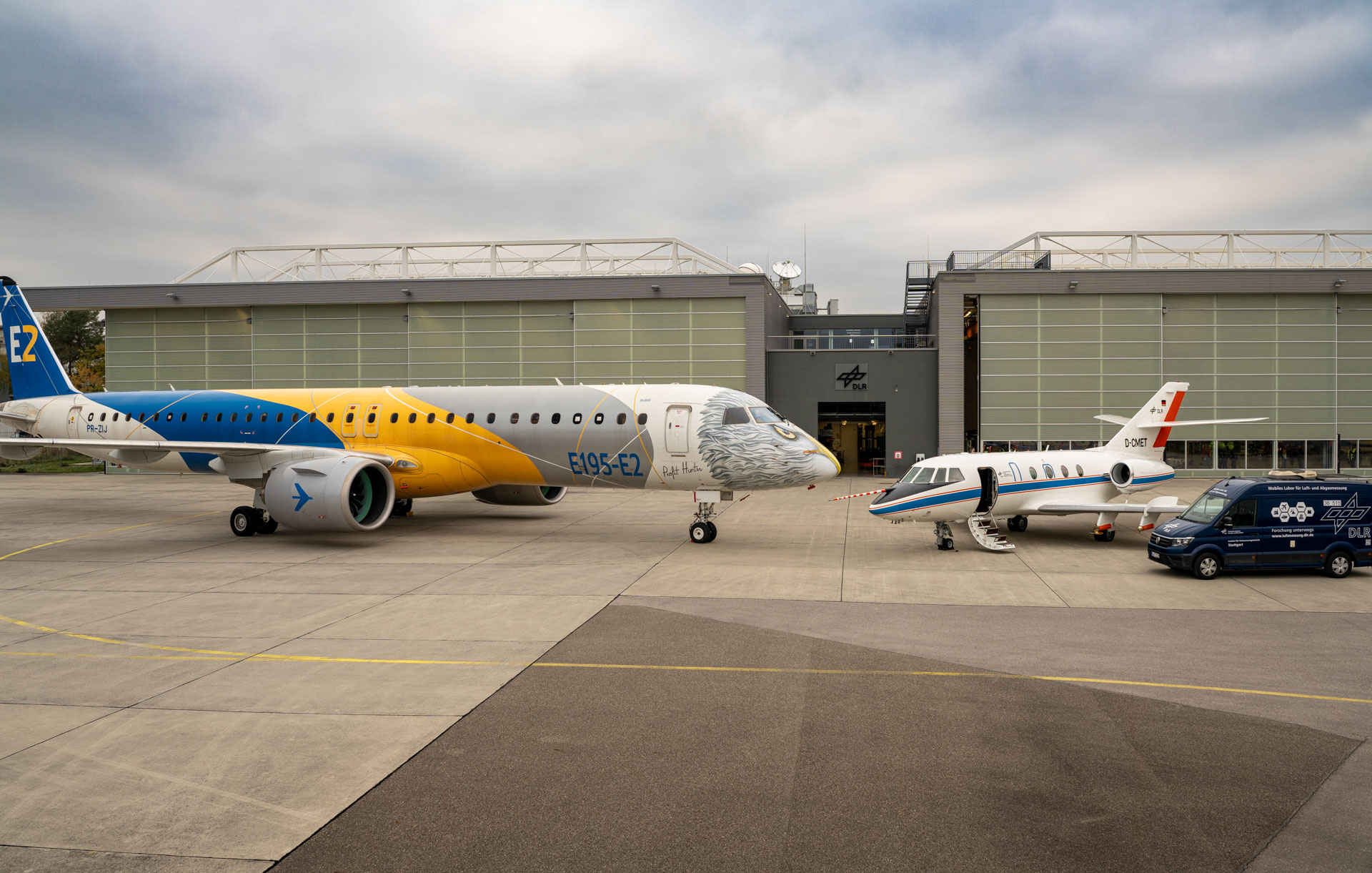
As part of the IGNITE-X project, DLR and international collaborators carried out in-flight and ground measurements in autumn 2026 to investigate the effect of low-sulphur kerosene fuels on aircraft emissions and the resulting contrails. A special trio of test platforms was used for this (from left): the Embraer E195-E2 known as the ‘Profit Hunter’ (equipped with GTF PW1900G engines), DLR's Falcon 20E research aircraft and the mobile measurement laboratory of the DLR Institute of Combustion Technology.
In October and November 2026, DLR carried out ground and in-flight measurements to investigate the effect of low-sulphur fuel on aircraft emissions and the resulting contrails.
DLR's Falcon 20E research aircraft and an Embraer E195-E2 powered by Pratt & Whitney geared turbofan engines were used for the measurement flights.
The measurements were carried out as part of the international IGNITE-X project, which aims to reduce the climate impact of contrails in the near term.
Focus: Aviation, climate-compatible aviation
Contrails contribute significantly to aviation's climate impact. One key to reducing this impact lies in optimising aircraft fuels and engines. But how does the composition of a fuel affect the emissions of modern aircraft engines? In particular, what role does sulphur content play in contrail formation? These questions are being investigated in the international research project IGNITE-X (International Ground and Inflight Turbine Emission Experiment), led by the German Aerospace Center (Deutsches Zentrum für Luft- und Raumfahrt; DLR). To answer them, over a period of approximately four weeks in October and November 2026, the teams carried out ground measurements in Manching, Bavaria, and flight measurements over test areas across Bavaria and Saxony.
The test aircraft was an Embraer E195-E2 with Pratt & Whitney GTFTM PW1900G engines. The project team used two fuels: one with a particularly low sulphur content and the other with conventional kerosene containing its naturally occurring sulphur content. Comparing the two allows the team to investigate how fuel properties influence particle formation. For measurements under cruise conditions, the DLR Falcon 20E research aircraft flew into the exhaust plume, close behind the Embraer test aircraft. DLR, Embraer, RTX's Pratt & Whitney, Aerodyne Research and Missouri University of Science and Technology are involved in the project.
"We measured the emissions directly within the exhaust plume – this is extremely challenging, both from a scientific and operational perspective. The test procedure, which involves using low-sulphur fuel in the modern Pratt & Whitney engines of an Embraer E2 passenger aircraft, provides unique insights into the potential for reducing emissions. These innovative and, at the same time, challenging tests with our international partners are the result of an exceptionally committed, trusting and inspiring collaboration between applied research and industry", explains Markus Fischer, DLR Divisional Board Member for Aeronautics.
Less soot and sulphur, fewer ice crystals?
Contrails are clouds of ice crystals that form at cruising altitude when hot exhaust gases meet very cold, humid air. Soot particles from engine exhaust act as nuclei on which these ice crystals can form. Lower soot emissions could therefore lead to fewer ice particles and thus reduce the climate impact of contrails.
In addition to soot, volatile particles also play an important role. The sulphur content of the fuel influences the formation of these particles, which can also act as nuclei for ice crystals. IGNITE-X is therefore investigating the impact of fuel composition on the engine emissions and contrail properties. The researchers aim to determine whether combining an engine with low soot emissions and low-sulphur fuel can significantly reduce contrail formation. The results are intended to improve understanding of the climate impact of aviation that is not caused by carbon dioxide (CO2) and to help assess potential mitigation measures.
Chase flight into the exhaust plume
The Embraer E195-E2 test aircraft, known as the 'Profit Hunter', is particularly fuel-efficient and economical to operate. It is equipped with Pratt & Whitney GTF PW1900G engines, which feature advanced combustor technology designed to significantly reduce particulate emissions including soot, compared to previous generation engines.
"The E195-E2 was designed to deliver outstanding efficiency and lower emissions, making it an ideal platform for advancing research into the future of sustainable aviation. Through our participation in IGNITE-X, we are working alongside leading research institutions and industry partners to better understand the relationship between fuel characteristics, engine performance, and contrail formation. This collaboration reinforces Embraer's commitment to supporting science-based solutions that contribute to a more sustainable and environmentally responsible aviation sector", said Cleiton Silva, Vice President of Technology and Advanced Projects at Embraer.
During the flight tests, the DLR Falcon 20E research aircraft followed the Profit Hunter, measuring its emissions and the resulting contrails. Researchers from the DLR Institute of Atmospheric Physics were responsible for the flight measurements, which they carried out at various distances. For far-field measurements, the Falcon flew between 10 and 30 kilometres behind, while for near-field measurements the research aircraft approached the Embraer to as close as 30 metres.
Flying into the exhaust plume for targeted sampling requires a high level of piloting skill, so experienced and specially trained pilots from the DLR Flight Experiments facility were deployed. This DLR facility also operates the Falcon 20E.
Characterising engine emissions on the ground
The ground measurements complement the flight measurements and form a central component of the IGNITE-X campaign. Led by the DLR Institute of Combustion Technology, the international team systematically investigated the emission behaviour of the engines across the entire thrust range, from idle to take-off thrust. To do so, the Profit Hunter was positioned at a designated test location and a sampling probe designed specifically for the campaign was placed in the exhaust plume. Each engine was operated individually and run through defined thrust levels. This allowed the researchers to clearly attribute the measured emissions to the respective engine and its operating condition, and to identify possible differences between the engines.
"The IGNITE-X test campaign, which brings together world-class technical expertise and testing capabilities, is making a significant contribution to advancing the fundamental understanding of contrail formation, including the how different fuel types influence contrail properties," says Graham Webb, vice president, Advanced Commercial Engine Programs, Pratt & Whitney. “The results of this campaign will inform the development of advanced engine technologies for future aircraft by validating the exceptionally low emissions performance of our GTF engine and its Talon X combustor design."
Particular attention was paid to the smallest particles in the nanometre range. Investigating their number, size distribution and properties provides insights into early particle formation and the initial transformation processes in the exhaust plume. However, detecting nanoparticles places high demands on measurement technology. The international IGNITE-X project team achieved this by configuring a special set-up for the campaign.
The technically demanding set-up also required careful coordination of the sampling and the measuring instruments. The ground measurements were carried out at the German Armed Forces (Bundeswehr) airfield in Manching, with on-site support from the Bundeswehr Technical Center for Aircraft and Aeronautical Equipment (Wehrtechnische Dienststelle für Luftfahrzeuge und Luftfahrtgerät; WTD 61).
From experiment to more climate-compatible aviation
DLR is contributing its extensive expertise in aeronautics to IGNITE-X, ranging from scientific analysis and measurement technology to research flight operations. The low-sulphur kerosene used was produced specifically for the measurement campaign. It is certified as an aviation fuel, meaning it can be used in any aircraft. Now that the test campaign has been completed, the flight and ground measurements are being analysed together.
If low-sulphur kerosene fuels do indeed lead to fewer ice particles forming, they could be a key lever for reducing the climate impact of contrails in the near future. The results of IGNITE-X are intended to help shape and drive forward the transformation of aviation on a sound scientific basis.