
Geological and aeolian features in the southern part of Kaiser Crater on Mars
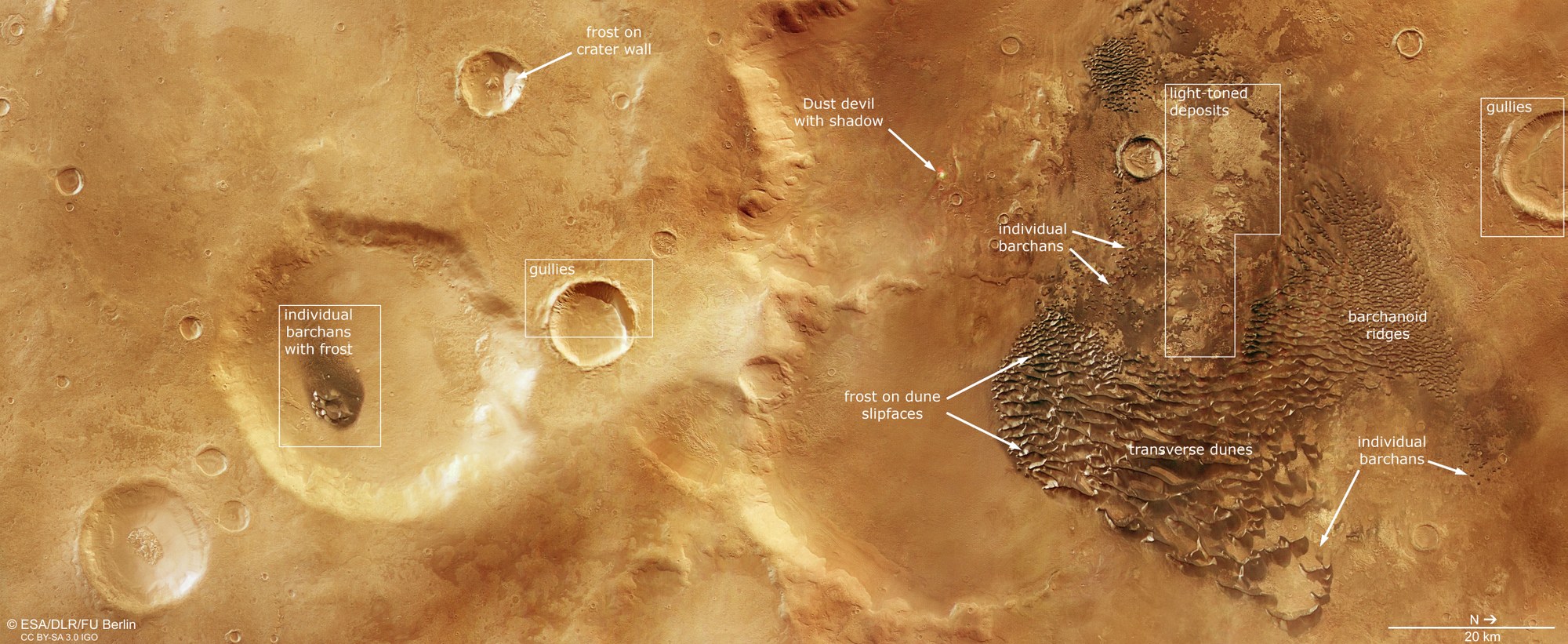

Geological and aeolian features in the southern part of Kaiser Crater on Mars
This region in the southern Martian highlands is approximately four billion years old. In more recent geological history, wind-driven processes have sculpted the landscape. Crescent-shaped dunes, known as barchans, are widespread. In places, they merge into larger ridges, forming a transitional stage towards larger transverse dunes. Hoarfrost reflects the sunlight, giving the dune fields a metallic sheen ('barchans with frost' in the annotated image). Hoarfrost has also persisted in places on south-facing crater walls ('frost on crater wall'). On some steep crater slopes, channels known as gullies have formed, although their origin remains uncertain. In several locations, wind erosion has removed the surface material, exposing the underlying layers, which appear as bright deposits ('light-toned deposits').
