Remote-controlled sensor systems and AI detect hazardous substances
July 14, 2026 | On board drones or rovers
Remote-controlled sensor systems and AI detect hazardous substances
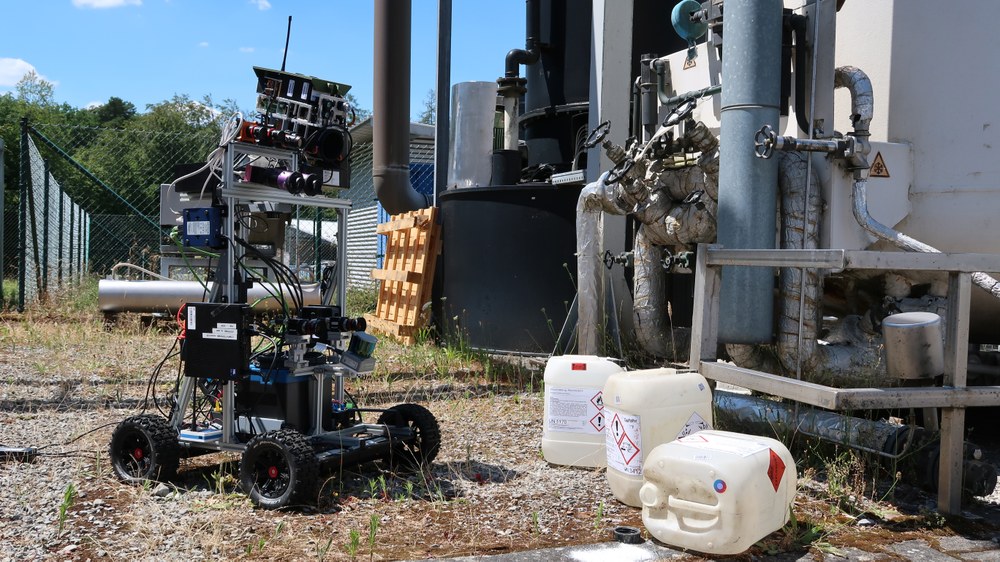
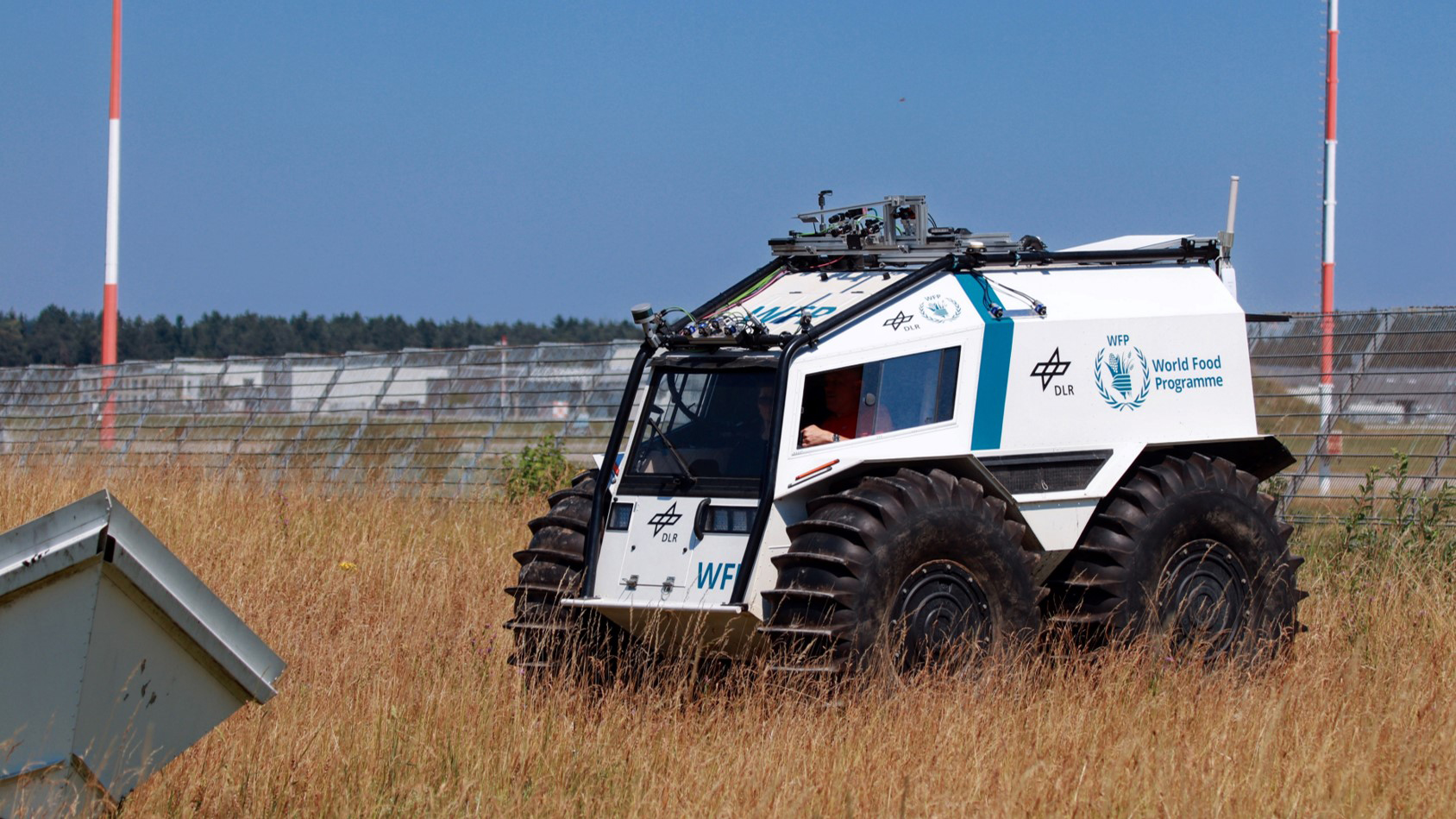
Rover equipped with DLR sensor system examines powder from a container (simulated scenario)
In initial tests, the sensor system has successfully analysed typical containers of hazardous substances, hazardous substance symbols and suspicious areas such as powder or liquid stains.
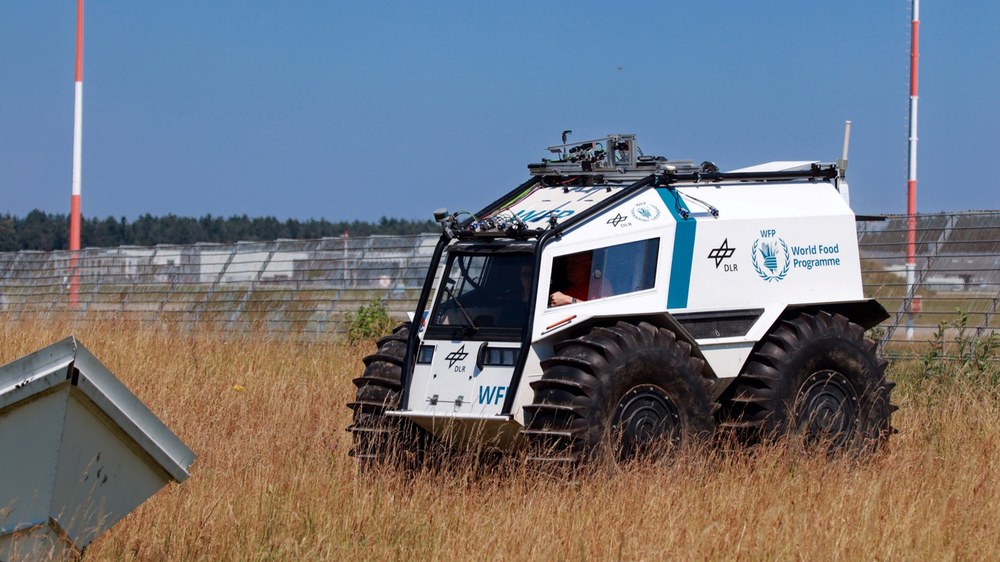
Sensor system for detecting hazardous substances on the SHERP robotic platform
At the DLR site in Oberpfaffenhofen, the system was deployed on the SHERP vehicle and tested in the field. Both the detection system and the vehicle can also be controlled remotely.
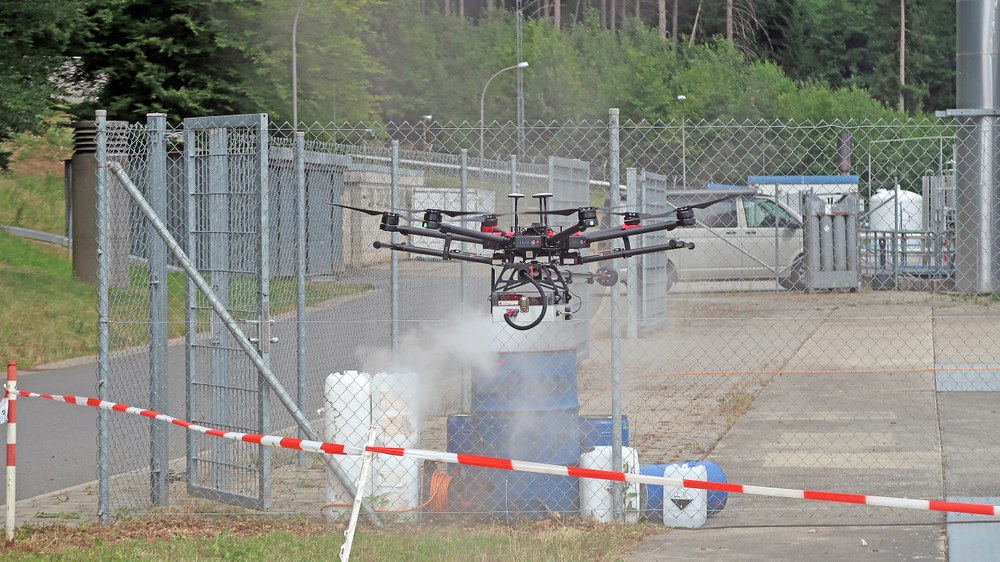
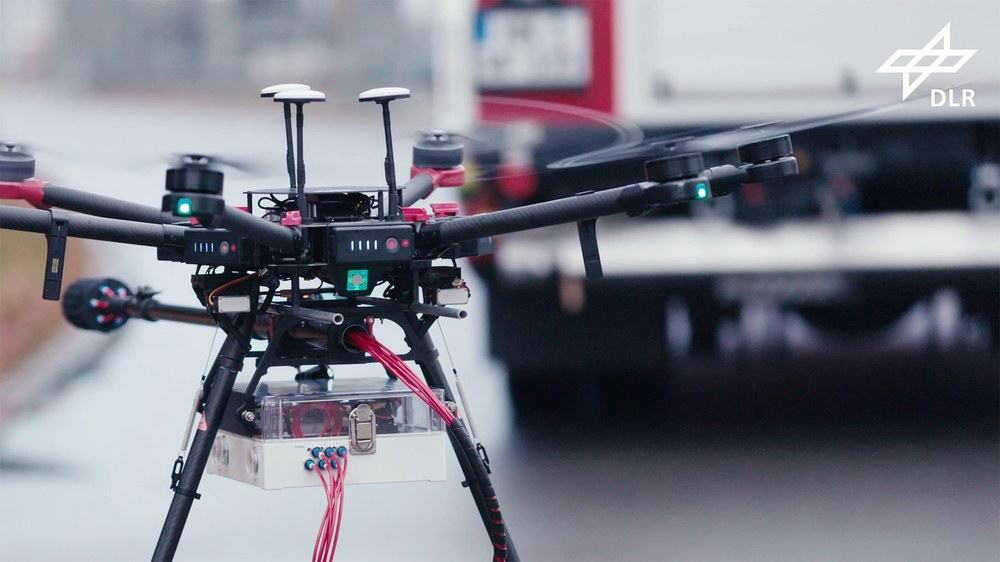
Drone-based investigation of airborne hazardous substances
The drone, equipped with the sensor system, can even reach inaccessible areas. Using its extendable measuring probe, it can take samples quickly and reliably and make an initial classification – all from a safe distance for emergency responders.
DLR has developed and tested demonstrators that will enable emergency services to detect hazardous substances from a safe distance in the future.
Compact sensor technology, laser measurement technology and artificial intelligence enable an initial assessment of the situation directly at the scene.
Rover- and drone-based systems can also detect and analyse hazardous substances in hard-to-reach areas.
Focus: Security and defence, operational and protective technology, laser technology, sensor technology, AI, disaster relief
The German Aerospace Center (Deutsches Zentrum für Luft- und Raumfahrt; DLR) has developed and tested several remote detection systems which will enable emergency services to evaluate hazardous substances from a safe distance and gather vital information. To do this, a range of compact sensors and artificial intelligence are deployed on board remote-controlled or autonomously operating robotic systems such as rovers or drones. The combination of these technologies makes it possible to obtain a better situational picture quickly and flexibly.
The first priority is detection – determining whether a hazardous substance is present at the scene. The second step, classification, is to make an initial assessment of what type of hazardous substance it might be. "The methods and options for detection and identification vary depending on the hazardous substance," says Thomas Dekorsy, Director of the DLR Institute of Technical Physics. His institute, in collaboration with the DLR Institutes of Software Technology and of Robotics and Mechatronics, has developed the necessary technologies. These have already been tested in a laboratory environment in collaboration with Germany's Federal Office of Civil Protection and Disaster Assistance (Bundesamt für Bevölkerungsschutz und Katastrophenhilfe; BBK) and the Bundeswehr Research Institute for Protective Technologies and CBRN Protection (Wehrwissenschaftliches Institut für Schutztechnologien – ABC-Schutz; WIS). At the DLR site in Lampoldshausen, the team also simulated deployment scenarios in a realistic operational environment. There, DLR has access to complex process engineering infrastructure that closely resembles real industrial plants – particularly those in the chemical industry.
Using multiple sensors: autonomously detecting and locating hazards
At present, emergency responders need to know where to look for hazardous substances in most scenarios. They must also get very close to potential sources of danger. "To reduce the risk to emergency responders, we at DLR are working to automate future systems as far as possible and equip them with multiple types of sensors that work together. They are designed to navigate autonomously into the investigation area and independently identify objects and areas, detect anomalies and determine which class of substance is involved," explains Dekorsy. For liquids and powdered solids, DLR combines multispectral cameras, laser-based measurement techniques and artificial intelligence for data analysis.
DLR has tested and refined this multi-sensor system during test runs. It is compact and can be mounted on a small rover or used on larger, remote-controlled or autonomous vehicles. Off-road test drives with the system took place, for example, on the SHERP robotic platform at the DLR site in Oberpfaffenhofen.
During initial tests, the sensor system first identified conspicuous objects such as containers or drums, as well as areas with patches of powder or liquid on roads and in the surrounding terrain. It then used laser spectroscopy techniques to examine suspicious locations from a distance of a few metres, without coming into contact with them. Laser spectroscopy exploits the interaction between light emitted by a laser and the substance being analysed. This enables direct, on-site detection, classification and identification of chemical and biological hazards.
Detecting and classifying airborne hazardous substances
Gases and aerosols can be released in the event of a fire, accident, technical fault or deliberate act. Until now, emergency responders have had to enter the potential danger zone wearing full protective equipment to take air samples by hand. On behalf of the BBK, DLR has developed a system capable of remotely collecting air samples for subsequent analysis in the laboratory. It can be mounted on a drone or other mobile platform.
A drone-based system developed by the DLR Institute of Technical Physics is set to help detect, in particular, hazardous chemical substances that spread through the air. It enables emergency services to take air samples remotely.
Video: Drone-based system for the chemical industry
Your consent to the storage of data ('cookies') is required for the playback of this video on Quickchannel.com. You can view and change your current data storage settings at any time under privacy.
Video: Drone-based system for the chemical industry
A drone-based system developed by the DLR Institute of Technical Physics is set to help detect, in particular, hazardous chemical substances that spread through the air. It enables emergency services to take air samples remotely.
"When mounted on a drone, the system is remote-controlled and can also be used in hard-to-reach locations. This allows air samples to be taken quickly and from a distance that is safe for people. It also provides more precise information on the location and time of sampling. Depending on the testing methods used, we can also provide initial indications as to which hazardous substance might be involved. All of this is transmitted wirelessly, in near-real time," summarises institute director Dekorsy. The system, comprising several sensors, is the size of a small cardboard box and weighs approximately three kilograms. The sampling probe is attached to an extendable measuring lance. It contains up to six sample tubes to test for different hazardous substances. The choice of which tube to sample can also be made remotely. Further potential applications for this system include environmental monitoring and occupational health and safety.