Say cheese! JUICE snaps flyby photos of Earth and Moon
October 16, 2026 | ESA's JUICE mission still on course for Jupiter
Say cheese! JUICE snaps flyby photos of Earth and Moon
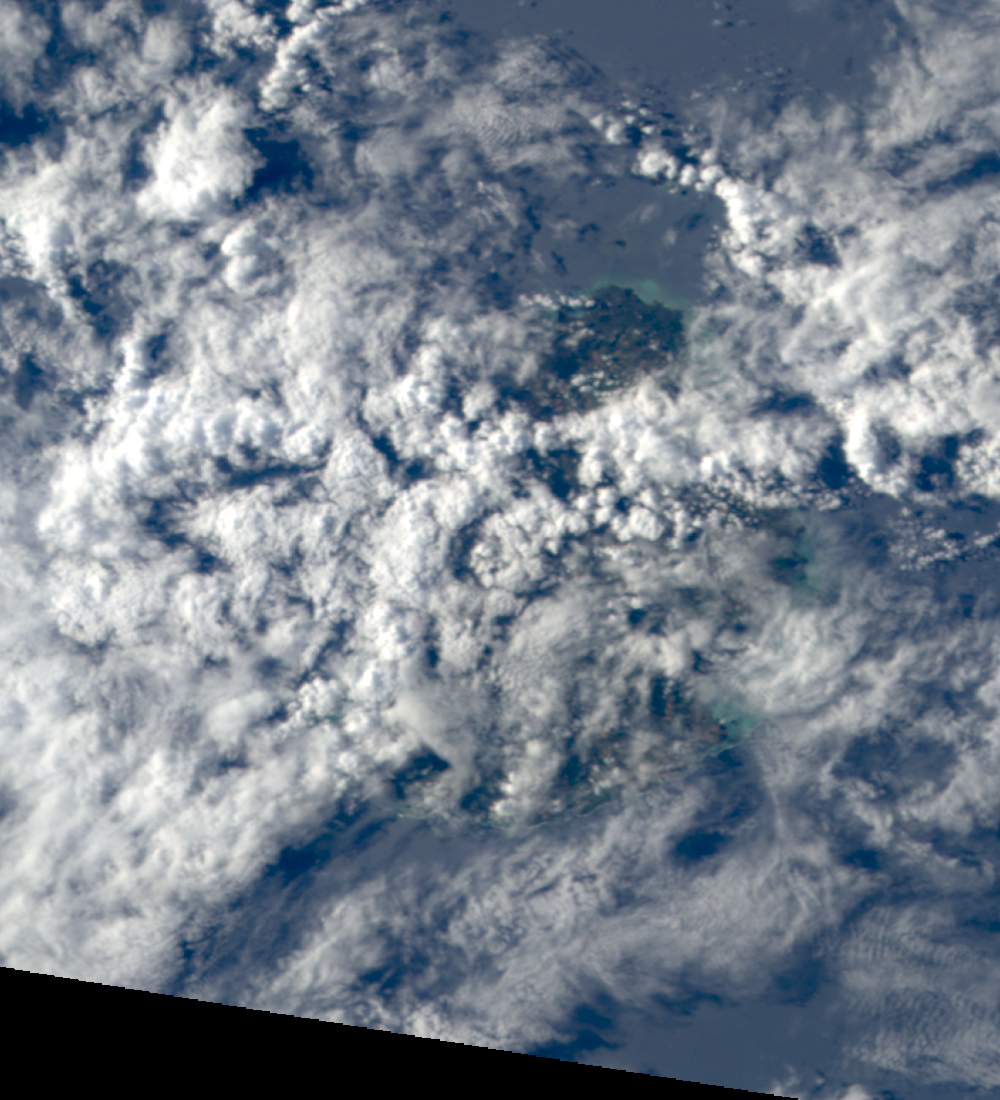
Section of the image sequence of the island of Mauritius
This image is composed of a single series of red, green and blue images, each with a resolution of approximately 150 metres per pixel. The island was mostly shrouded by clouds. The northern plains and the turquoise lagoon on the east coast can be seen.
Image: 1/6, Credit:
ESA / JUICE / JANUS team. Processing: L. Penasa
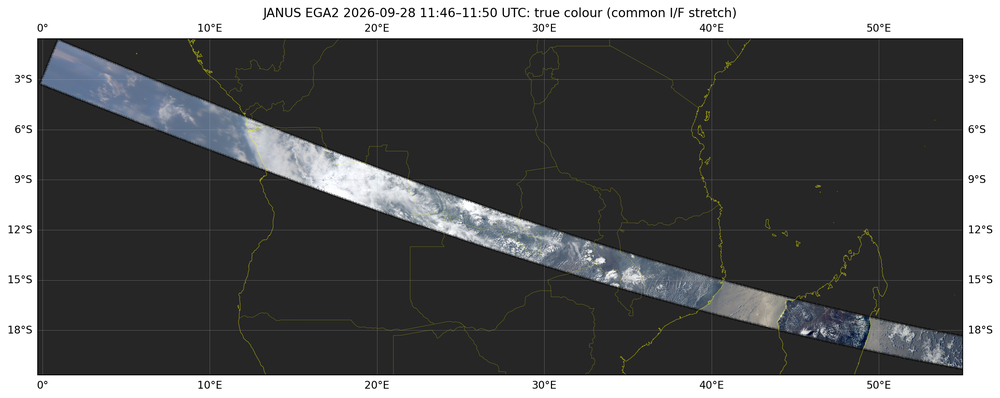
A swath of JANUS observations, approximately 250 to 300 kilometres wide
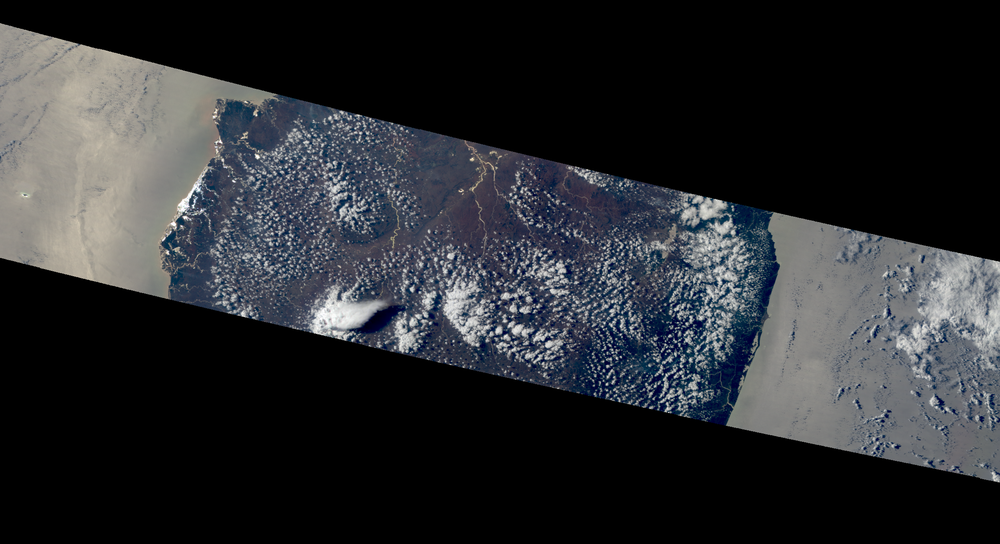
JANUS cycled through its filters one after another while Earth turned beneath the spacecraft. In doing so, the camera recorded a swath approximately 250 to 300 kilometres wide, stretching east of Madagascar across Mozambique, Malawi, Zambia, the Democratic Republic of the Congo and Angola to the Gulf of Guinea. The pixel size increases from approximately 150 metres over Madagascar to approximately 375 metres over the Atlantic as JUICE moves away. Approximately 40 individual red, green and blue images were placed onto a common map grid, using the position and orientation of the JUICE probe. Overlapping individual images were blended seamlessly into one another. The three colours were scaled together, so that the colour rendering matches what the eye would see – including the slight blue haze of the atmosphere.
Image: 2/6, Credit:
ESA / JUICE / JANUS team. Processing: L. Penasa
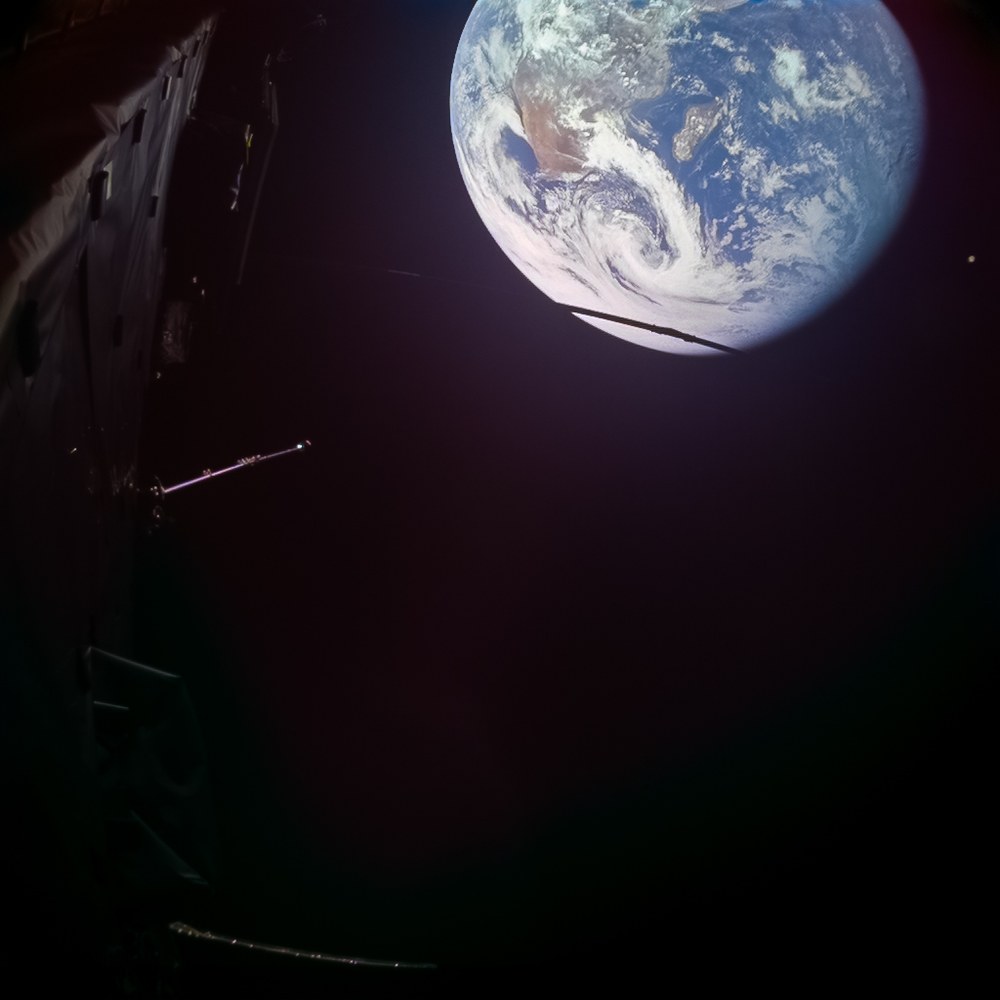
Image of Earth from JUICE monitoring camera JMC1
This image was taken by the JUICE monitoring camera 1 (JMC1) during the Earth flyby on 28 September 2026 at 13:56 CEST, as the Jupiter probe was heading away from its closest approach to Earth. This successful flyby of Earth altered JUICE's path through space to put it on course for another flyby of Earth in 2029. In the image, we see much of the African continent. To the right of the main continent is the island of Madagascar. The Moon is visible as a tiny grey dot at the upper right of the frame. The JUICE monitoring cameras were designed to monitor the spacecraft's various booms and antennas. They were not designed to carry out science or to image the Moon and Earth. The JANUS scientific camera is providing high-resolution imagery during the flybys of Earth, the Moon and Venus, and of Jupiter and its icy moons once JUICE reaches the Jupiter system in 2031.
On 28 September 2026, ESA's JUICE spacecraft completed its second Earth flyby manoeuvre, using our planet’s gravity to adjust its course while, at the same time, testing its instruments ahead of their deployment in the Jupiter system from 2031.
The JANUS camera, in which DLR is extensively involved, took 740 images of Earth and the Moon over several days, enabling the science team to carry out important functional tests, among other things.
The laser altimeter GALA, another instrument on board JUICE led by DLR, also collected valuable data for calibrating the instrument.
Focus: Space, exploration
The European Space Agency's (ESA) JUICE (Jupiter Icy Moons Explorer) space probe passed Earth on 28 September 2026, marking another important step on its journey to the Jupiter system. At its closest approach at 13:45 CEST, the probe came within 8640 kilometres of Earth, above the Indian Ocean. The flyby manoeuvre steered JUICE's trajectory further towards Jupiter; a final Earth flyby is scheduled for January 2029. While passing Earth, on-board scientific instruments were active, including the GALA laser altimeter and the JANUS camera, in which the German Aerospace Center (Deutsches Zentrum für Luft- und Raumfahrt; DLR) plays a key scientific and technical role. JANUS will later investigate the surfaces of Jupiter's moons Ganymede, Callisto and Europa, reveal geological structures and help us to understand the evolution of these 'ice worlds'. The camera will also explore Jupiter's uppermost cloud layers, the planet's thin rings and some of its small, irregularly shaped moons.
Background – flyby manoeuvre
A flyby, also known as a gravity assist, is a spaceflight manoeuvre in which a spacecraft is accelerated, slowed down or steered onto a new trajectory using the gravitational pull of a celestial body, without using its own propellant. To do this, the probe passes close to a massive celestial body, usually a planet.
Observations of known celestial bodies on the long journey to the Jupiter system repeatedly give the JANUS team the opportunity to further characterise the camera's performance under real conditions and to prepare for the observations planned following JUICE’s arrival in the Jupiter system. At Ganymede, JANUS is expected to achieve resolutions of up to 2.4 metres per pixel in its closest orbit, and approximately 10 kilometres per pixel at Jupiter. During its flyby of the Earth–Moon system, the camera took 740 images from different distances and with varying spatial resolution.
The multi-day observation programme began while JUICE was in Earth's shadow. JANUS pointed at Earth’s night side using long exposures to capture even faint light. The camera then turned its attention to the sunlit surface of the Moon. By pointing at the brightly lit edge of the Moon, the team investigated how stray (unwanted) light enters the images. This understanding is important for distinguishing these effects from relevant surface features.
From right up close to far away
When the JUICE probe made its closest approach to Earth, JANUS carried out an image sequence lasting approximately 20 minutes. During this period, the camera observed our planet from one edge of Earth's visible disc to the other. This allowed the team to test how JANUS images the surface and atmosphere across the entire Earth disc.
During the flyby, JANUS also captured a long sequence of images over the western Indian Ocean, Madagascar and Central Africa. The camera covered a swath approximately 250 to 300 kilometres wide, stretching from eastern Madagascar via Mozambique, Malawi, Zambia, the Democratic Republic of the Congo and Angola to the Gulf of Guinea. The pixel size varied along the flight path, from approximately 150 metres over Madagascar to around 375 metres over the Atlantic, as the probe moved further away from Earth.
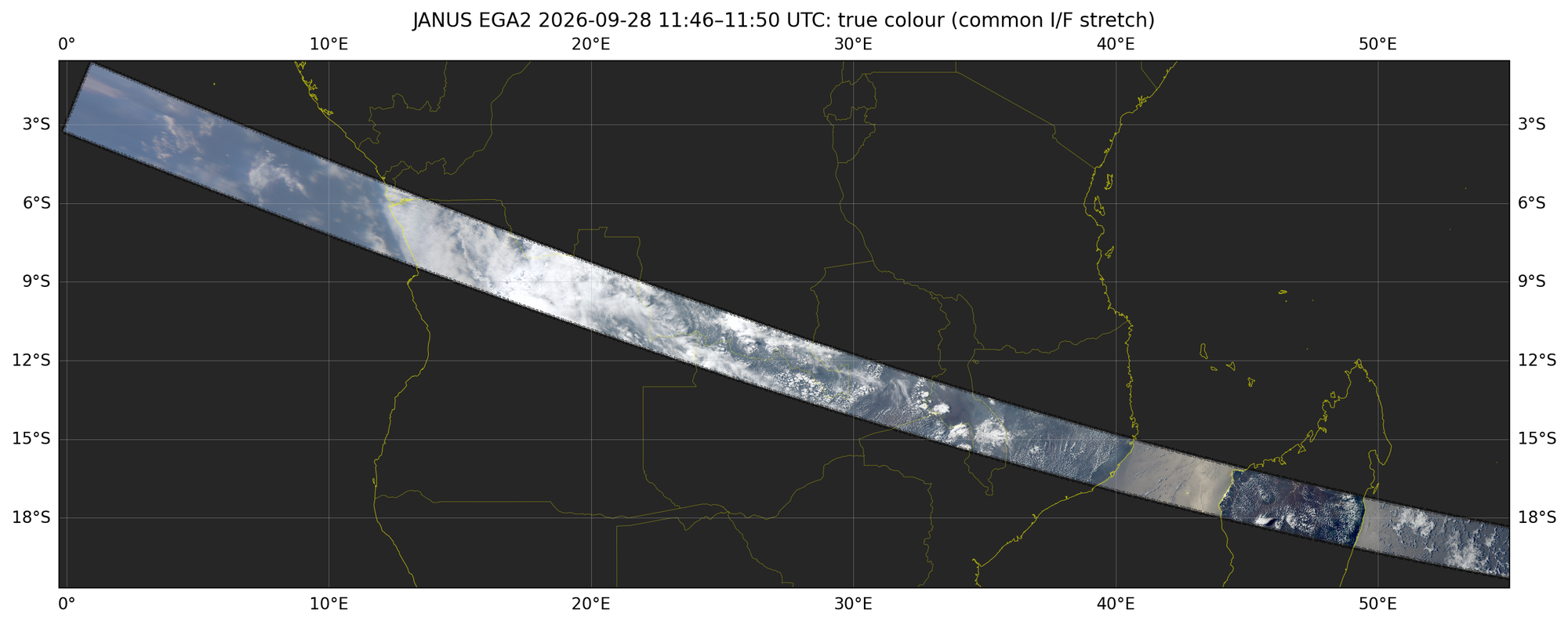
JANUS image swath, approximately 250 to 300 kilometres wide
Approximately 40 individual red, green and blue images were laid onto a common map grid, using the position and orientation of the spacecraft. Overlapping individual images were blended seamlessly into one another. Combining the three individual colour images into one visually matches what the human eye would perceive – including the slight blue haze caused by the atmosphere.
The images show, among other things, details of Madagascar, with fair-weather clouds over land and river valleys in the west. On both sides of the island, bright, sand-coloured sunlight can be seen reflected from the water's surface. Mauritius was also imaged, at approximately 150 metres per pixel. Although the island was mostly under cloud, the northern plains and the turquoise lagoon on the east coast are visible.
Credit:
ESA / JUICE / JANUS team. Processing: L. Penasa
The observations continued as JUICE moved away from Earth. Three further observations of the Moon were planned for approximately three and a half hours, one day and two days after closest approach. During these, the Moon's apparent diameter in the JANUS images shrank from around 470 to 160 and finally to 100 pixels. This sequence helps the team to assess how JANUS images targets at different apparent sizes – a situation that will also arise during approaches to Jupiter and its moons. A final look back at Earth followed, almost four days after closest approach. Our planet then still occupied around 240 pixels of the image width.
Detail of the JANUS image swath
This is a section of the swath, showing the full width of the island of Madagascar, with fair-weather cumulus clouds over land and the river valleys in the west. The bright, light-brown sea on both sides is glaring sunlight reflected from the water's surface.
Credit:
ESA / JUICE / JANUS team. Processing: L. Penasa
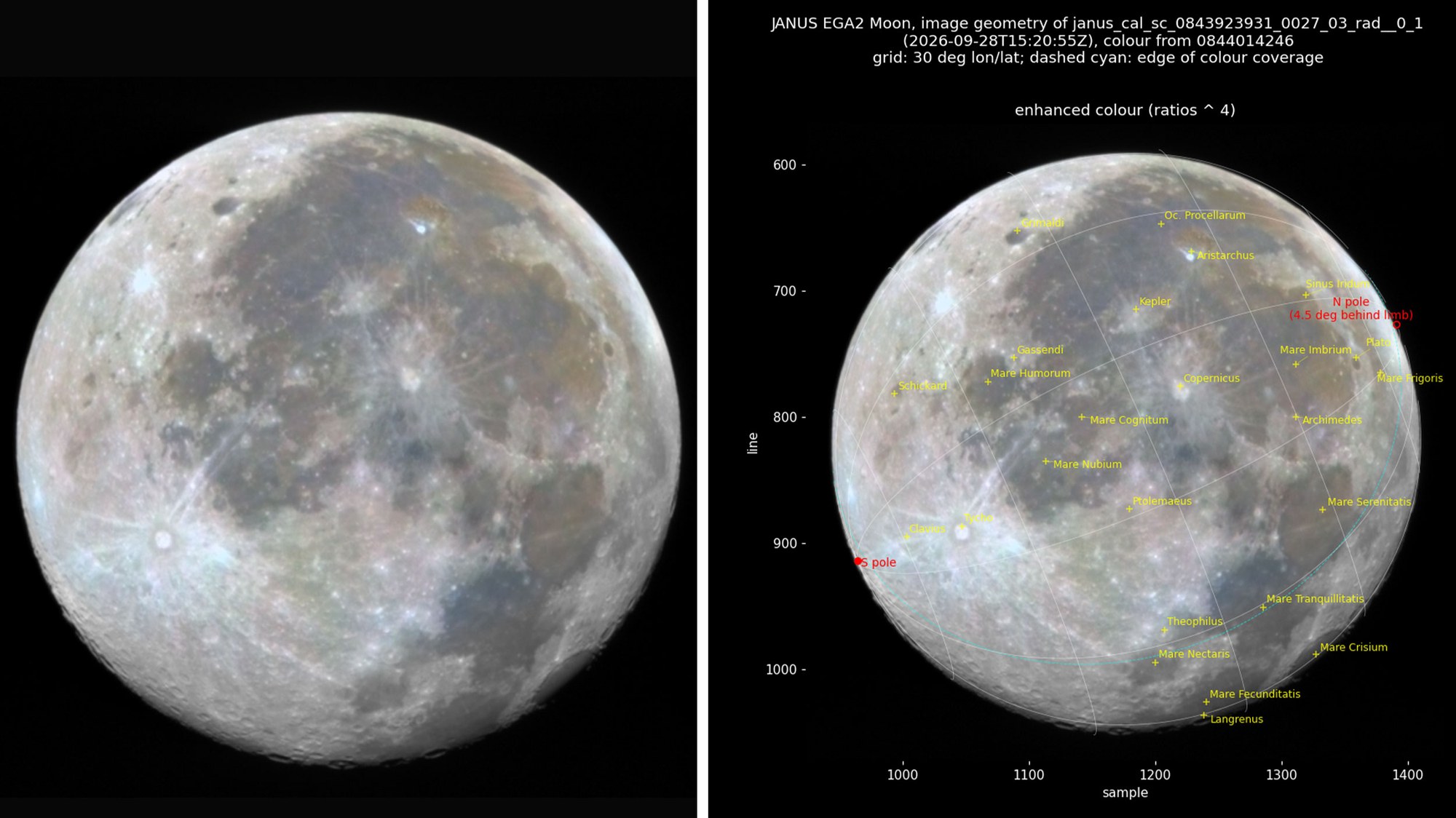
As well as Earth, JANUS repeatedly turned its gaze towards the Moon, which was almost fully illuminated at the time of the observations. The images show, among other things, the dark lunar maria Imbrium, Procellarum, Serenitatis and Tranquillitatis, as well as the bright rayed craters Tycho and Copernicus. Aristarchus is particularly striking as the brightest point on the visible side of the Moon. A detailed green-filter image was taken on 28 September 2026 at 17:20 CEST from approximately 497,000 kilometres, with a resolution of 7.6 kilometres per pixel.
Almost full Moon – the side of the Moon facing Earth, as seen by JANUS
These views from the JANUS camera show the dark regions (maria) of the Moon: Imbrium, Procellarum, Serenitatis and Tranquillitatis, as well as the bright rayed craters Tycho and Copernicus. Aristarchus is the brightest spot on the Moon. The detail view comes from a green-filter image taken on 28 September 2026 from a distance of approximately 497,000 kilometres, at 7.6 kilometres per pixel. The colour rendering is based on red, green and blue images taken the following day from a distance of approximately 1.37 million kilometres. The sharp green image provides the brightness and the detail. The colour information from the second, more distant series of images is laid over it (pan-sharpening). Colour differences on the Moon are very subtle, so they have been 'exaggerated': the real Moon appears grey-brown. The colour differences in this image correspond roughly to what the JANUS camera can measure. The colours therefore serve only to illustrate and do not reflect chemical composition. The bluish tinge of the brightest young craters and their rays (Tycho, Aristarchus) is the most distinct feature. The edges of the lunar disc, where the colour images captured the surface at a grazing angle, are the least reliable. The Moon appears tilted because it is shown as the camera captured it, not with north at the top. In the right-hand image, the red dots mark the poles.
Credit:
ESA / JUICE / JANUS team. Processing: L. Penasa
Possible applications of the data
The JANUS data can also be used for comparative scientific analyses. One possible case study is vegetation on Earth. The camera's multispectral capabilities allow for investigations into vegetation patterns and chlorophyll-sensitive data products. For this, visible, narrow-band red and near-infrared filter bands can be analysed. The JANUS data can also be compared with data from Earth observation missions – such as PRISMA (PRecursore IperSpettrale della Missione Applicativa), an Earth observation system with electro-optical instruments that combines a hyperspectral sensor with a medium-resolution, full-colour (panchromatic) camera, or EnMAP (Environmental Mapping and Analysis Program), the first hyperspectral satellite developed and built in Germany. This makes it possible to answer current questions in the fields of the environment and near-natural ecosystems, agriculture and forestry, land use, water management and water quality, as well as mineralogy and geology.
GALA laser altimeter – ready to peer beneath the ice
The GAnymede Laser Altimeter (GALA), developed under the leadership of the DLR Institute of Space Research, uses laser pulses to measure distances to solid surfaces. At Jupiter, its primary purpose will be to map the topography of the moon Ganymede and to record changes to its icy surface caused by tidal forces. From this, conclusions can be drawn about a possible ocean beneath the icy crust.
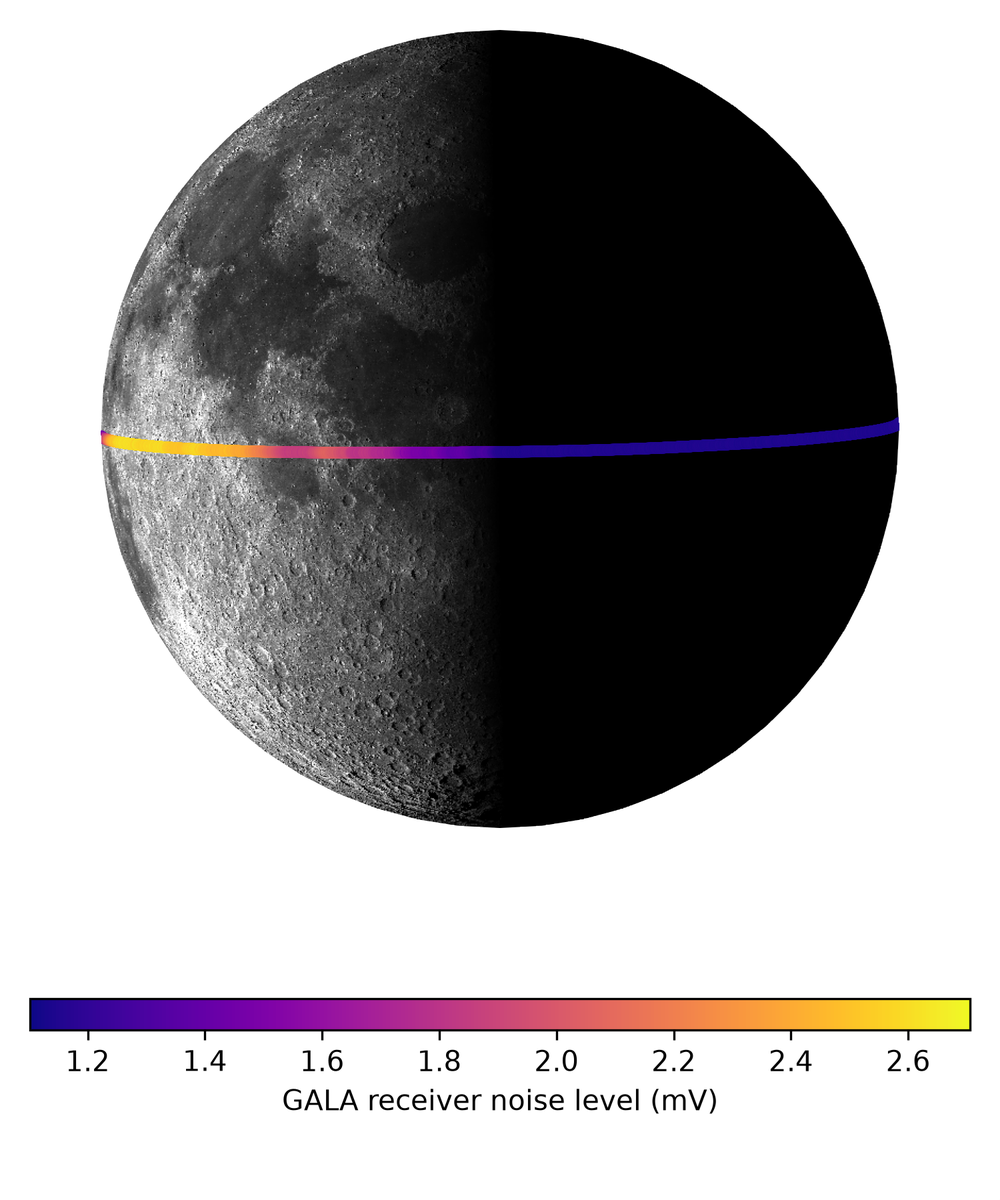
Representation of the measured GALA receiver noise
Representation of the measured GALA receiver noise, which is determined by the reflected photon flux. The distribution of the measurements across the lunar surface is shown on an orthographic projection of a Moon map, based on data from the Lunar Reconnaissance Orbiter's Wide Angle Camera (LROC WAC).
Credit:
NASA/GSFC/Arizona State University (base map)
'Active' measurement with a laser pulse is typically possible from orbit or during a close flyby of a planetary body. However, GALA's highly sensitive detector also allows 'passive' measurement of the reflectivity of more distant targets. This means that measurements of the Moon and Earth could be made during the recent Earth flyby. The technique exploited the effect whereby the noise level in the GALA receiver increases in relation to the incoming photon density. This was particularly impressive when observing the Moon shortly before JUICE's flyby of Earth.
At the start of the measurement, GALA was pointing towards the dark side of the Moon, and the GALA detector showed the nominal noise level of 1.1 millivolts. As soon as the illuminated side of the Moon came into its field of view, the photon density rose and, with it, the noise level, which reached a maximum value of 2.7 millivolts at the Moon's edge. It was even possible to distinguish differences in the reflectivity of the surface – for example the dark Mare Nectaris and the brighter highlands. The measurements were taken from a distance of approximately 124,000 kilometres, more than 20 times per second. Each individual measurement covered a circular area 56 kilometres in diameter, with the centre of the observation moved across the lunar surface by only 508 metres.
As well as calibrating the sensitivity of the detector, the measurement also serves to determine the exact orientation of the GALA receiver. Though this was measured precisely before launch, the vibrations that acted on the instrument during the rocket launch led to deviations. To determine GALA's orientation in flight, the times at which the Moon entered and exited GALA's field of view were determined. GALA's exact line of sight is derived from the times at which the noise level rose and fell, compared with the calculated times from the known positions of the Moon and JUICE.
GALA also had Earth in its field of view. During its closest approach to Earth, GALA was able to determine differences in reflectivity, primarily caused by cloud formations. On 2 October 2026, a few days after the flyby, GALA's transmitter was switched on to enable a laser ranging campaign: GALA sent a laser pulse towards Earth, and the laser telescope at the Geodetic Observatory Wettzell, on a mountain ridge in the Bavarian Forest, tried to pick up GALA's faint signals. From a distance of 3.65 million kilometres, GALA illuminated an area of 365 square kilometres at once, 30 times per second. Although the expected signal strength would be sufficient for detection on Earth, the campaign was made more difficult by the unfavourable observation time in the early morning and poor weather conditions. Like the passive observation of the Moon, the laser ranging campaign was carried out to determine the orientation of the GALA instrument. The data received on Earth will be analysed in detail in collaboration with the Geodetic Observatory Wettzell.
JUICE – an ESA mission with significant German involvement
JUICE is the largest and most comprehensive ESA mission to explore the planets of the Solar System. NASA and the Japan Aerospace Exploration Agency (JAXA) have also contributed to the mission. ESA's responsibilities include funding for the satellite platform, its launch on an Ariane 5 ECA rocket and the operation of the probe.
JUICE was launched on 14 April 2023 from Europe's Spaceport near Kourou, French Guiana. Following the first flyby of the Earth-Moon system in August 2024 and another of Venus in August 2025, it has now completed its second flyby of Earth. A final Earth flyby is planned for January 2029, before JUICE reaches the Jupiter system in 2031. After a total of 35 flybys of Ganymede, Europa and Callisto, the probe is to enter orbit around Ganymede at the end of 2034. This would mark the first time in the history of spaceflight that a space probe has orbited the moon of another planet.
Funding for the JUICE scientific payloads is largely provided by the national space agencies and participating scientific institutes and organisations themselves. In addition to JANUS, SWI (the Sub-millimetre Wave Instrument) and GALA, the German Space Agency at DLR is supporting further German scientific contributions from the national space programme: the particle spectrometer (Particle Environment Package), the Jupiter magnetometer (J-MAG), the radar instrument RIME (Radar for Icy Moon Exploration) and an instrument for radio sounding of Jupiter’s atmosphere (3GM).