
Almost full Moon – the side of the Moon facing Earth, as seen by JANUS
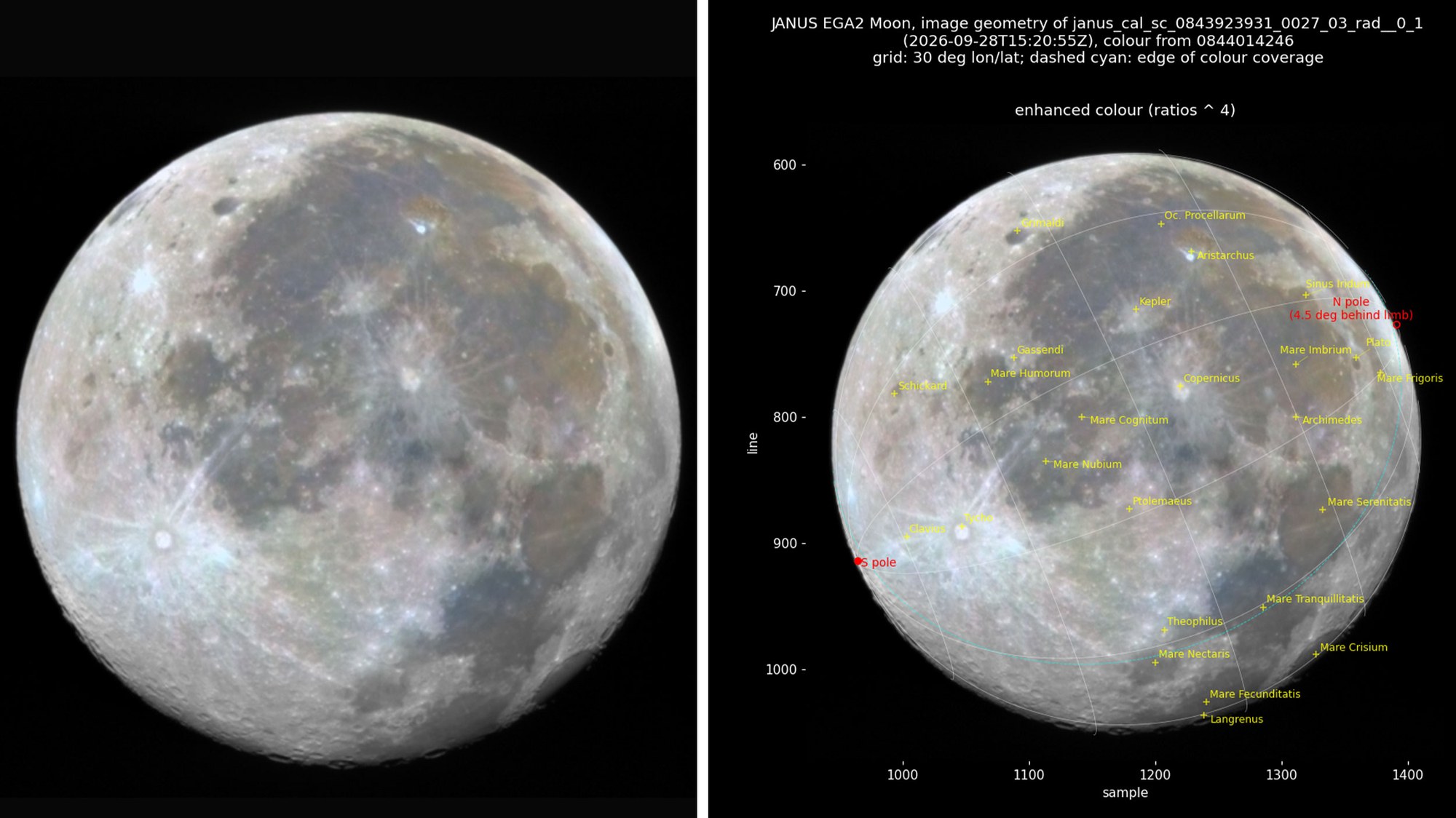

Almost full Moon – the side of the Moon facing Earth, as seen by JANUS
These views from the JANUS camera show the dark regions (maria) of the Moon: Imbrium, Procellarum, Serenitatis and Tranquillitatis, as well as the bright rayed craters Tycho and Copernicus. Aristarchus is the brightest spot on the Moon. The detail view comes from a green-filter image taken on 28 September 2026 from a distance of approximately 497,000 kilometres, at 7.6 kilometres per pixel. The colour rendering is based on red, green and blue images taken the following day from a distance of approximately 1.37 million kilometres. The sharp green image provides the brightness and the detail. The colour information from the second, more distant series of images is laid over it (pan-sharpening). Colour differences on the Moon are very subtle, so they have been 'exaggerated': the real Moon appears grey-brown. The colour differences in this image correspond roughly to what the JANUS camera can measure. The colours therefore serve only to illustrate and do not reflect chemical composition. The bluish tinge of the brightest young craters and their rays (Tycho, Aristarchus) is the most distinct feature. The edges of the lunar disc, where the colour images captured the surface at a grazing angle, are the least reliable. The Moon appears tilted because it is shown as the camera captured it, not with north at the top. In the right-hand image, the red dots mark the poles.
Credit:
ESA / JUICE / JANUS team. Processing: L. Penasa