Space Tech Expo 2025 – DLR is back as one of the largest exhibitors
November 17, 2025 | From research to application – rocket technologies, satellite communication and Earth observation
Space Tech Expo 2025 – DLR is back as one of the largest exhibitors
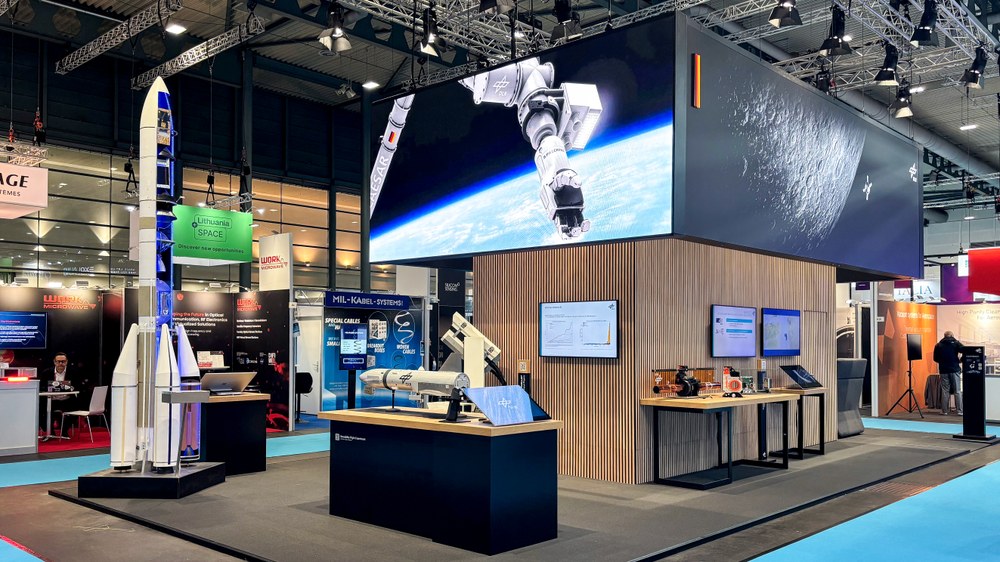
DLR exhibition stand at Space Tech Expo 2025
The Space Tech Expo will take place from 18 to 20 November 2025 in Bremen. At the exhibition stand in Hall 5, stand number J28, DLR and the German Space Agency at DLR will present current space missions and exhibits from space research.
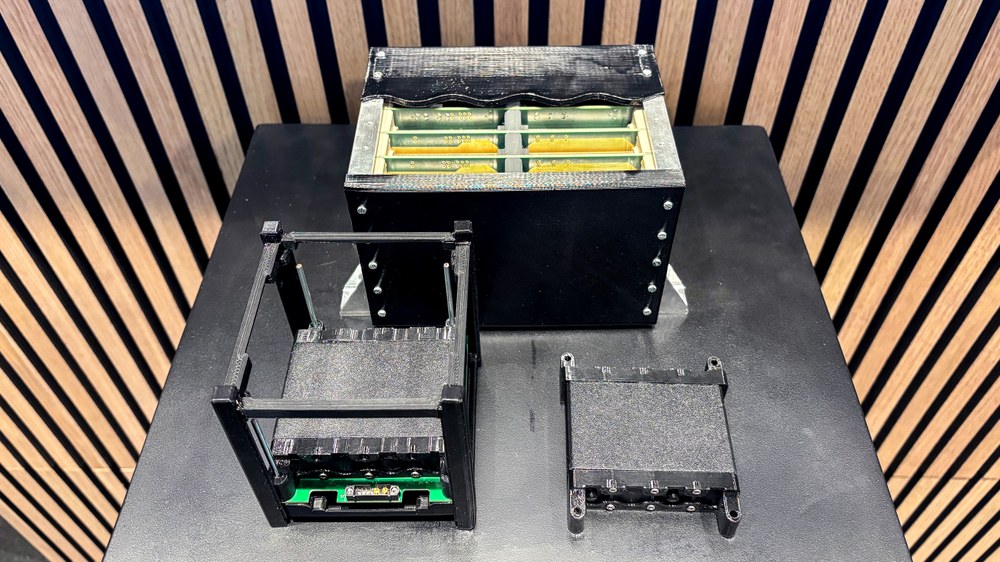
Modular, chemistry-independent battery system for satellites
In the PULSE project, DLR researchers are developing a modular battery system that combines different cell chemistries and system architectures within a single design.
At Space Tech Expo, DLR will provide insights into its research in the field of space research.
The focus will be on space applications such as rocket technologies, satellite communications and Earth observation, as well as projects in cooperation with industry.
Focus: Spaceflight, space agency, technology transfer
Space Tech Expo Europe is celebrating its 10th anniversary in Bremen, Germany, from 18 to 20 November. The German Aerospace Center (Deutsches Zentrum für Luft- und Raumfahrt; DLR) will once again be participating with one of the largest exhibition booths in Hall 5, Stand J28. Here, DLR and the German Space Agency at DLR will present current space missions and research, as well as topics that are finding their way from research into application. Visitors will also have the opportunity to experience a virtual space flight in the SPACEBUZZ ONE simulator from the German Space Agency at DLR.
Space Tech Expo Europe is one of the most important platforms for the European space industry. It brings together companies, research institutions and policymakers and showcases the ongoing, dynamic development of the sector. Bremen plays a central role in this. With its robust industrial base and close integration of research and development, the 'City of Space' is a dense knowledge network driving space innovation in Germany and Europe. We are delighted once again to be one of the largest exhibitors, presenting diverse technological applications. Earth observation, secure communication and navigation in the interests of public stakeholders, as well as security and resilience, are just a few of the important areas of development.
Vertically launching and horizontally landing rocket stage
With ReFEx (Reusability Flight Experiment), DLR is developing a rocket stage that takes off vertically and lands horizontally (Vertical Take Off and Horizontal Landing; VTHL). ReFEx will demonstrate key technologies: an aerodynamic design that allows stable flight within the atmosphere over a wide speed range; an autonomous guidance, navigation and control system to ensure an optimal flight path; and status monitoring using the latest sensor technology. This includes specially arranged pressure sensors integrated into the structure for measuring speed and flight attitude, as well as glass fibres that can be used to measure the thermal and mechanical distortion of the ReFEx vehicle.
The Reusability Flight Experiment (ReFEx) is a technology demonstrator for future winged, reusable stages. This animation shows ReFEx in its re-entry configuration after it has been launched from its carrier rocket. Instead of a vertical landing, the test focuses on the horizontal landing of a stage, with autonomous navigation and controlled flight during each phase of the vehicle's mission. The vehicle is stabilised using an active aerodynamic control system, which transforms inputs from the navigation and guidance system into control commands for the individual actuators. A demonstration flight is planned for 2025 from Koonibba Test Range, Australia.
Video: Technology demonstrator ReFEx
Your consent to the storage of data ('cookies') is required for the playback of this video on Youtube.com. You can view and change your current data storage settings at any time under privacy.
Video: Technology demonstrator ReFEx
The Reusability Flight Experiment (ReFEx) is a technology demonstrator for future winged, reusable stages. This animation shows ReFEx in its re-entry configuration after it has been launched from its carrier rocket. Instead of a vertical landing, the test focuses on the horizontal landing of a stage, with autonomous navigation and controlled flight during each phase of the vehicle's mission. The vehicle is stabilised using an active aerodynamic control system, which transforms inputs from the navigation and guidance system into control commands for the individual actuators. A demonstration flight is planned for 2025 from Koonibba Test Range, Australia.
Unfolding, ultra-lightweight structures are the technical basis for power generation, communication, measurements, optical controls and space debris avoidance in the New Space sector. The extremely light carbon fibre SpaceMast System can be rolled up for launch and extended to 14 metres once in space in order to support large structures.
Thanks to its modular design, the SpaceMast system is a promising and versatile component for the growing commercial space sector. Individually customisable systems are particularly in demand for communication, Earth observation and navigation missions. Depending on the application, one to four identical mast modules can be attached to a central module containing the drive mechanism and assembled into a single unit. The size, length and arrangement of the masts can also be adapted.
Modular, chemistry-independent battery system for satellites
In the PULSE project, DLR researchers are developing a modular battery system that combines different cell chemistries and system architectures in a common design. The aim is to create a versatile power system for CubeSats and small satellites, featuring flexible electronics, autonomous software and a scalable structure.
A key element is the development of advanced algorithms for determining the state of charge (SoC) and state of health (SoH) for precise and robust battery monitoring. The focus is on lithium-sulphur technology, which offers significantly higher energy density and lower weight than today's lithium-ion cells.
Space Tech Expo in Bremen is an important marketplace for the German and European space industry. In particular, in the run-up to the ESA Ministerial Council meeting, which will also take place here in Bremen the following week, the trade fair is an ideal showcase for German and international cutting-edge technologies and innovations in the space sector. We want to continue to exploit this potential to the fullest in the future. For the Ministerial Council, one of our core priorities is therefore for Europe to strengthen competitive and commercial approaches in space. Germany is pushing for initiatives including the European Launcher Challenge – or ELC – in order to make the European launch vehicle landscape more resilient and ensure more cost-effective European access to space.
Ariane 6 – Europe's launch vehicle
Ariane 6 uses a combination of liquid hydrogen and liquid oxygen as propellants in both the lower and upper stages. The new lower stage is based on the technology of the Ariane 5 lower stage but has been designed to be more cost-effective. The upper stage is a modification of the new upper stage already planned for the Ariane 5ME, with the re-ignitable Vinci engine. Depending on the configuration, Ariane 6 can carry a payload of 4.5 or 12 tonnes. The rocket is built by the European space company ArianeGroup, and an interactive model will be on display at the trade fair.
Germany is participating in the Ariane 6 development programme, contributing approximately 21 percent of the total costs. The German Space Agency at DLR coordinates Germany's contribution to the ESA budget. The DLR site in Lampoldshausen plays a key role in all stages of the Ariane 6 propulsion system's development – testing the Vinci and Vulcain engines, developing them further and qualifying the entire upper stage. In future, final assembly and acceptance testing of the Ariane upper stage Vinci engine will also take place in Lampoldshausen.
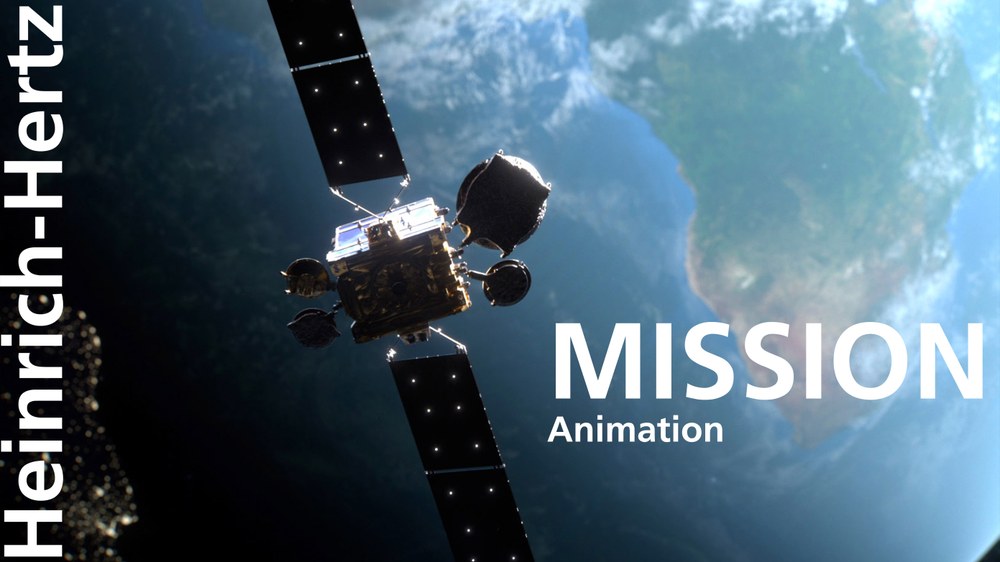
Heinrich Hertz – Pioneering work in satellite communications
The Heinrich Hertz mission has several ambitious goals. One is to test new technologies for satellite communications, which must perform reliably in the demanding conditions of extreme heat and cold, vacuum and microgravity. If the components successfully pass this in-orbit verification, they minimise the risk of failure when used in future satellite missions.
The mission makes an important contribution to the information society in Germany. The Heinrich Hertz mission is carried out by the German Space Agency at DLR on behalf of the German federal government.
The Heinrich Hertz mission is pioneering new technology. Germany is sending a satellite into space that can be adapted to changing requirements – even after launch. This ensures that Heinrich Hertz will remain up to date well into the future.
Video: The Heinrich Hertz communications satellite (German only)
Your consent to the storage of data ('cookies') is required for the playback of this video on Youtube.com. You can view and change your current data storage settings at any time under privacy.
Video: The Heinrich Hertz communications satellite (German only)
The Heinrich Hertz mission is pioneering new technology. Germany is sending a satellite into space that can be adapted to changing requirements – even after launch. This ensures that Heinrich Hertz will remain up to date well into the future.
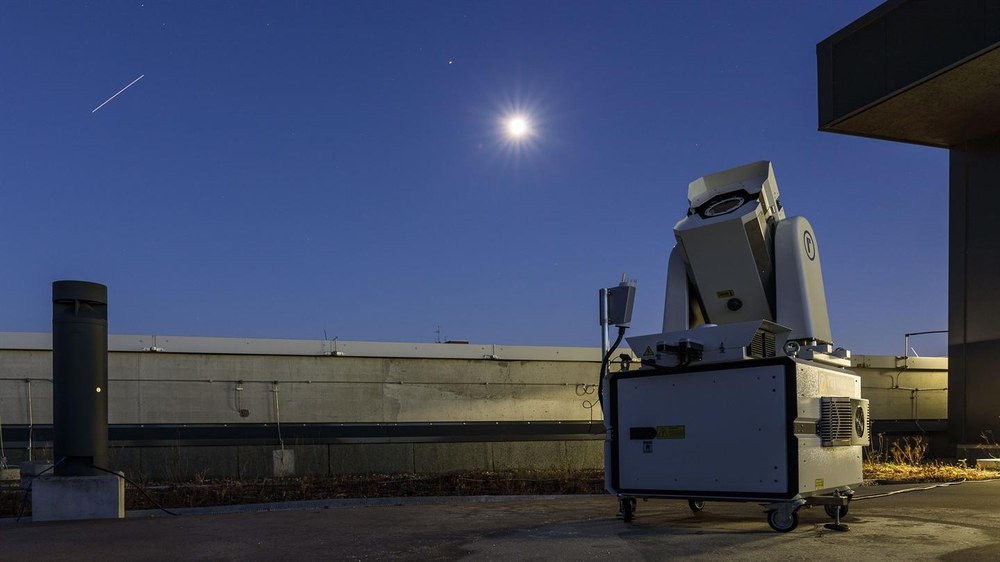
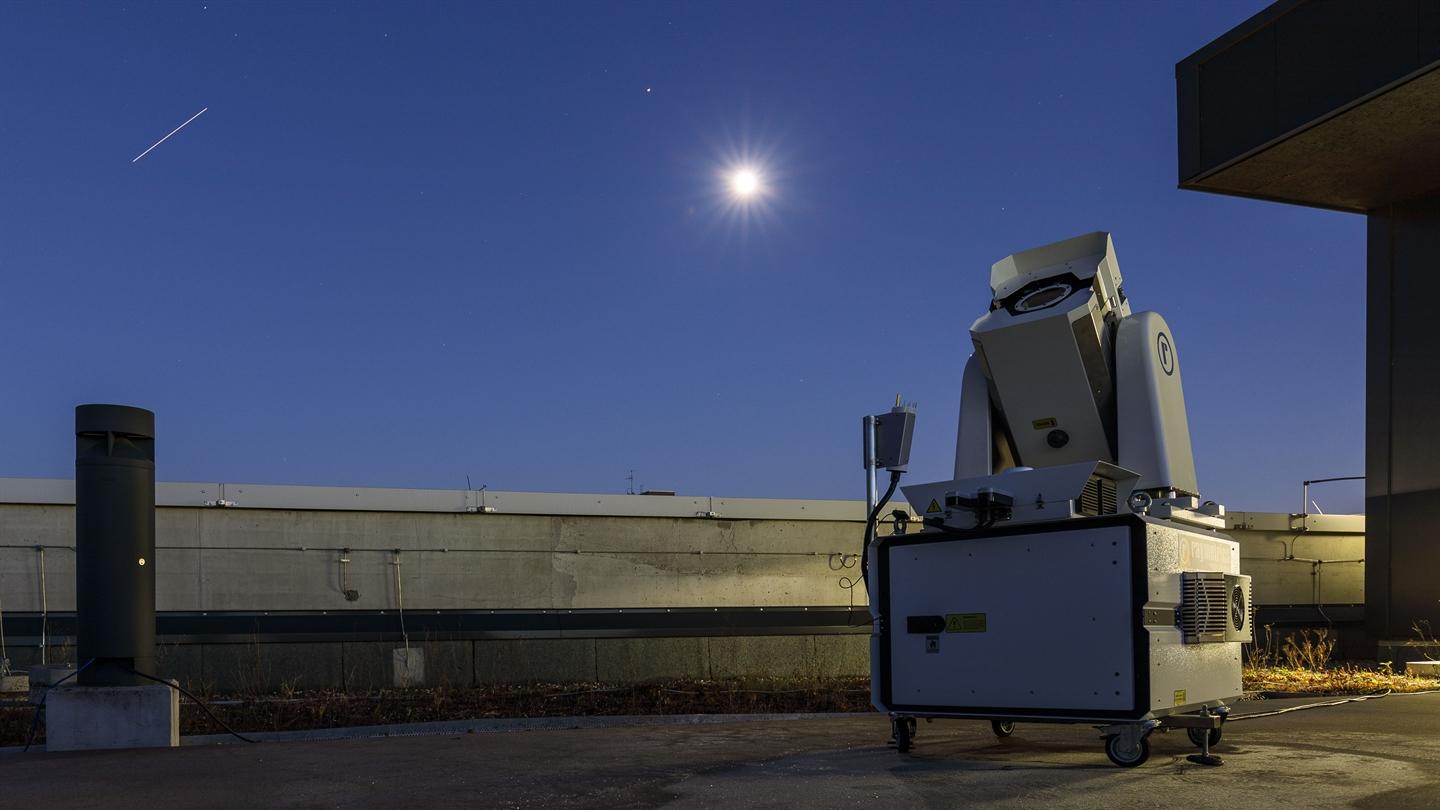
With APPARILLIO, images of objects in low Earth orbit can be captured and processed. This weatherproof, mobile unit is equipped with comprehensive control and image processing software; the system can measure the angular positions of orbital objects and forward them to servers for data processing. APPARILLIO is a cost-effective alternative to radar sensors and can be used for space surveillance or locating space debris.
New standards for Earth observation
With the CMOS-TDI Detector 8000, DLR is presenting a miniaturised sensor system for next-generation satellite missions. The technology enables high-resolution, multispectral Earth observation with an elevenfold improvement in signal-to-noise ratio. The model exhibited at Space Tech Expo is based on CMOS (Complementary Metal-Oxide Semiconductor) technology and has 8000 pixels. The detector was developed in collaboration with partners from industry and the research community – with the common goal of integrating it into sensor systems for space-based instruments in the future.
Virtual spaceflight in SPACEBUZZ ONE
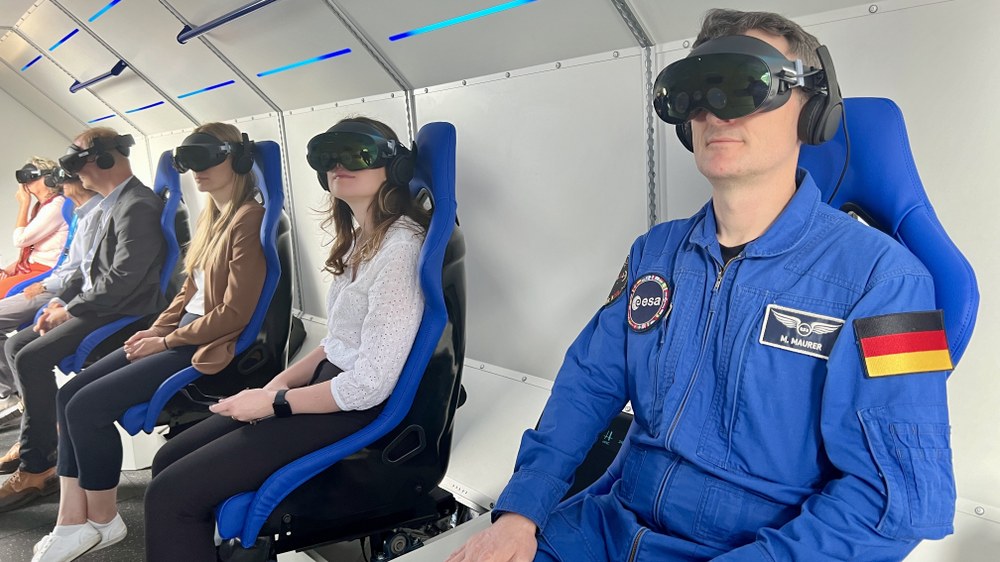
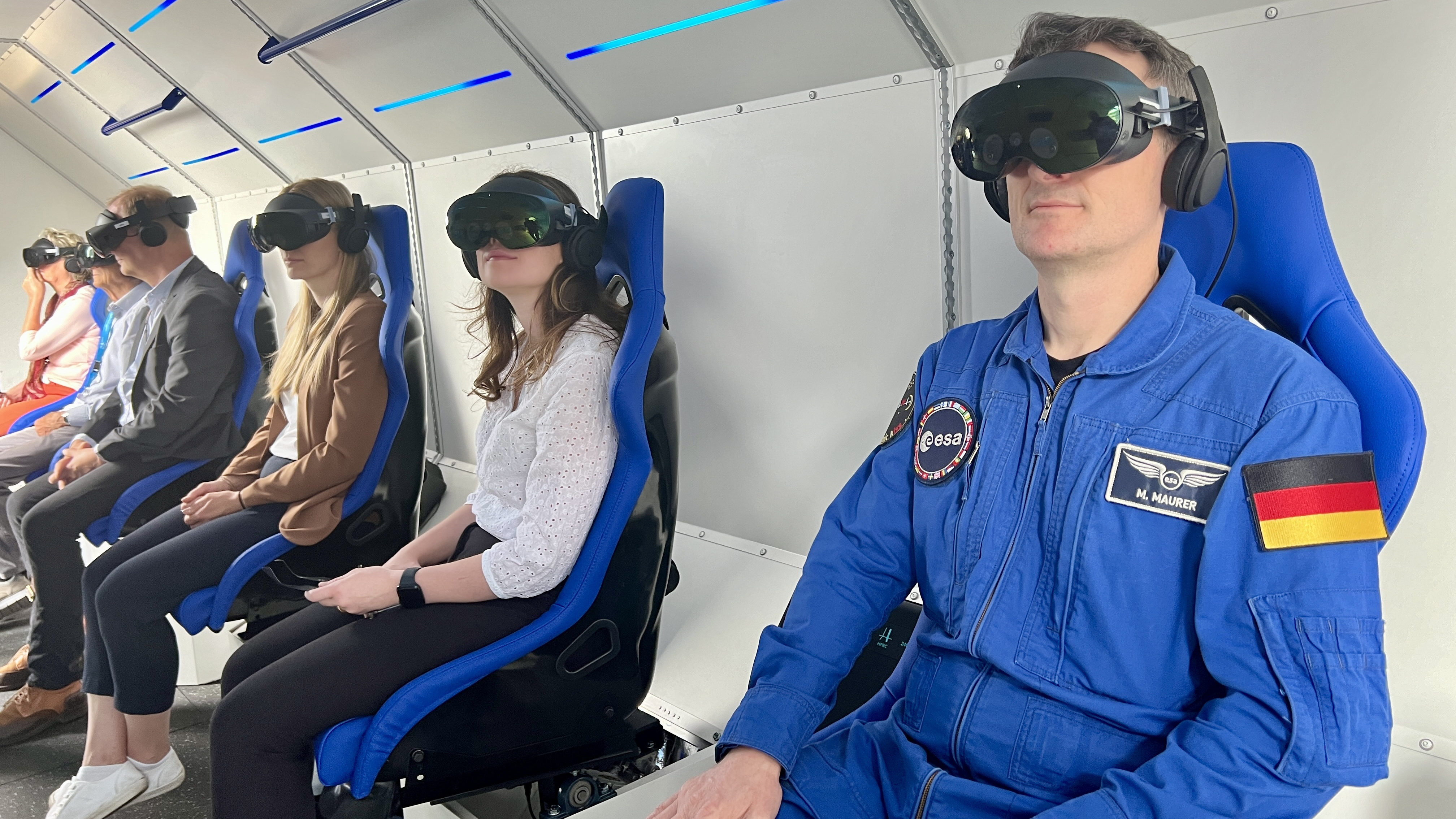
The rocket-shaped SPACEBUZZ ONE from the German Space Agency at DLR will be stopping off at the Messe Bremen exhibition centre from 18 to 20 November. Admission is free and no advance booking is required. Visitors take a seat on motion-enabled seats, put on a VR headset and experience an unforgettable virtual flight into space. They leave Earth for 15 minutes and orbit the globe and the International Space Station ISS. From an astronaut's perspective, they learn about our planet and human-induced climate change before continuing to the Moon and, finally, landing back on Earth. The flight is accompanied by avatars of German ESA astronauts Alexander Gerst and Matthias Maurer.
The SPACEBUZZ ONE from the inside
Spectators take their seats on motion seats, put on VR glasses and experience an unforgettable virtual space flight into space.