Asteroid defence – Hera spacecraft reaches its destination
November 25, 2026 | Space safety and asteroid research
Asteroid defence – Hera spacecraft reaches its destination
Hera's AFC camera examines the DART crater
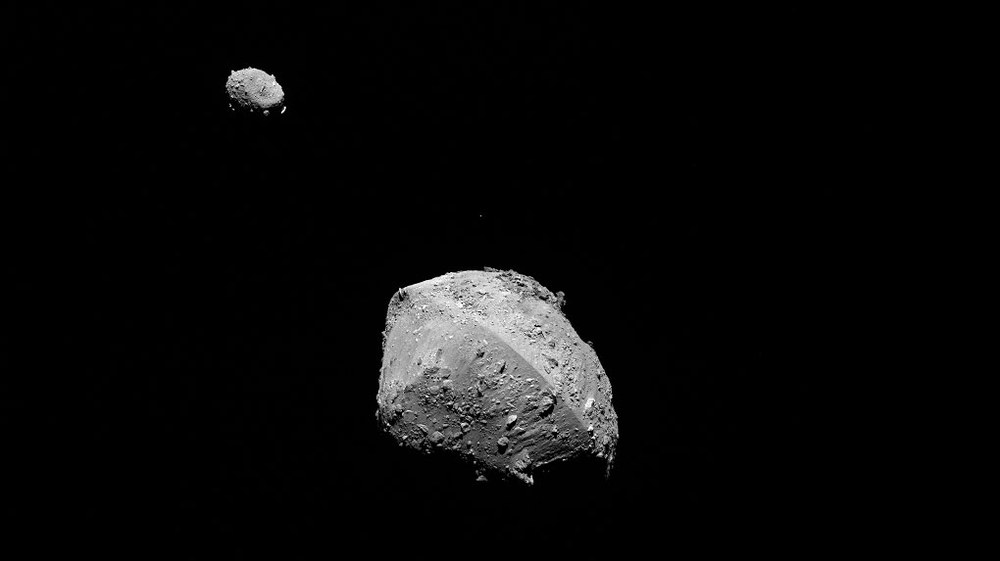
This image from the Asteroid Framing Camera (AFC) on board ESA's Hera spacecraft shows the smaller Dimorphos in its orbit around Didymos, with the crater created by the DART impact in 2022 clearly visible. The impact appears to have flattened one side of Dimorphos and left a crater that seems to be as wide as the whole side of the asteroid that was hit. The striking structures inside the crater can also be seen, including a 'cigar-shaped' structure in its centre.
The companion moon Dimorphos, about 150 metres across, orbits the 730-metre main body Didymos at an average distance of approximately one kilometre. On the larger Didymos, the clearly pronounced central ridge running along the equator can also be seen.
This image was taken on 7 November 2026 from a distance of 29 kilometres, with a spatial resolution of 2.7 metres per pixel.
Comparison of images before and after the DART impact
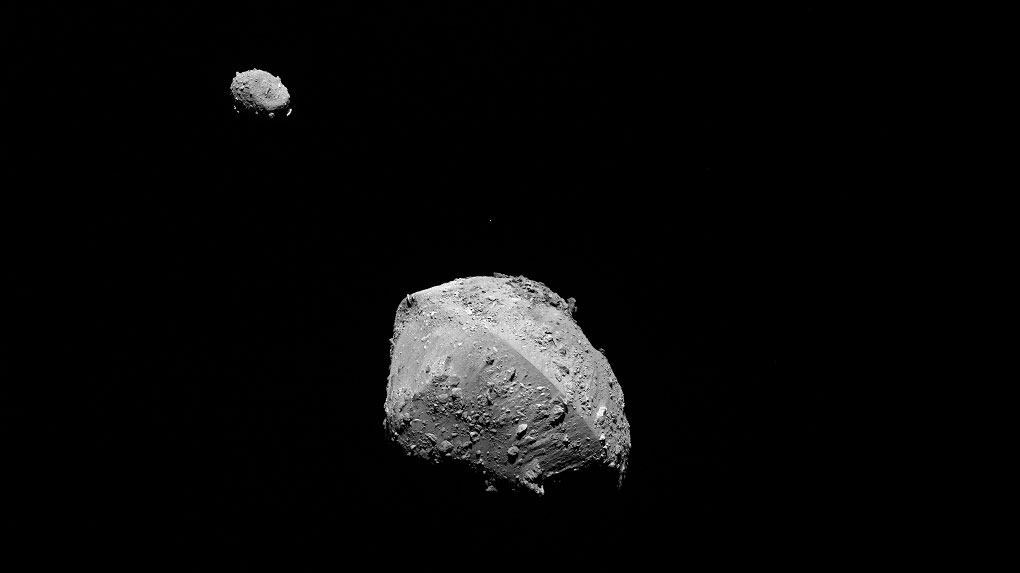
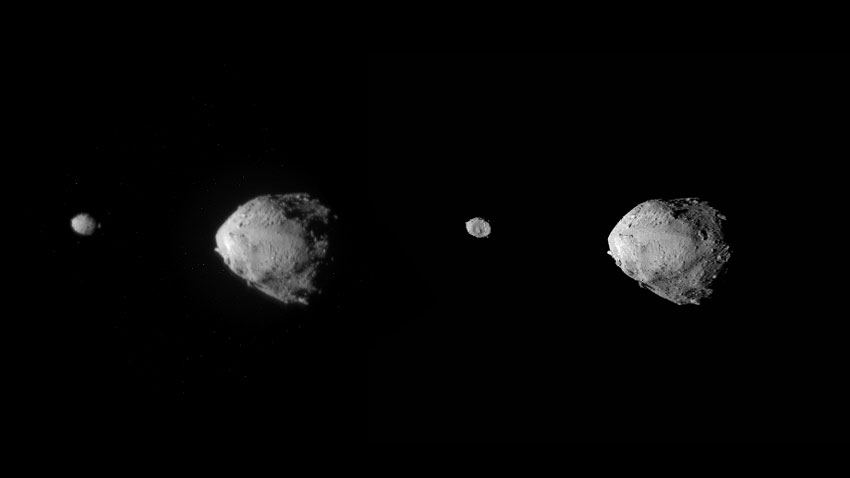
In 2022, NASA's DART probe deliberately struck the small moon Dimorphos, which orbits the larger asteroid Didymos. The image on the left shows a view from DART's main camera, DRACO, shortly before the impact. The image on the right is a recent image from the Asteroid Framing Camera (AFC) on board ESA's Hera mission, selected so that its viewing angle matches that of the earlier mission as closely as possible.
The roughly 150-metre moon Dimorphos orbits the 730-metre main body Didymos at an average distance of about one kilometre. The first thing to note is that Didymos apparently has not undergone any major changes as a result of the DART impact. The boulder fields and the central equatorial ridge have remained largely unchanged.
The side of the smaller Dimorphos visible in the AFC image, by contrast, appears completely changed: a large crater can be clearly seen. It is almost as large as the entire side of Dimorphos affected by the impact. Inside it are some striking structures, including an elongated, almost 'cigar-shaped' structure in its centre.
Image: 2/14, Credit:
Left image: NASA/Johns Hopkins APL, right image: ESA
Didymos and Dimorphos form a binary asteroid system that came as close as approximately seven million kilometres to Earth in 2003, during its 25-month orbit around the Sun. Dimorphos, at about 150 metres the smaller of the two bodies, was deliberately rammed by NASA's DART spacecraft in 2022 at over 22,500 kilometres per hour.
After a journey of just over two years, ESA's Hera spacecraft reached its destination in November 2026.
The mission to the Didymos and Dimorphos binary asteroid system aims to find out how the threat from hazardous asteroids can be successfully averted.
Hera is investigating the effects of the deliberate impact of NASA's DART spacecraft in 2022 on the binary asteroid system.
The German Space Agency at DLR coordinates Germany's contributions to the Hera mission with federal funds.
Images were captured by the Asteroid Framing Camera (AFC) system, for which DLR is the scientific lead. DLR is also responsible for the PALT-H laser altimeter on board.
The spacecraft was developed and built in Germany.
Focus: Space, asteroid defence, Solar System exploration, space safety
After a journey of more than two years, the European Space Agency's (ESA) Hera spacecraft has reached the Didymos and Dimorphos binary asteroid system and is sending back its first images. They show a distinct crater on Dimorphos, left by the deliberate impact of NASA's DART (Double Asteroid Redirection Test) spacecraft in September 2022. Hera will now study both asteroids in detail for six months. The aim is to determine how the impact affected the smaller asteroid, its shape and its surface properties. The findings are also intended to help develop measures to deflect asteroids on a collision course with Earth – an approach first attempted with DART, and one that the latest Hera images can now confirm was successful. The German Aerospace Center (Deutsches Zentrum für Luft- und Raumfahrt; DLR) is playing a key role in the mission, both through the German Space Agency at DLR and through its contribution to the scientific instruments and investigations. On 25 November 2026, the international Hera team presented the first spectacular images and findings.
"A human-made impact crater on the distant asteroid Dimorphos, captured at close range – these images are far more than a scientific sensation. They are proof that we are no longer helpless in the face of dangers from space", said Anke Pagels-Kerp, DLR Divisional Board Member for Space. "With the expertise of our DLR Institute of Space Research in Berlin, we are producing and analysing the high-resolution images of Dimorphos taken by the Hera spacecraft. We now aim to use them to understand precisely how a celestial body is altered by a targeted impact."
"The fact that the Hera mission has now arrived after a two-year journey and is sending back images is a great success for ESA and for Germany too. The spacecraft was developed and built by OHB in Bremen – on schedule and within budget", added Walther Pelzer, member of the DLR Executive Board and Director General of the German Space Agency at DLR. "The mission is an important European contribution to international efforts to protect us from the dangers of asteroid impacts."
Animation – Dimorphos orbits Didymos
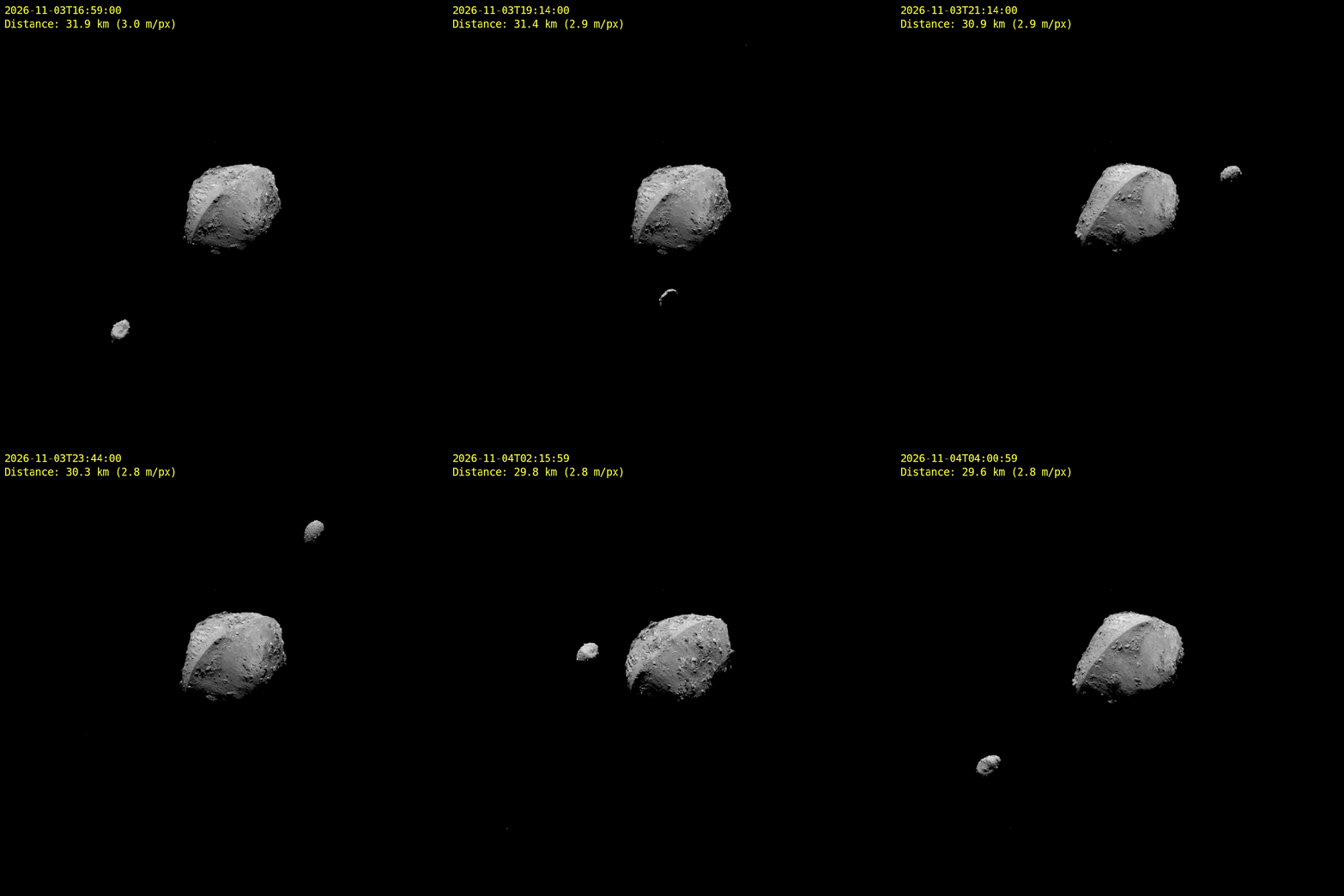
This animation shows the smaller moon Dimorphos orbiting the larger asteroid Didymos. The individual frames were taken 15 minutes apart. Because of mission-related 'observation breaks', the animation contains a gap of one hour. Here, Hera is mostly observing the northern hemisphere of Didymos. The impact crater left on Dimorphos by the DART impact becomes clearly visible as it orbits. At the bottom of the image, the smaller asteroid can be seen briefly dipping into the shadow of Didymos. The average distance between Hera and the asteroids is 31.6 kilometres. The spatial resolution is about three metres per pixel. The images that make up this animation were taken on 3 November 2026.
Credit:
ESA
The German Space Agency at DLR coordinates Germany's contributions to ESA with funding from the Federal Ministry of Research, Technology and Space (Bundesministerium für Forschung, Technologie und Raumfahrt; BMFTR). Germany is the largest financial contributor to the mission. The spacecraft was also developed and built in Germany.
One of the six international members of the mission's Science Management Board comes from the DLR Space Operations and Astronaut Training facility. The DLR Institute of Space Research in Berlin is the scientific lead for the Asteroid Framing Camera (AFC) system and for the Planetary ALTimeter (PALT-H) for altitude measurement on board Hera. The researchers also play a leading role in analysing the mission data. For example, the Berlin-based institute co-leads the working group analysing the AFC images and is directly responsible for the scientific analysis of the asteroids' shape and morphology.
The camera system is designed with redundancy, meaning there are two identical cameras on board Hera. These were developed by Jena-Optronik and are operated by ESA in close coordination with DLR. The AFC captures black-and-white images in the visible part of the spectrum. In addition to their scientific use, these images are also used to navigate the spacecraft. DLR's tasks include planning the scientific observations, in-flight calibration and generating data products such as topographic models of the asteroids' shapes and maps.
How dangerous are asteroids to Earth?
Earth's history has repeatedly shown how dangerous asteroids can be. On 15 February 2013, for example, approximately 1500 people were injured when an asteroid 20 metres in diameter entered Earth's atmosphere near the Russian city of Chelyabinsk. Although most of it vaporised, its remnants broke apart at an altitude of 30 kilometres. This triggered a shockwave that shattered countless windows, causing the injuries.
A larger object several kilometres in diameter would cause a far more violent impact. It could threaten entire continents and have existential consequences for humankind. One example of such an impact is the Chicxulub crater, which measures almost 200 kilometres across and is located in present-day Mexico. The crater is the remnant of the impact of an asteroid up to 15 kilometres across, which brought the age of the dinosaurs to an end 66 million years ago.
More than 42,000 near-Earth objects (NEOs) are currently known. Fortunately, none of them is on a collision course with Earth. However, new objects are constantly being discovered, such as the asteroid Apophis in 2004. In 2029, Apophis will pass Earth at a distance of just 31,750 kilometres – closer than satellites in geostationary orbit at an altitude of 35,786 kilometres. If the 350-metre Apophis were to strike Earth, the consequences would be extreme. However, such a collision can be ruled out with certainty for the 21st century. Nevertheless, the fact that it will pass so close to Earth shows that we must always be prepared for such objects.
Asteroid defence – the DART and Hera missions
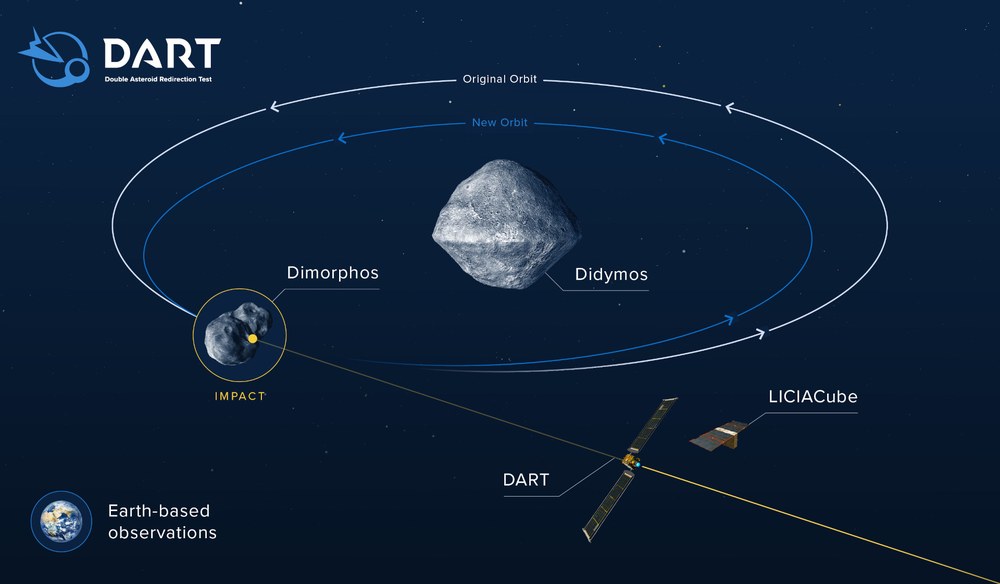
To develop methods that would enable humankind to counter such dangers effectively, NASA and ESA are conducting the joint Asteroid Impact & Deflection Assessment (AIDA) collaboration. AIDA consists of NASA's DART mission and ESA's Hera mission.
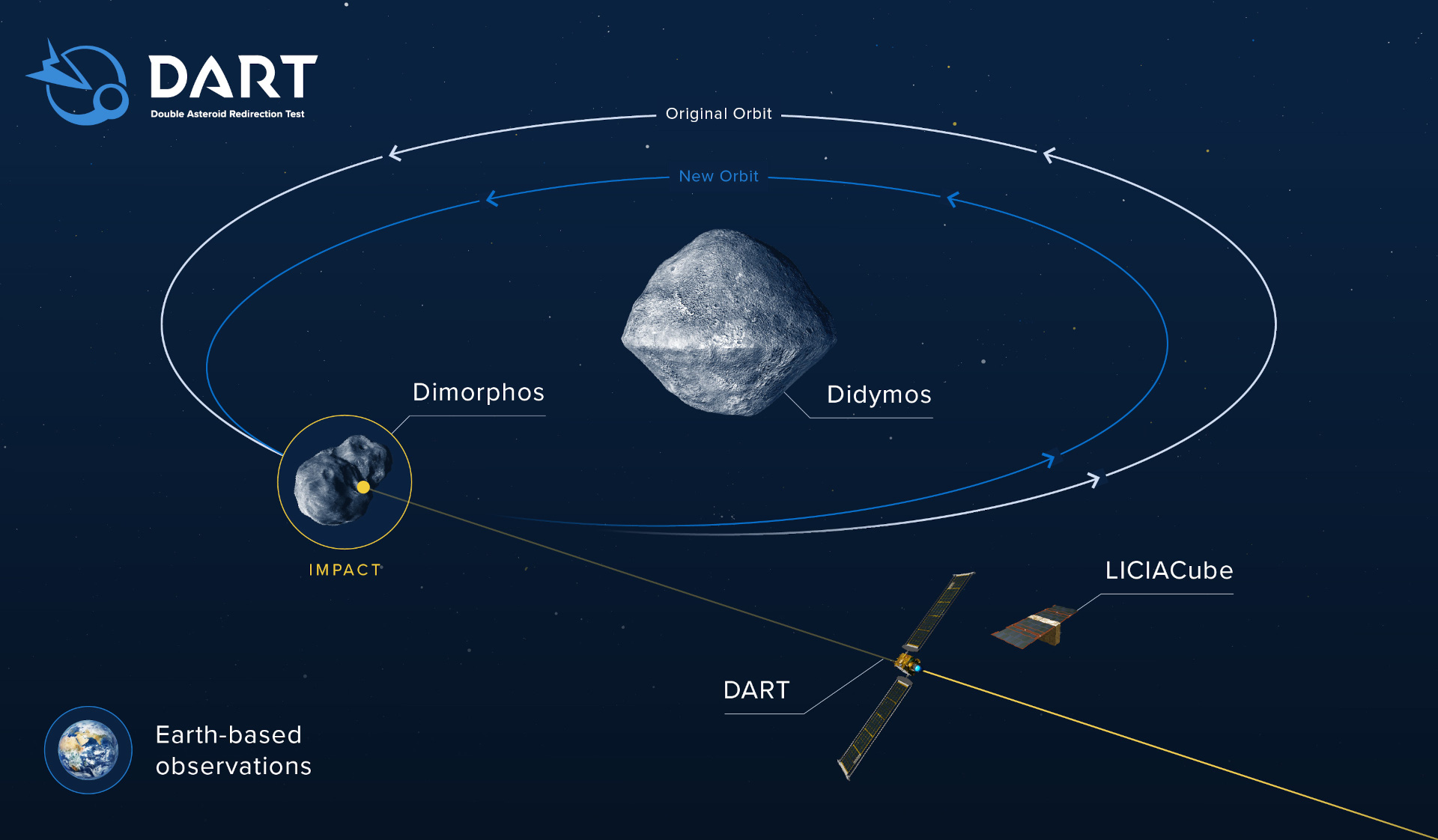
NASA led the way with the DART spacecraft, which flew first to Didymos and Dimorphos. The significantly smaller Dimorphos, approximately 150 metres in diameter, orbits the larger Didymos, which is approximately 730 metres in diameter. The aim was to alter the orbital period of the asteroid's moon, Dimorphos, through the targeted impact of the DART spacecraft. The binary asteroid was an ideal target because it does not cross Earth's orbit, meaning the test posed no risk whatsoever to Earth. In addition, Dimorphos is relatively small, so the impact of a spacecraft weighing just 570 kilograms was enough to measurably shift its orbit.
On 26 September 2022, DART struck Dimorphos in a controlled impact at a speed of over 22,000 kilometres per hour. Telescope measurements showed that its orbital period, originally 11 hours and 55 minutes, had been shortened by 33 minutes. This far exceeded expectations: calculations had predicted a reduction of only about ten minutes.
Hera maps Dimorphos and Didymos in 3D
The Hera science team will use the AFC images to compute a digital terrain model of the asteroids and search Dimorphos for changes caused by the DART impact. The name Dimorphos – meaning 'having two forms' – refers to its altered shape following the impact. The model is intended to show in detail how the impact changed Dimorphos – for example the size and shape of the crater, and whether the asteroid as a whole was reshaped.
Small satellites land on Dimorphos
Hera is also carrying two small satellites, known as CubeSats. Juventas and Milani are each the size of a shoebox. They will observe Dimorphos at close range and, in the final phase of the mission, even land on the asteroid to measure its surface, internal structure and gravity. The measurements will reveal the exact mass of Dimorphos, which is needed to understand precisely how effective DART's deflection was. The data obtained can then be used to calculate how other celestial bodies could be successfully deflected. Should an asteroid ever actually be on a collision course with Earth, this would provide important insights for a planetary defence mission. The data collected will also benefit asteroid research.
German technology in a European joint project
Germany is the largest financial contributor to the ESA mission, providing approximately 130 million euros – some 37 percent of the total. The Hera spacecraft was developed and built by OHB SE in Bremen. A newly developed antenna made of carbon-fibre-reinforced plastic was supplied by the Munich-based company High Performance Space Structure Systems (HPS). The two AFC cameras come from Jena-Optronik. The PALT-H laser rangefinder, which is used for both navigation and science, also comes from Jena, from the company Jenoptik. Both systems are under the scientific leadership of the DLR Institute of Space Research in Berlin. Dresden University of Technology played a key role in developing the Juventas Radar (JuRa) experiment on the Juventas CubeSat. Researchers from DLR and other German institutions are also part of the Hera science team, analysing the scientific data gathered by the mission.