Day 100 – the SOLIS100 isolation study comes to an end
August 7, 2026 | Research for future space missions
Day 100 – the SOLIS100 isolation study comes to an end
Opening the doors to the SOLIS100 'space station'
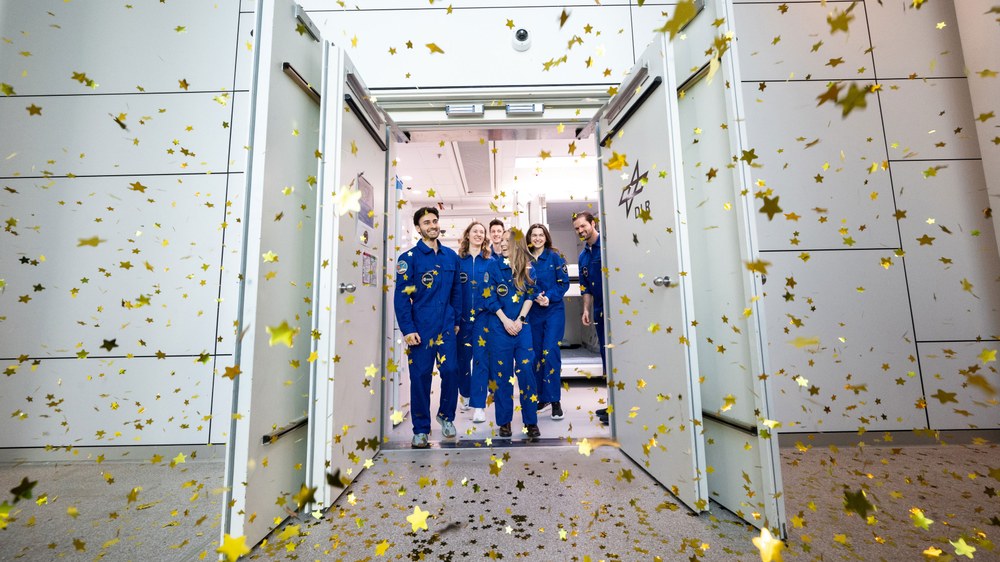
For 100 days, the heavy double doors of the SOLIS100 M5 module remained shut at :envihab, the high-tech research facility of the DLR Institute of Aerospace Medicine in Cologne. On 1 August 2026, they opened at 09:13 CEST to welcome 'home' the six-member international crew of terrestrial astronauts.
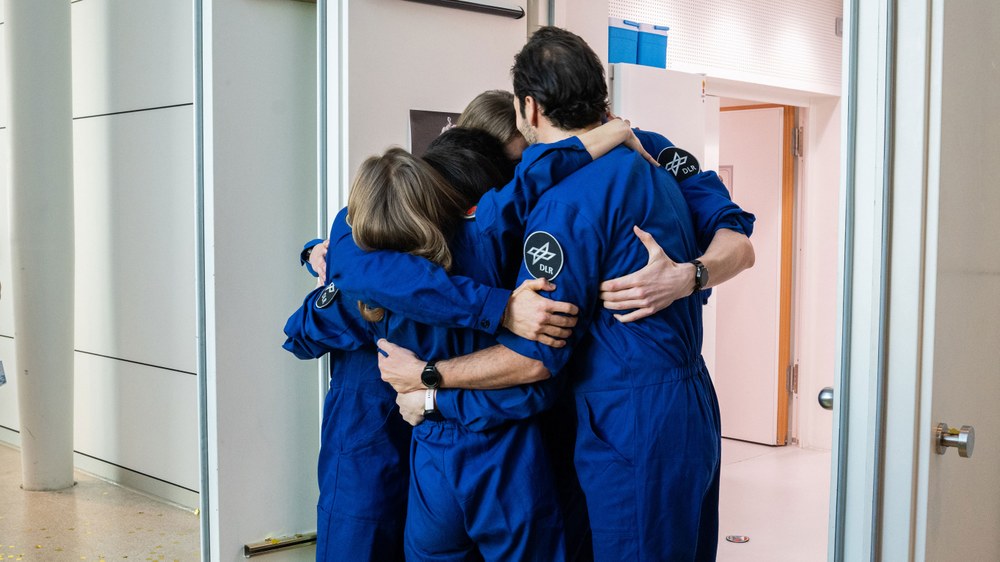
After more than three months cut off from the outside world, living under strict rules and with the limited resources of a space mission, the six participants of the SOLIS100 isolation study – conducted by DLR in Cologne on behalf of the European Space Agency (ESA) – were delighted.
Creativity was required during 100 days of complete isolation
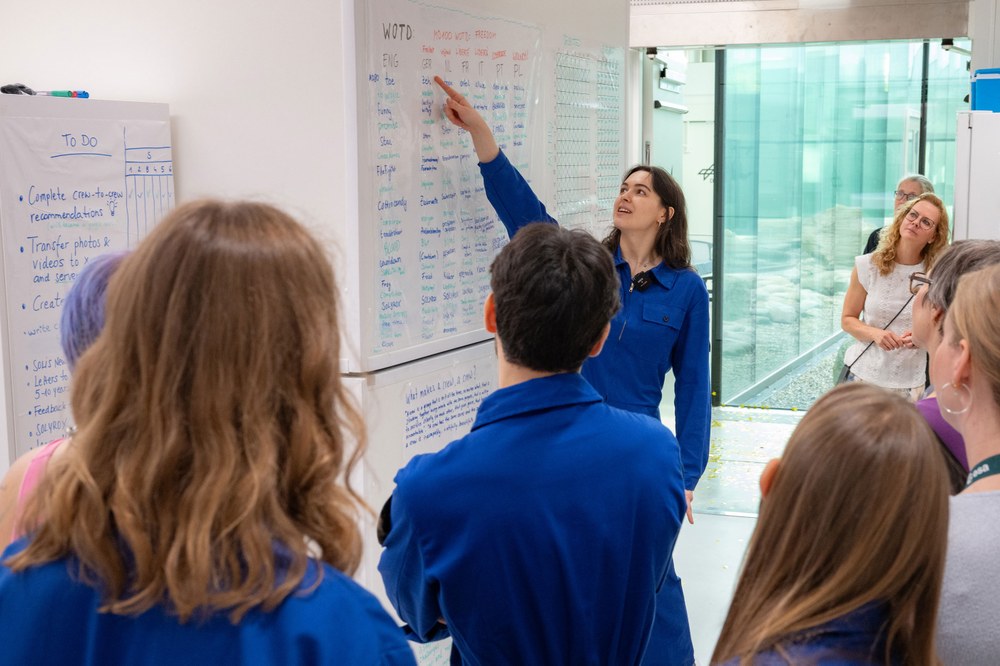
How do you say 'countdown' in the six languages of the terrestrial astronauts? One way the international crew found to pass the long period of isolation in the SOLIS100 study was to learn vocabulary.
The ESA SOLIS100 study was carried out at DLR's :envihab facility in Cologne.
The doors to the 'space station' reopened on 1 August 2026, followed by a one-week recovery phase.
SOLIS100 investigates the effects of isolation on humans.
Focus: Space, exploration, space medicine
One hundred days of isolation are over and the SOLIS100 crew have left their 'space station', bringing to a close 100 days in a confined environment, without sunlight, friends or family. Six men and women spent more than three months cut off from the outside world. They had to comply with strict rules and cope with the limited resources of a space mission. What effects does this have on wellbeing, performance and health? This is the focus of the SOLIS100 isolation study, conducted by the German Aerospace Center (Deutsches Zentrum für Luft- und Raumfahrt; DLR) in Cologne on behalf of the European Space Agency (ESA).
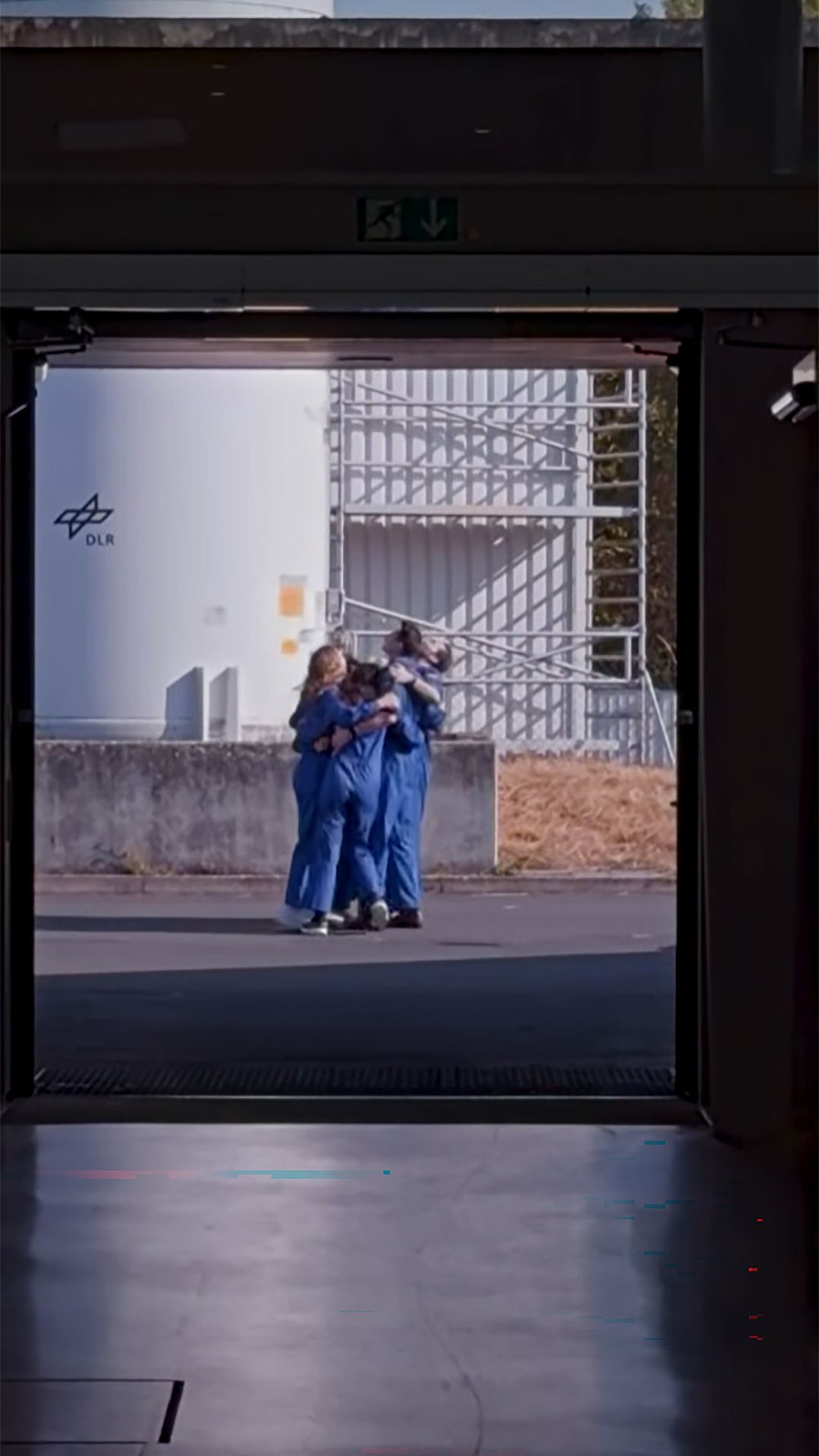
At 09:13 CEST on 1 August 2026, the heavy double doors at :envihab, DLR's aerospace medicine research facility, swung open at last. What was the crew's first, spontaneous assessment? A supportive, adaptable, complementary and tolerant team that sticks together is crucial to success. Contact with and support from family and friends create a sense of connection. Open and transparent communication is crucial. A balance between structure, discipline and fun makes the day fly by. These are some initial conclusions the crew noted down. The crew's first steps took them outside, onto a meadow in the sunshine. They were also welcomed with fresh fruit, croissants and coffee, which were much appreciated.
Over the following days, the crew continued to spend time together, albeit outside the SOLIS100 module and under significantly less strict rules. For example, family and friends came to visit, meals could be chosen freely and personal mobile devices could be used again. This period is also part of the study and focuses on responses to the end of isolation. On 7 August, the crew members returned to their familiar surroundings and their everyday lives. Data is now being analysed by 23 participating research teams.
Future long-duration missions in extreme conditions
"Future space missions will leave Earth orbit and target distant destinations such as the Moon or Mars. As this involves long mission durations with limited resources, far away from familiar social environments, it is important to prepare astronauts for the psychological and physical challenges," says Anke Pagels-Kerp, DLR Divisional Board Member for Space. "Missions to the Moon and Mars require mental and physical resilience, independence and the ability to cope in isolated and confined environments. To carry out such missions successfully and ensure the safety of astronauts, we are researching the effects of these extreme conditions."
Youtube Short: After 100 days in isolation, the SOLIS100 crew is back outside
Your consent to the storage of data ('cookies') is required for the playback of this video on Youtube.com. You can view and change your current data storage settings at any time under privacy.
Youtube Short: After 100 days in isolation, the SOLIS100 crew is back outside
The six crew members were selected through a rigorous process. They had to meet many of the same requirements that apply to astronauts. During the 100 days, their only contact with 'mission support' was via an intercom system. Once a week, they were allowed a two-hour conference call with up to five previously designated people. The international SOLIS100 crew comes from Germany, France, Italy, the Netherlands, Poland and Portugal. The crew followed a daily routine similar to that of astronauts on a mission – they worked on scientific tasks, collected medical data, followed a strict exercise programme and were responsible for maintaining their station.
"SOLIS100 is a study that aims to establish standardisation. In other words, we want to have comparable data for future studies. This data will serve as a basis, for example, for researching measures that could help crews on long missions," says Amelie Therre, DLR project lead for SOLIS100. "Overall, we have taken into account many aspects that also apply to a real space mission. All the resources we provided at the start of the isolation period had to last." This included everyday items such as toilet paper and cleaning products, as well as food. There was no refrigerator available; instead, only a kettle and a microwave were provided for preparing meals. In addition, there was only non-perishable, packaged food – no fresh produce. The meals were balanced and the dietary plan worked well.
Crew selection and study duration
The study team first determined the physical and psychological suitability of the applicants through questionnaires, tests and detailed examinations at an assessment centre. As the language of the study was English, a very good command of the language was required. Including preparation and the subsequent recovery phase, which concluded on 7 August 2026, SOLIS100 lasted 126 days. The isolation phase began on 23 April 2026. During the week-long follow-up examinations, data was collected on physical and cognitive performance, mood, sleep and crew cohesion, among other things. The study team also recorded this information before and during the isolation period, enabling them to identify developments and the effects of isolation.
"To safely carry out future space missions, we need to develop completely new technologies that allow for autonomous medical support for crews. SOLIS100 is an excellent platform for this as well", adds Jens Jordan, director of the DLR Institute of Aerospace Medicine.
Background info: Life in a confined habitat
A trip to the Moon takes approximately three days. Going to Mars, astronauts travel for roughly six months – and that is only when Mars and Earth are in a favourable alignment. Anyone who spends months travelling in a spacecraft or living at a lunar base hundreds of thousands of kilometres away from Earth must cope with extraordinary conditions. They not only have to get along with their crewmates but also adapt to the limited space in the habitat and the distance from home, manage resources carefully and work effectively for the success of the mission. This is why the SOLIS100 study is investigating the psychological and physical effects associated with isolation and confined environments during long-duration missions.
The SOLIS100 crew's 'space station' is located in a laboratory – Module 5 – at :envihab. With :envihab, the DLR Institute of Aerospace Medicine has a facility that is unique in Europe. Here, world-leading studies are conducted into the effects of extreme environmental conditions on humans – such as microgravity, isolation and altered atmospheric conditions – to develop countermeasures. The aim is to improve health, performance and safety for people in space, aviation and on Earth.
The SOLIS100 study module is now available for other purposes, including 'direct return'. After returning from the International Space Station ISS, 'real' European astronauts also spend several days in the module undergoing scientific tests and readjusting to gravity.