ESA astronaut Sophie Adenot back in Cologne's gravity
October 10, 2026 | DLR mission doctor Hoyer accompanies Adenot to :envihab after ISS mission
ESA astronaut Sophie Adenot back in Cologne's gravity
Arrival in Cologne
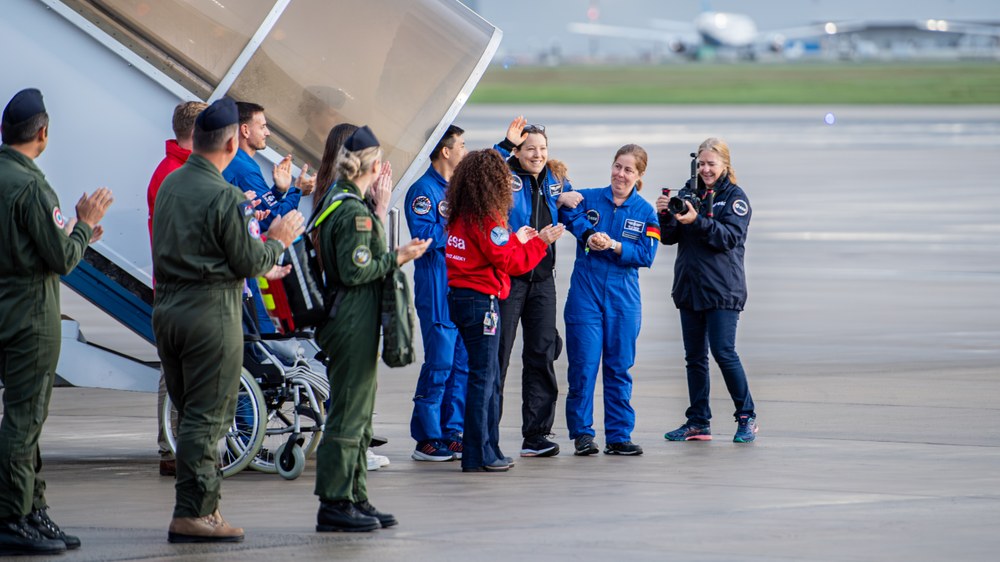
On the morning of 10 October 2026, ESA astronaut Sophie Adenot landed in Cologne. Close at hand to support her after almost eight months in weightlessness: the mission medical team comprising Bimba Hoyer (to Sophie’s right) and her Canadian colleague David Kim (left).
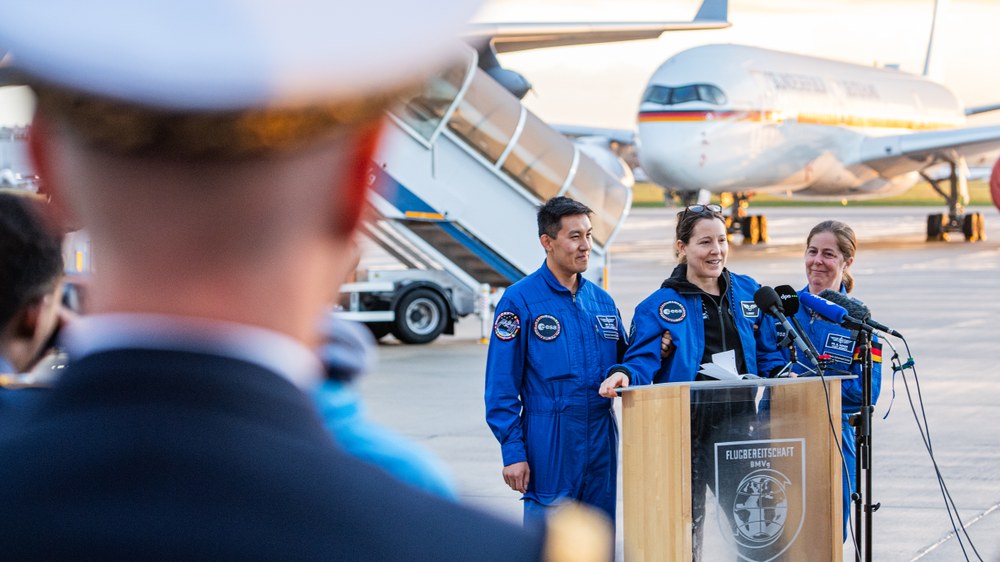
Happy, grateful and visibly moved: after her arrival in Cologne, French ESA astronaut Sophie Adenot spoke to the press and guests about her experiences, and her first reflections after almost eight months on the International Space Station ISS that were intense both mentally and physically. Weakened by the long time in weightlessness, she is supported by David Kim (left) and Bimba Hoyer (right), Adenot's two-person flight surgeon team.
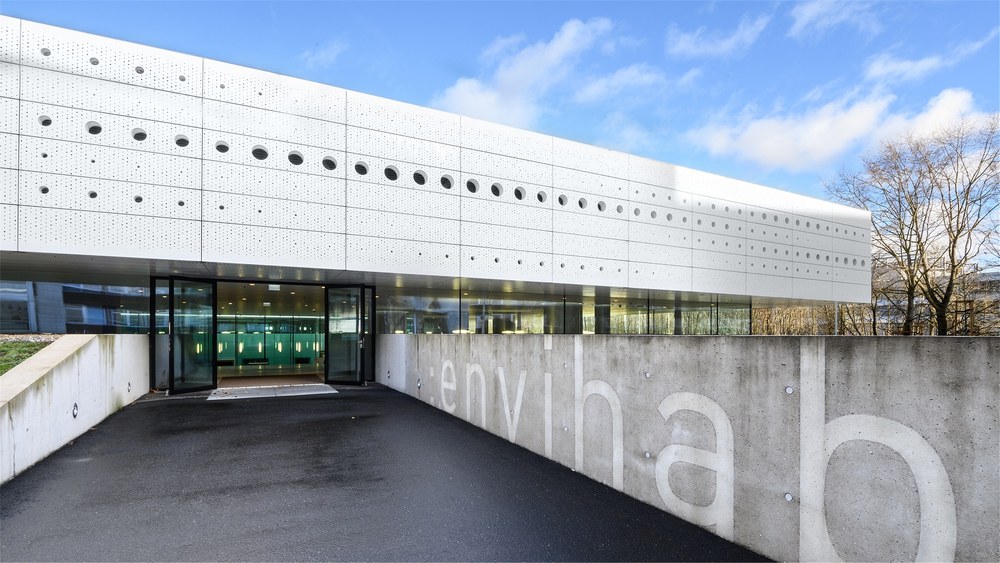
DLR's :envihab aerospace medicine research facility in Cologne
:envihab is a medical research facility of the DLR Institute of Aerospace Medicine. Research here examines how various environmental conditions affect people, and what countermeasures can be taken.
After almost eight months in weightlessness, the ESA astronaut Sophie Adenot returned to Earth on 8 October 2026.
Bimba Hoyer, Adenot's German mission doctor from DLR and ESA, is seeing her through the final stage of her mission: the Direct Return for medical follow-up care.
Direct Return takes Adenot – like almost all ESA astronauts since 2014 – to :envihab, DLR's aerospace medicine research facility in Cologne.
Adenot set off on 13 February 2026 aboard a SpaceX Crew Dragon capsule (Crew-12) for the Space Station.
Focus: Space, space medicine
Just a few days ago, the European Space Agency (ESA) astronaut Sophie Adenot of France was still floating inside the International Space Station ISS. Her εpsilon (Epsilon) mission lasted almost eight months. On three separate occasions, she had to leave the Space Station for a physically and mentally demanding EVA (extravehicular activity), with only a spacesuit between her and the vacuum of space. Now, a less spectacular but equally important part of Adenot's mission begins: her return to gravity. Following her splashdown, Adenot arrived at :envihab – the high-tech research facility of the German Aerospace Center (Deutsches Zentrum für Luft- und Raumfahrt; DLR) in Cologne – on 10 October 2026 as part of the Direct Return programme. There, experts from DLR and ESA are supporting Adenot during her first two weeks back on Earth. Right by her side: the astronaut's German mission doctor, Bimba Hoyer.
An astronaut's mission doesn't end with splashdown
Months in weightlessness have an enormous effect on the human body. Back on Earth, it must readapt slowly to gravity. Circulation, balance, muscles, coordination and the distribution of fluids throughout the body – physiologically, the return from weightlessness is demanding. "An important topic in space medicine is the eyes, which change in microgravity, for example in terms of visual acuity. Or the optic nerve can become thicker," explains Hoyer. "We check this and much more after the return to Earth. So, we know that coordination under 'normal' gravity is initially difficult. Walking round a corner suddenly becomes a challenge. And blood pressure also has to get used to the conditions down here again. These are the most important areas we address here at :envihab, alongside the back muscles, which simply don't have to work on the ISS."
Hoyer is a key point of contact for Adenot during this final phase of the mission too. The doctor from the DLR Institute of Aerospace Medicine and ESA has been supporting the astronaut throughout the entire mission in her role as flight surgeon, a role which extends far beyond routine medical duties. Hoyer acts as the link between 'her' astronaut, the ground-based medical team and the scientific, organisational and technical aspects of mission operations. During the EVA – several hours of intense activity, often somewhat irreverently called a 'spacewalk' (in German, 'Weltraumspaziergang', a 'space stroll') – Hoyer was connected live from NASA's control room in Houston, ready to respond at a moment's notice to any medical issues.
During her stay in space, Adenot carried out a wide range of scientific experiments across various disciplines, sometimes acting as the test subject herself and sometimes as the 'extended arm' of scientists on Earth. The experiments cover a broad spectrum of topics in medicine and physiology, physical performance, microbiology, Earth sciences and space technology.
Physiological stocktake – how is Adenot doing after more than six months in space?
During her mission, Sophie Adenot became the European astronaut with the longest-duration single spaceflight. In early September 2026, she passed the 200-day mark in orbit. She also completed three spacewalks within 15 days, clocking up a total of almost 20 hours of EVA time. These are all feats of physical endurance achieved in microgravity.
Not every physical change following months in space constitutes a medical problem upon return to gravity. Much of it is part of the expected physiological adaptation resulting from a long-term mission, for which there is a specialised, well-established training programme designed to help astronauts readjust to gravity.
While raw examination data and measurements are important, they do not, on their own, provide a complete medical picture. What does the astronaut herself report? Does she have any complaints? Which subjective observations can be linked to the medical data? The Direct Return programme usually lasts between 10 and 14 days. Here, too, the mission doctor's special role and close relationship come into play; Hoyer has got to know Adenot very well and has learnt to assess her condition over the entire period. Hoyer and Adenot first came together 21 months before the launch in February this year – long enough for a trusting relationship to grow. And so, with their holistic approach and the sophisticated programme at :envihab, Adenot, Hoyer and the team from DLR and ESA will bring the εpsilon mission to a successful conclusion, both scientifically and medically.
Direct Return – from space to Cologne and DLR
For years now, teamwork between DLR and ESA has characterised the care of European astronauts at DLR's :envihab aerospace medicine research facility immediately after landing. Alexander Gerst was the first ESA astronaut, in 2014, to return directly to Cologne from his Space Station mission, 'Blue Dot'.
For the astronauts, :envihab is not only the place where the experiments and examinations take place – it is home for their first days back on Earth. Facilities for the crew and family members are comfortable, with bedrooms, a living area, a kitchen and bathrooms in a private, self-contained area offering a place of retreat after the excitement of spaceflight.
As well as helping the returning crew members readjust to life on Earth, a Direct Return always involves further scientific and medical experiments. Carrying out these experiments is just as much a part of the mission as the stay on the Space Station.
The aim of the work at :envihab is to gather ever-better information about the effects of microgravity on the human body. On this basis, training programmes are developed for before, during and after the stay in space, along with other suitable countermeasures to the negative effects of microgravity.