
'International Charter: Space and Major Disasters' wins IAF World Space Award

International Astronautical Federation
- The purpose of the Charter is to provide satellite data rapidly to support disaster relief worldwide.
- It was founded in 2000 and has 17 member organisations.
- DLR has been a member of the Charter since 2010.
- On 5 October 2026, the World Space Award was presented at the International Astronautical Congress (IAC).
- Focus: Space, Earth observation, disaster relief, collaboration
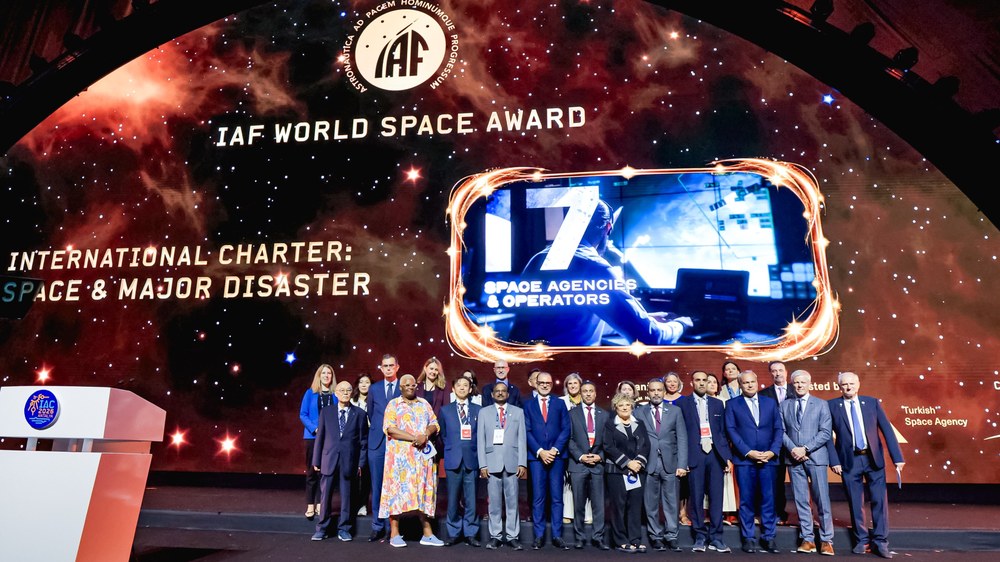
For more than 25 years, the 'International Charter: Space and Major Disasters' has been providing satellite data rapidly, worldwide and free of charge whenever disasters strike, supporting civil protection and relief organisations in their work. In recognition of this commitment by its 17 member organisations, the Charter received the World Space Award of the International Astronautical Federation (IAF) on 5 October 2026. The award was accepted by representatives of the member organisations, including Walther Pelzer, member of the Executive Board of the German Aerospace Center (Deutsches Zentrum für Luft- und Raumfahrt; DLR) and director general of the German Space Agency at DLR.
The German Space Agency at DLR coordinates Germany's contribution to the Charter. As a research organisation, DLR ensures the technical and operational integration of German Earth observation missions and contributes its expertise to the Charter's operational work. Through this joint contribution, the Charter provides data from the TerraSAR-X and TanDEM-X radar satellites and from the German hyperspectral satellite EnMAP (Environmental Mapping and Analysis Program), among others. In future, thermal data is also to be provided by the German company OroraTech, which operates satellites capable of rapidly detecting forest fires.
"We are delighted to receive this award – it shows that space technology can help to tackle global challenges. We are proud to be part of an international community that uses satellite data to support disaster relief worldwide and help protect lives. For more than 25 years, the Charter has demonstrated what international cooperation in space can achieve in practice", says Pelzer.
Disaster relief from space
Since its founding in 2000, the Charter has been activated more than 1000 times in approximately 150 countries in response to natural disasters and technological accidents. In crisis situations, it provides satellite data promptly. This data is used, for example, to map the disaster-affected areas, helping authorities and emergency responders on the ground to protect lives, infrastructure and the environment. The Charter has thus become a prominent example of how space contributes to global disaster resilience.
The Charter is also an outstanding example of international collaboration: its members coordinate global access to satellite resources for humanitarian purposes on an entirely voluntary basis. The data is available free of charge to every country in the world, including those without a space programme of their own. This promotes fair, global access to the benefits that space offers for people's lives on Earth.
Thanks to many years of collaboration and coordination with international organisations – including the United Nations and the Emergency Management Service of the EU's Copernicus Earth observation programme – as well as with civil protection authorities worldwide, the Charter has become an important part of global disaster relief.
The International Astronautical Federation's World Space Award
Since 2013, the IAF has presented the World Space Award at the annual International Astronautical Congress to an individual or team that has made an exceptional contribution to the advancement of global space activities over an extended period. Based in Paris, the IAF is an international organisation for the promotion of space activities. It was founded in 1951 as a non-governmental organisation to establish dialogue between scientists worldwide and to lay the foundations for international cooperation in space. It has more than 600 members from 82 countries, coming from space agencies, companies, universities, professional associations, museums, government organisations and scientific societies.