Network strengthens resilience of critical space capabilities
February 13, 2026 | European project brings together 40 institutions and companies
Network strengthens resilience of critical space capabilities
REACTS – a European network for Responsive Space
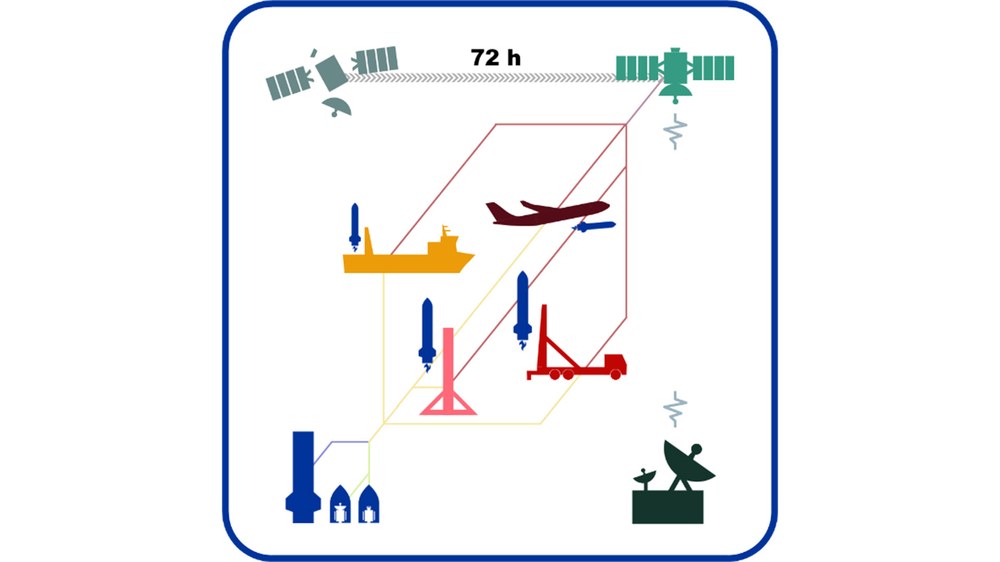
Under DLR's leadership, 40 institutions and companies from 13 EU countries and Norway worked together with a shared goal: to pave the way for a future European network capable of placing satellites into low Earth orbit and transmitting initial data within 72 hours.
One of the key questions addressed in the REACTS project was how satellites can be placed into orbit and their initial data transmitted back to Earth – all within 72 hours.
If space assets fail, small satellites launched at short notice can fill the resulting gaps.
This European Defence Fund (EDF) project was led by the Responsive Space Cluster Competence Center (RSC3) at DLR.
Focus: Security, space, responsive space
'Mission accomplished' is a phrase often used in spaceflight. It also applies to the REACTS (Responsive European Architecture for Space) project, which has now concluded. Under the leadership of the German Aerospace Center (Deutsches Zentrum für Luft- und Raumfahrt; DLR), 40 institutions and companies from 13 EU countries plus Norway worked together on a shared goal: to pave the way for a future European network capable of placing satellites into low Earth orbit (LEO) and transmitting initial data within 72 hours.
This would allow gaps resulting from the shortage, failure or impairment of existing space assets to be closed rapidly. Three days is an extremely short timeframe in which to launch and commission a satellite; normally, satellite missions and launches are planned months or even years in advance. REACTS is a project funded by the European Defence Fund (EDF).
Meeting short-notice needs
Over the course of two years, the project focused on developing a shared vision, as well as on interfaces, operational concepts and, for example, simulating case studies. All of the areas examined contribute to the establishment of a European architecture for a Responsive Space System (RSS). 'Responsive Space' refers to the ability to meet needs at short notice – either by launching small satellites or by reconfiguring space systems already in operation.
"The results of the project will lay the foundation for an interoperable, holistic European network for Responsive Space systems capable of launching satellites and delivering data in just 72 hours. This achievement was only possible thanks to the cooperation, innovation and commitment of every single European team member involved in the project," reports DLR's Responsive Space Cluster Competence Center (RSC3). RSC3 led REACTS – a project funded by the EU through the European Defence Fund (Grant Agreement EDF-2022-101121212-REACTS).
This project has received funding from the European Defence Fund (EDF) under grant agreement EDF-2022-101121212-REACTS