Off to the moons of Mars – MMX mission and Idefix® rover ready for launch
September 1, 2026 | German-French lander to fly with Japanese space probe on historic mission
Off to the moons of Mars – MMX mission and Idefix® rover ready for launch
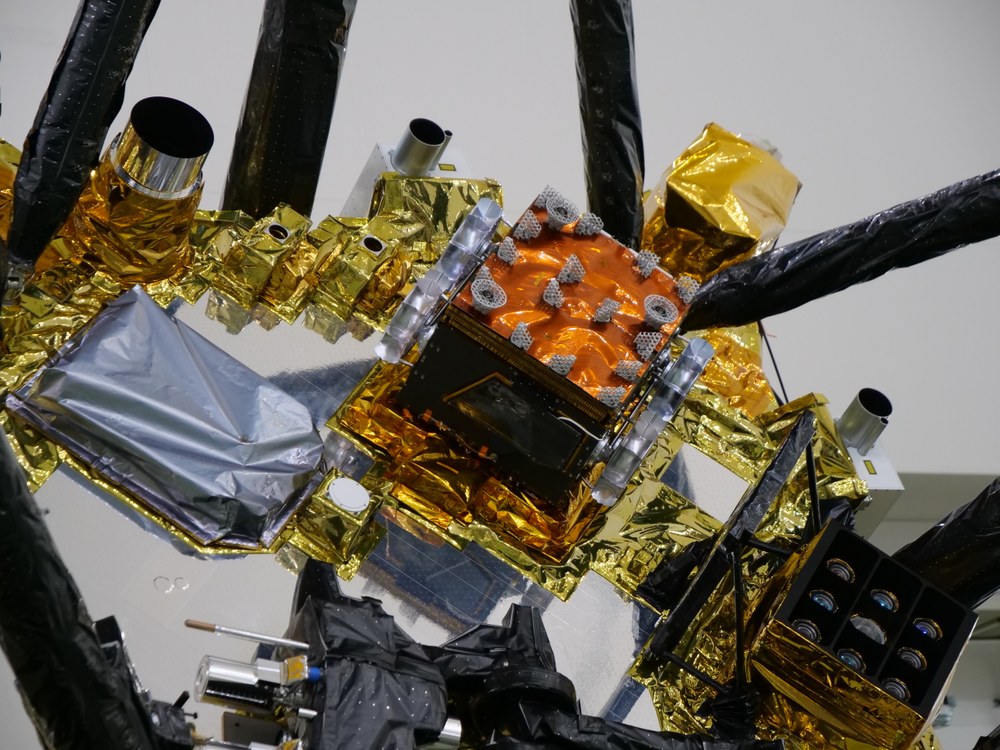
The Idefix® rover securely mounted between the landing legs of the MMX space probe
Idefix®, roughly the size of a crate of drinks, is clearly visible in its travel position between the probe's landing legs. Despite its compact size, Idefix® has essentially all the elements of a fully fledged science rover, though its highly integrated design keeps its mass to just 25 kilograms.
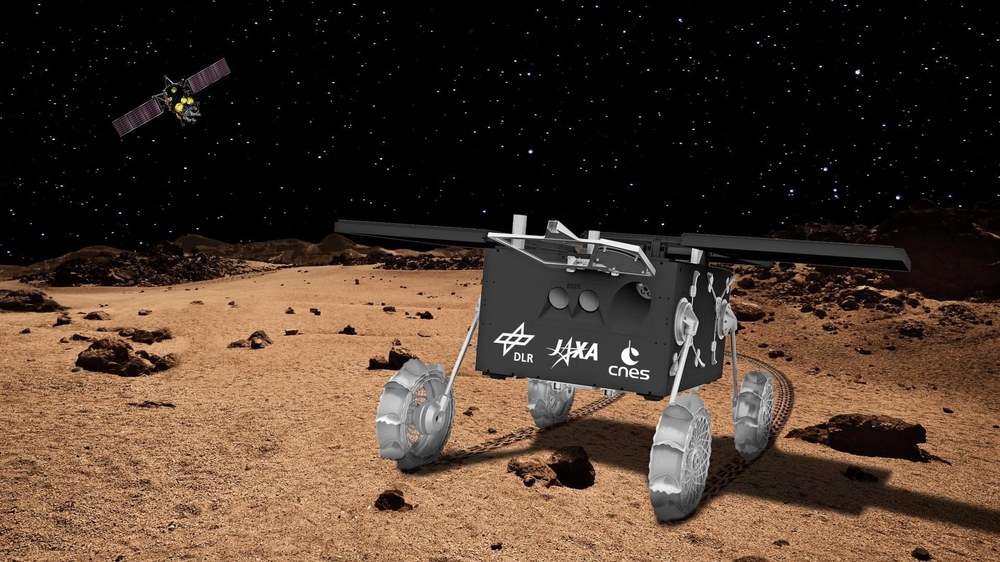
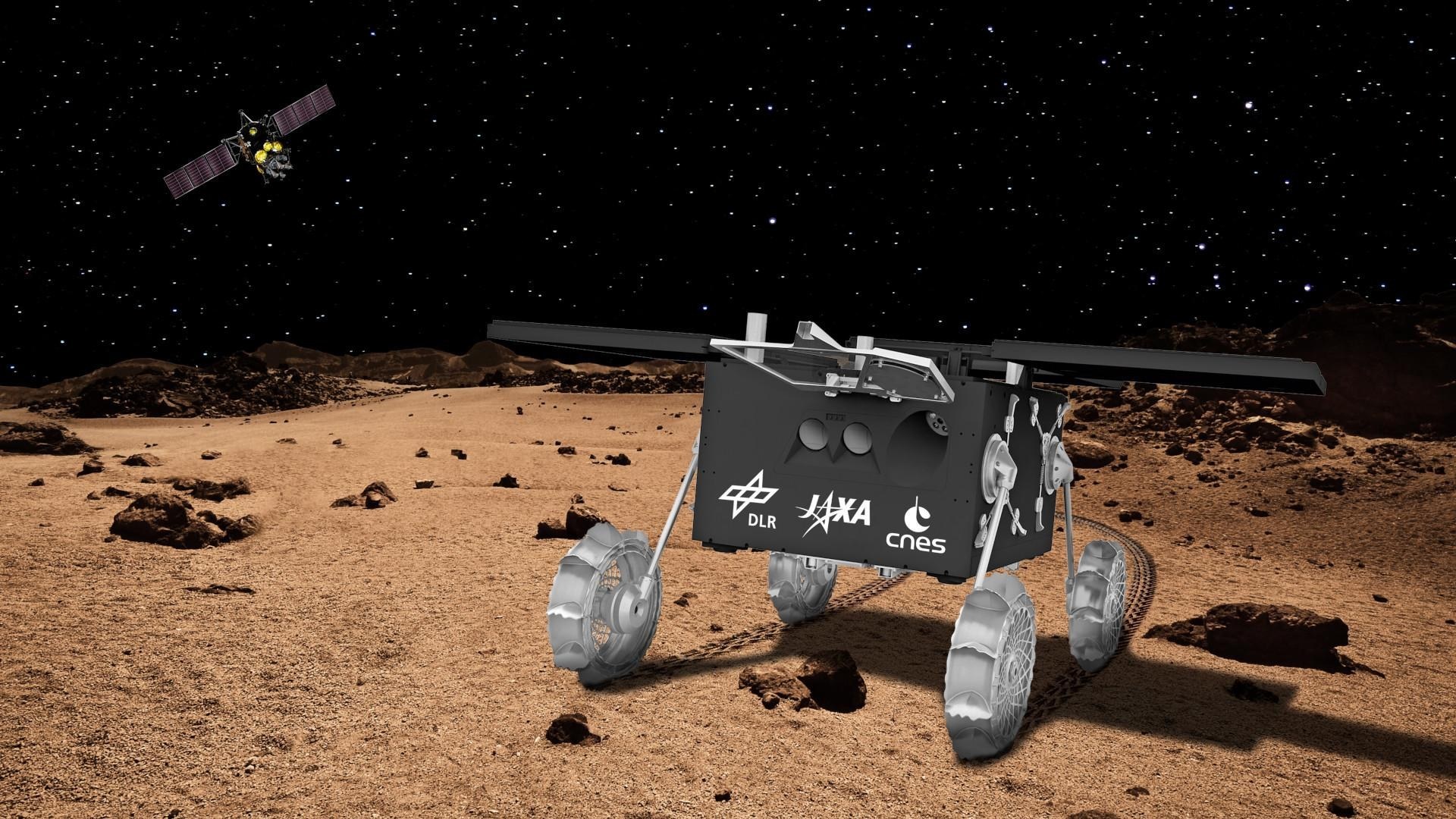
Arrived at its destination: After being released by the mothercraft (in the background) and falling to Phobos' surface, the MMX rover – Idefix® – has righted itself and powered up. Now it is ready to explore the Martian moon.
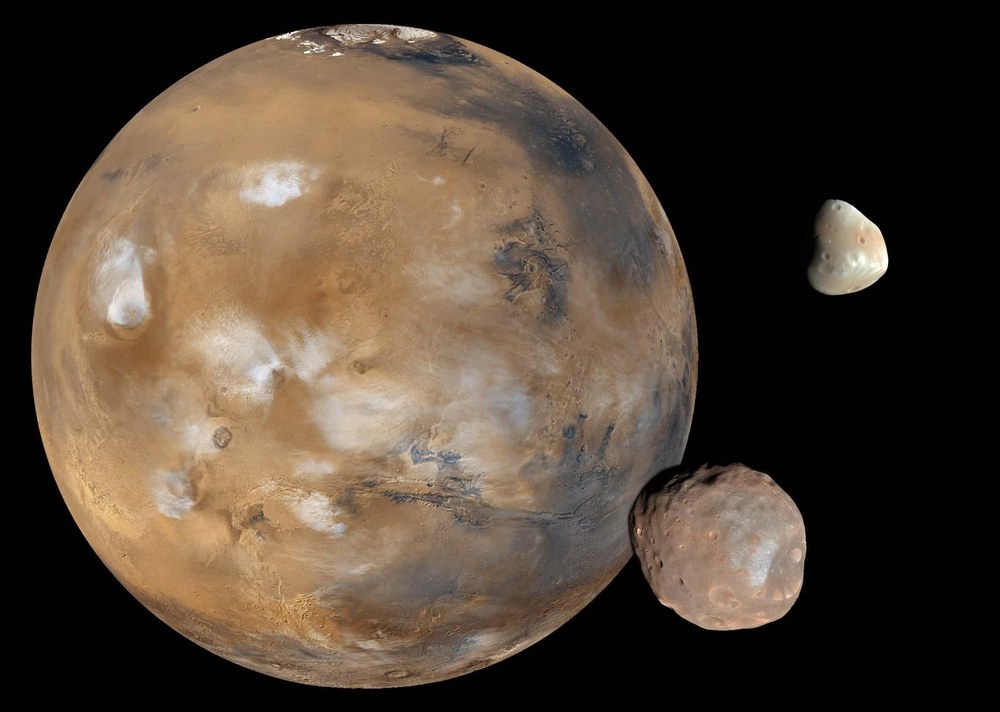
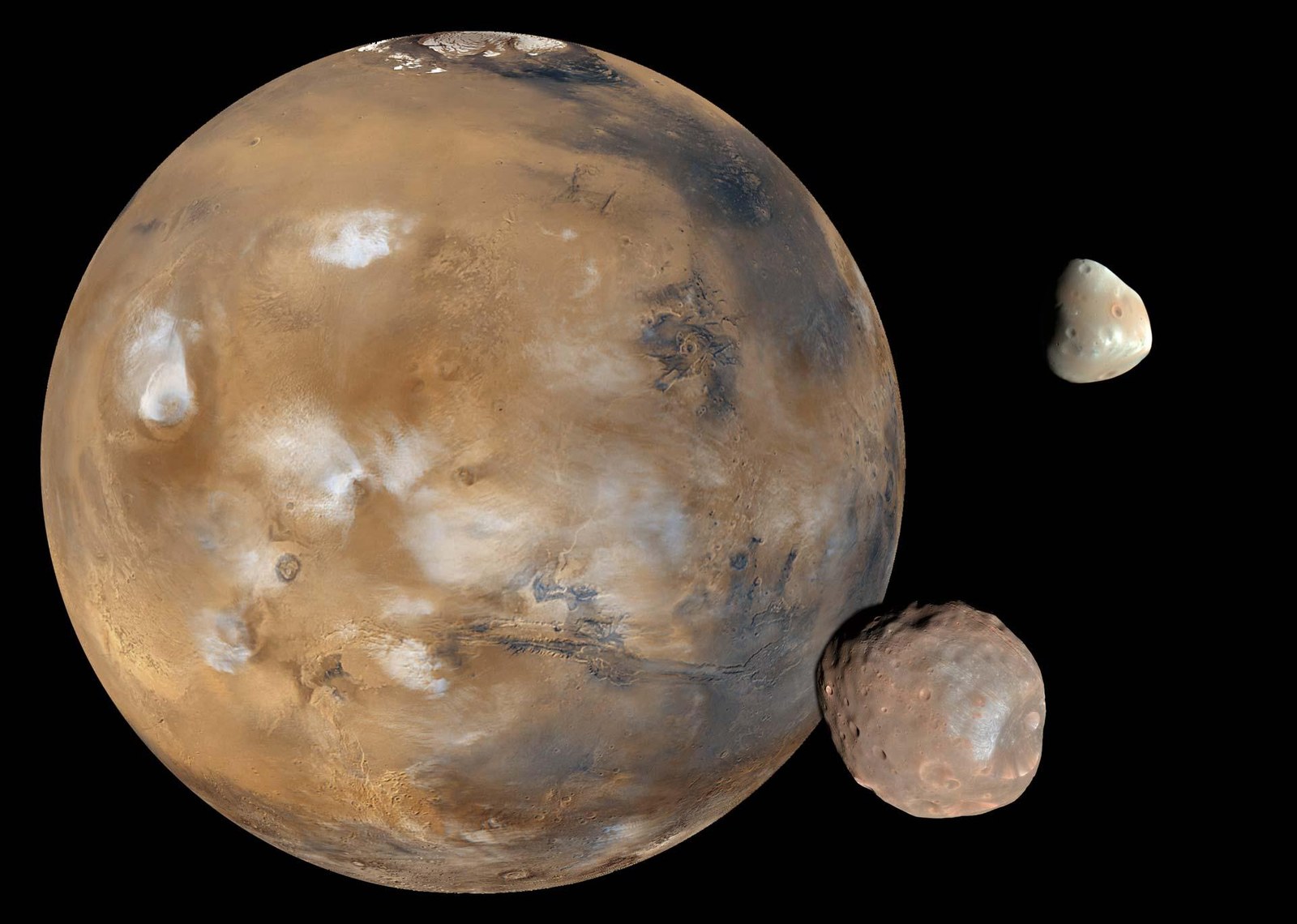
The two Martian moons Deimos (top) and Phobos are the targets of the MMX mission. Owing to their small size (diameter: Phobos 27 kilometres, Deimos 15 kilometres), both moons are irregularly shaped. Their origin remains an unsolved mystery in planetary research. (Photo montage)
The launch of the MMX mission is scheduled for 19 October 2026. The launch window to Mars extends until 7 November 2026.
As part of the MMX mission, the German-French rover Idefix® will land on the Martian moon Phobos in 2029.
Japan and France are important strategic collaborating countries for DLR.
Focus: Spaceflight, robotics, exploration, Mars
The MMX (Martian Moons eXploration) space probe will launch for Mars on 19 October 2026 at 21:41 CEST. This was recently announced by the Japan Aerospace Exploration Agency (JAXA). It is the largest Japanese mission to the Solar System to date: it will be the first in the world to land on the Martian moon Phobos, and in 2031 will bring the first samples ever obtained from Phobos – and therefore from the Mars system – back to Earth. An important part of the mission is the German-French rover Idefix®, which will be the first lander ever to touch down on Phobos, in 2029, exploring its surface at close range for 100 days. In August, JAXA presented the completed space probe, with the rover mounted, to the public at the Tanegashima Space Center, in the presence of the German Aerospace Center (Deutsches Zentrum für Luft- und Raumfahrt; DLR). DLR and the French space agency CNES (Centre national d'études spatiales) have jointly contributed Idefix®. Final launch preparations are now under way, with the space probe being mounted on JAXA's powerful new H3 rocket, which will carry MMX to the Mars system. The launch window to Mars extends until 7 November 2026.
"Our rover Idefix® and the MMX spacecraft of our Japanese collaborators are beginning their journey into the Mars system as a single unit. Only at Phobos will their paths separate. There, Idefix® will make history – as the first rover ever to leave tracks on a moon of Mars," says DLR project leader Markus Grebenstein and CNES project leader Julien Baroukh.
Idefix® – German-French rover for the Martian moon Phobos
As early as 2022, DLR completed the partially assembled Idefix® rover and two instruments. It was then fully assembled at the French space agency CNES in Toulouse, and further instruments and components were added. After completion in July 2023, Idefix® successfully underwent space qualification testing. The focus was on its flawless functioning, as well as its resistance to the vibrations of a rocket launch and to the extreme temperatures on Phobos, ranging from minus 170 degrees Celsius to 70 degrees Celsius. From 2024, the rover began to be integrated into the MMX mothership in Japan. In August 2026, JAXA presented the completed space probe to the public. Idefix®, roughly the size of a crate of drinks, could clearly be seen in its travel position between the probe's landing legs. What makes the Idefix® rover special is its extremely compact design. Idefix® essentially has all the elements of a fully fledged science rover, but thanks to its highly integrated construction, it has a mass of just 25 kilograms. Owing to its low weight and Phobos' low gravity, Idefix® will be able to land directly on the surface without the help of a landing vehicle.
Around the turn of 2028/2029, the MMX mothership is expected to release the Idefix® rover into free fall towards Phobos from a height of approximately 40 metres above the surface. Once it has landed, it will right itself autonomously and will then be ready for the roughly three-month mission phase on the Martian moon. On the surface, Idefix® will specifically search out and analyse scientifically interesting areas of Phobos. In doing so, Idefix® is breaking new technical ground, as no wheeled exploration vehicle has ever driven on a celestial body with gravity of less than a thousandth that of Earth. The rover's preliminary survey of the surface will also later help ensure that the mothership is as well prepared as possible to land on Phobos to collect samples.
"More than a decade ago, we began the MMX journey. Through countless challenges, the dedication and ingenuity of scientists and engineers across Japan and around the world have brought us to this moment. Seeing MMX lift off will be an emotional milestone for all of us," says Yasuhiro Kawakatsu, MMX Project Manager at JAXA.
How did the Martian moons Phobos and Deimos form? The international Martian Moons eXploration (MMX) sample-return mission aims to answer this question. Developed by the Japanese space agency JAXA, the space probe of the same name will explore Phobos from orbit and collect samples, while the Idefix® rover – a collaboration between the German Aerospace Center (DLR) and the French space agency (CNES) – analyses the surface properties and identifies a suitable landing site for the MMX mothership. The mission is expected to launch from the Tanegashima Space Center in Japan in 2026. This animation shows the planned course of the mission – from sample collection in orbit to the rover's exploration of the surface.
Animation: MMX mission – The journey to the Martian moon Phobos
Your consent to the storage of data ('cookies') is required for the playback of this video on Youtube.com. You can view and change your current data storage settings at any time under privacy.
Animation: MMX mission – The journey to the Martian moon Phobos
How did the Martian moons Phobos and Deimos form? The international Martian Moons eXploration (MMX) sample-return mission aims to answer this question. Developed by the Japanese space agency JAXA, the space probe of the same name will explore Phobos from orbit and collect samples, while the Idefix® rover – a collaboration between the German Aerospace Center (DLR) and the French space agency (CNES) – analyses the surface properties and identifies a suitable landing site for the MMX mothership. The mission is expected to launch from the Tanegashima Space Center in Japan in 2026. This animation shows the planned course of the mission – from sample collection in orbit to the rover's exploration of the surface.
MMX – Japanese space probe to explore the moons of Mars
The launch of the MMX mission is scheduled for 19 October 2026, with a 19-day launch window to Mars. After a flight of approximately one year, the MMX probe will reach Mars in the second half of 2027 and enter orbit around the planet. The exploration module's eight scientific instruments will then begin mapping and characterising the surfaces of Phobos and Deimos. To meet the mission's extensive requirements, the Japanese space agency JAXA has opted for a three-module design for the probe – the most massive Japanese interplanetary space probe to date: a powerful propulsion module handles the transfer to Mars and braking manoeuvres there; an exploration and landing module carries the scientific instruments, including telescope cameras, spectrometers and the German-French rover Idefix®; and a return module, including the re-entry capsule with its thermal protection shields, brings the probe back to Earth.
Where did 'fear' and 'terror' come from?
Besides our Moon, Phobos and Deimos are the only other two moons in the inner Solar System. They are much smaller than the Moon and not spherical, but irregularly shaped. Phobos has a maximum diameter of just under 27 kilometres, while Deimos measures just 15 kilometres. Both moons of our neighbouring planet were named Phobos and Deimos after their discovery in 1877 by the American Asaph Hall. In Homer's 'Iliad', they are two brothers who accompany Ares, the Greek god of war (the equivalent of Mars, the Roman god of war). Approximately 150 years after their discovery, the origin of the Martian moons remains an open question: are they captured asteroids, or did they form after a massive meteorite impact on Mars? MMX aims to help answer this question and uncover the history of Phobos and Deimos.
The formation of the Martian system is also key to better understanding the processes of planet formation in the Solar System as a whole. In any case, traces of Martian rock are likely to be found on the surface of Phobos, having landed there as ejected material from later asteroid impacts on Phobos. This means that, together with the samples from Phobos, material from Mars could also make its way to Earth in the return capsule – and from there into terrestrial laboratories.
MMX is a mission led by the Japanese space agency JAXA, with contributions from NASA, ESA, the French space agency (CNES) and the German Aerospace Center (DLR). DLR and CNES jointly contribute a 25-kilogram rover. The German-French MMX rover – Idefix® – was designed and built under the joint leadership of the two agencies. DLR is responsible in particular for developing the rover's chassis, including its carbon-fibre structure, as well as the righting and locomotion system. DLR is also contributing the docking and separation system connecting the rover to the mothership, along with two scientific experiments: a Raman spectrometer and a radiometer. These will measure the composition, temperature and texture of the surface of Phobos.
CNES is making significant contributions with camera systems for spatial orientation and surface exploration, as well as for investigating the mechanical properties of the ground. CNES is also developing the rover's central service module, including its onboard computer and its power and communication system. After the launch of the MMX mission, the rover will be operated from control centres run by CNES in Toulouse, France, and DLR in Cologne.
The MMX mission continues a long-standing and successful collaboration between JAXA, DLR and CNES. It builds on the precursor mission Hayabusa2, in which JAXA sent a space probe to the asteroid Ryugu carrying the German-French lander MASCOT (Mobile Asteroid Surface Scout). MASCOT landed on Ryugu on 3 October 2018 and sent back spectacular images of a fascinating, rugged landscape of rubble and rocks. Hayabusa2 collected samples from Ryugu and brought them back to Earth on 6 December 2020.