
A universe within the Atom

asbl Atomium – Axel Addington
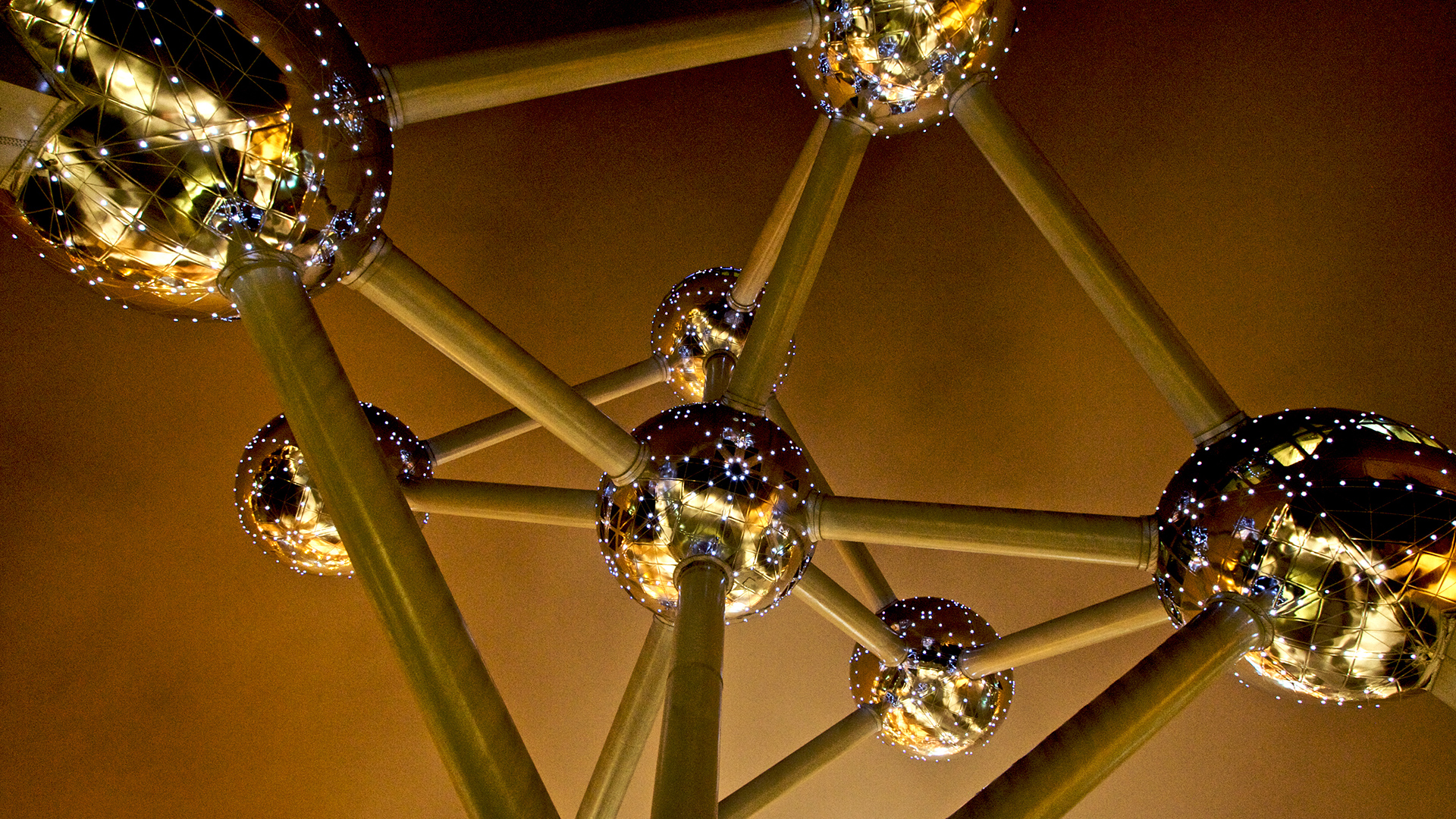
Through a sepia-tinted window, the panoramic view falls on the iconic central building of the Brussels Expo site – originally constructed as the centrepiece of the 1958 Brussels World's Fair. A giant, silver-shimmering sphere comes into view. The setting autumn Sun does its bit to give the scene a surreal aura – as if a spaceship were about to land next to an Aztec temple. Welcome to the Atomium, an exhibition building that doubles as a work of art.
From symbol to icon
The adventure begins with a permanent exhibition spread over two levels, telling the story of the Atomium within the context of Expo 58. Like the Eiffel Tower, this Belgian exhibit was originally intended to be temporary. The Parisian landmark built for the 1889 World Expo marked the dawn of the age of electricity; almost 70 years later, the construction of the Atomium coincided with the start of the civilian use of nuclear energy – a spirit of optimism in both instances. Another similarity between the Parisian and Brussels landmarks is that, by the time the respective World Expos ended, the public had become so fond of these unique techno-futuristic creations that dismantling them was out of the question. With time, however, the Atomium's outer shell began to corrode. At the turn of the 21st century, elaborate restoration work was carried out and the cladding of the spheres was completely replaced with rustproof stainless steel – this 'makeover' is another of the topics featured in the permanent exhibition. In 2026, the Atomium celebrates 20 years since its reopening.
Along winding paths
A seemingly endless escalator sets the mood for the artistic light and sound installations to follow: from fundamental particles to the Universe. Passing between the elementary particles, you're cloaked in darkness, surrounded only by spherical sounds and occasional pulsing light effects.
Since 2013, through its temporary exhibitions, the Atomium has given artists free rein to realise projects in parts of the spheres that celebrate the uniqueness of this world-famous site. Since 2023, the projects have centred on digital art, from immersive installations to live performances.
asbl Atomium – Lio Photography
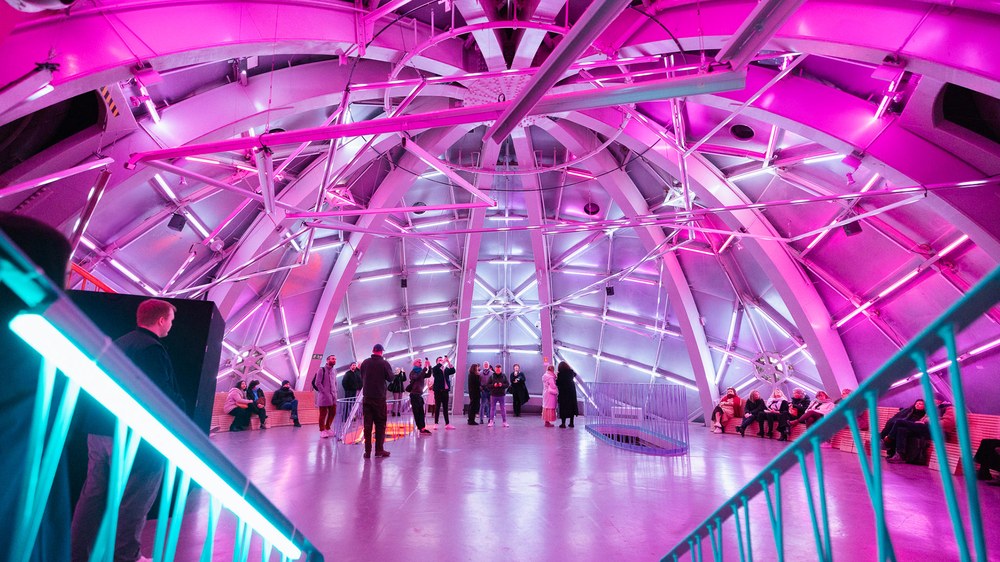
For example, the French artist collective Visual System has designed the permanent installation for the central sphere – an almost psychedelic 'mushroom of light' with changing light effects rotating around a central cylinder, surrounded by sculpted benches. This is a place to pause and relax before exploring the next exhibition spheres.
Or, you can take a completely different approach: ride the lift straight from the ground floor to the very top of the Atomium, immersing yourself in the installation 'Look up' along the way. Once at the top, visitors are rewarded with a 92-metre -high view, stretching as far as the centre of the European capital, almost ten kilometres away.
What's next?
Since 14 February this year, two new temporary exhibitions have been on show: Nimbus (by the already mentioned Visual System) and Supply Chain (by the French artist Romain Tardy).
Overall, it can be said that all of the Atomium's light and sound installations span the widest imaginable arc. If you allow yourself to engage with them, you cross an invisible threshold, embark on a journey through space and forget about time. Indifference is not an option here – hence the clear recommendation: go and see it for yourself, ideally in the early morning when visitor numbers are lower, and immerse yourself in the past and present of this oversized iron crystal.
An article by Michael Müller from the DLRmagazin 179. He is an editor in DLR's Communications department, enjoys spending time in Brussels and is happy to have now also seen the Atomium from the inside.