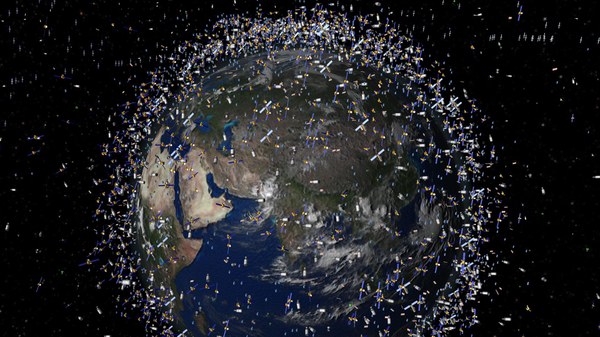
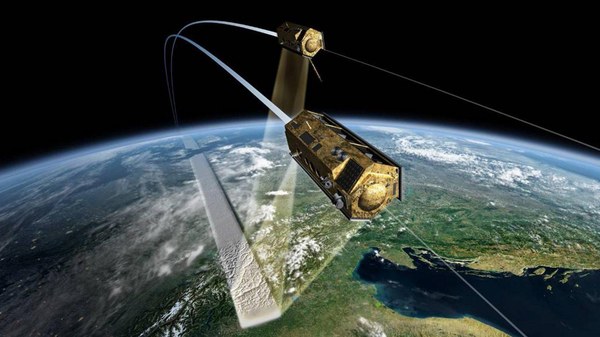
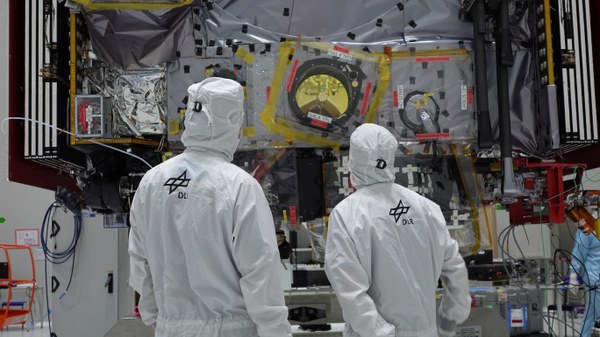
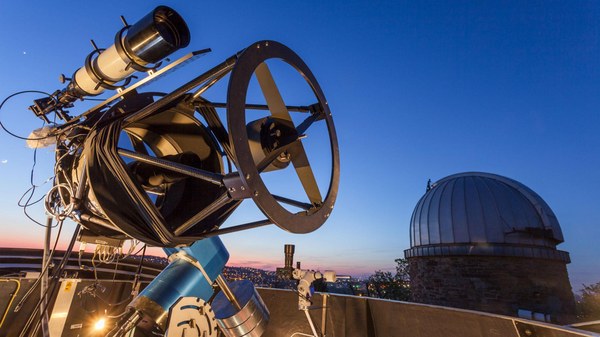
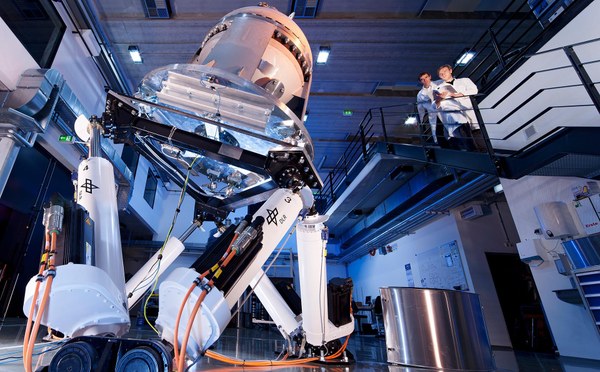
Earth is surrounded by a cloud of debris – a DLR database shows both the number and the position of objects in space.
Credit:
DLR, AIUB
Space debris, or space junk, refers to all human-made objects in space that no longer serve any purpose, such as decommissioned satellites, rocket bodies or small components of these such as paint and varnish particles, screws, nuts and other small parts. The amount of space debris has increased significantly over the decades because of the space activities of various nations.
Approximately 45,000 objects larger than ten centimetres in diameter are regularly detected and catalogued. In addition, it is estimated that more than 1.2 million fragments of space debris between one and ten centimetres in Earth orbit. Because of high orbital speeds of several kilometres per second, collisions with even these small objects can cause severe damage to satellites, up to and including their complete destruction. This threatens the failure of important applications in communication, navigation, Earth observation, weather forecasting or the defence sector. In addition, avoidance manoeuvres are costly and consume propellant, which shortens satellites' operational lifespan. Orbital debris also poses a risk on Earth, as fragments can strike the planet's surface if they do not burn up in the atmosphere.
Should there eventually be too many pieces of debris in orbit, a phenomenon called the Kessler syndrome could occur. This refers to a cascading series of collisions, involving small or large pieces of debris and active or defunct satellites, with each collision generating more debris – leading to more collisions. As a result, individual orbital regions could become completely cluttered with debris, rendering them unusable for spaceflight for a long time.
Observing, removing and preventing space debris
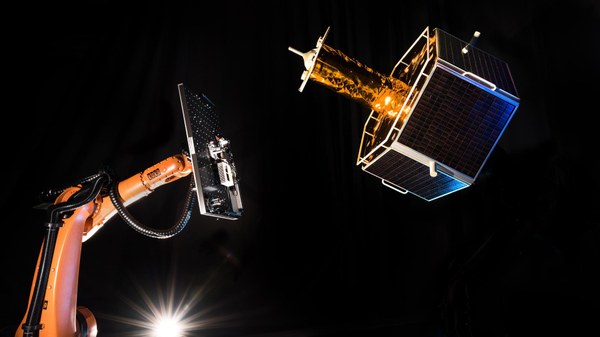
DLR researches technologies for sustainable spaceflight and space debris mitigation. As part of this work, DLR space research investigates robotic technologies for extending the operational lifetime of satellites in space, as well as to actively capture and remove of space debris.
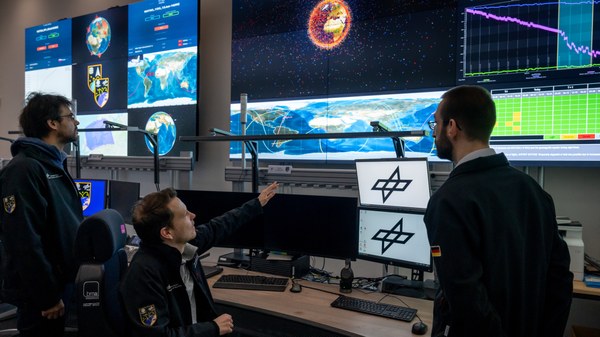
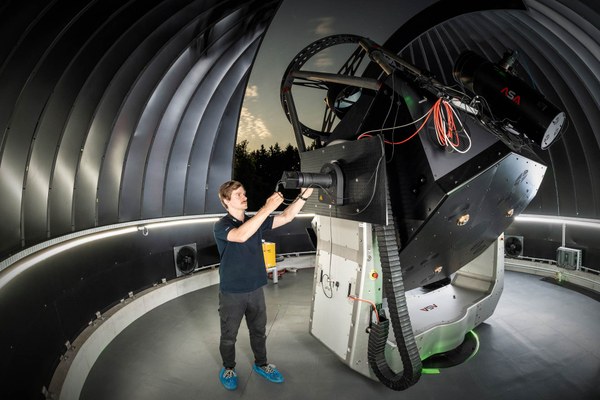
The best form of prevention, however, is to minimise the risk of failure or destruction of a space object from the outset, and to ensure that objects remove themselves from orbit independently at the end of their operational lifetime. Reusable launch systems and deorbiting technologies make important contributions here. For all satellite operators, it is essential to know which objects are close to their own satellites, so as to detect and avoid potential collisions in good time. This space situational picture, which the German Space Agency at DLR produces together with the Bundeswehr (German Armed Forces) at the Space Situational Awareness Centre, forms the basis for planning avoidance manoeuvres. To this end, both active objects and space debris are continuously tracked and catalogued.
Finally, we are active in international bodies working on regulatory measures to prevent space debris. At the same time, DLR researchers ensure that internationally recognised mitigation measures are considered and implemented in their own projects. As a signatory to the European Space Agency's (ESA) Zero Debris Charter, we are committed to the safe and sustainable use of space. This also means that no debris should be left in space after a mission has ended.
The following background pages offer an overview of our research activities and present technological solutions for satellite operations, robotics, debris detection, space weather and servicing.
Your consent to the storage of data ('cookies') is required for the playback of this video on Youtube.com. You can view and change your current data storage settings at any time under privacy.
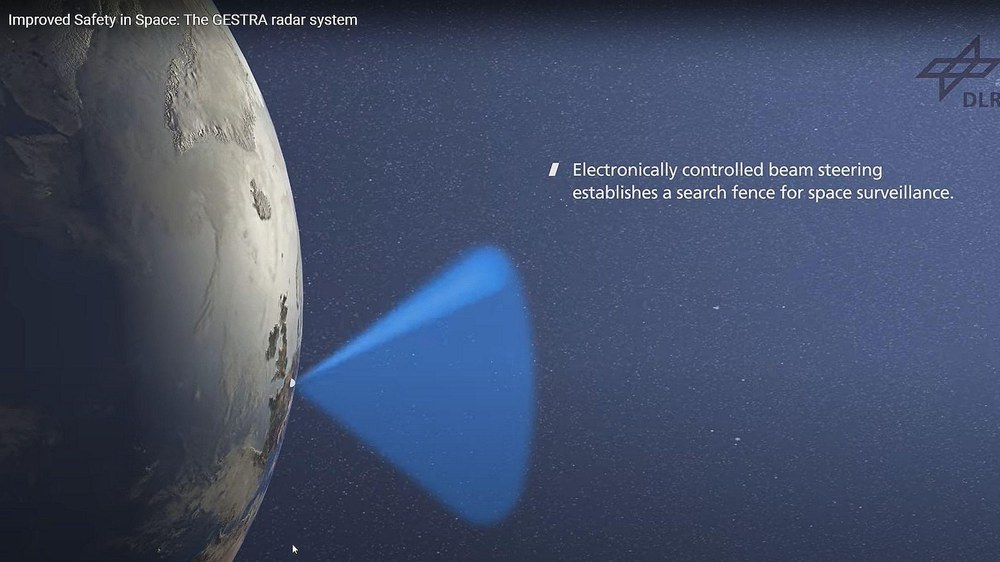
Video: Improved safety and security in space – the GESTRA radar system
The GESTRA system is one of the most modern radar systems for detecting objects in space. This unique system can monitor space debris and active space systems in low Earth orbit around the clock. GESTRA was built by the Fraunhofer Institute for High Frequency Physics and Radar Techniques (FHR) on behalf of the German Space Agency at DLR with funding from the Federal Ministry for Economic Affairs and Energy (BMWE). It is operated from the FHR site near Koblenz, making a significant contribution to space security at national, European and international levels.
Your consent to the storage of data ('cookies') is required for the playback of this video on Youtube.com. You can view and change your current data storage settings at any time under privacy.
Video: 🛰️💥Space debris – what is it? ℹ️ A DLR expert explains #dlr #shorts #space (German only)
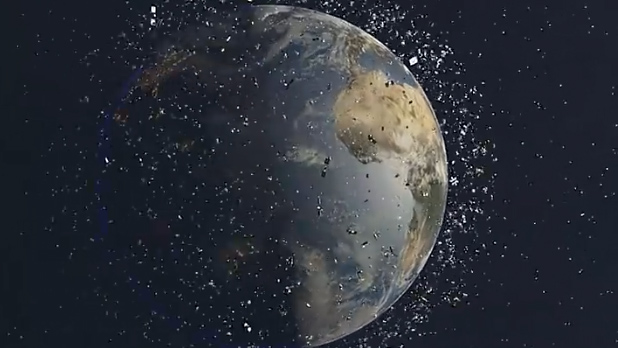
More and more space activities mean more and more satellites in low Earth orbit. But what happens when these satellites are decommissioned? What if they collide with one another or explode? With the steadily growing number of large debris objects and tiny particles, the threat posed by space debris is increasing. As a result, everyday navigation and communication applications that everyone relies on, as well as weather and Earth observation services, could be disrupted. Manuel Metz from the German Space Agency at DLR explains what exactly space debris is and how it burns up or re-enters the atmosphere.