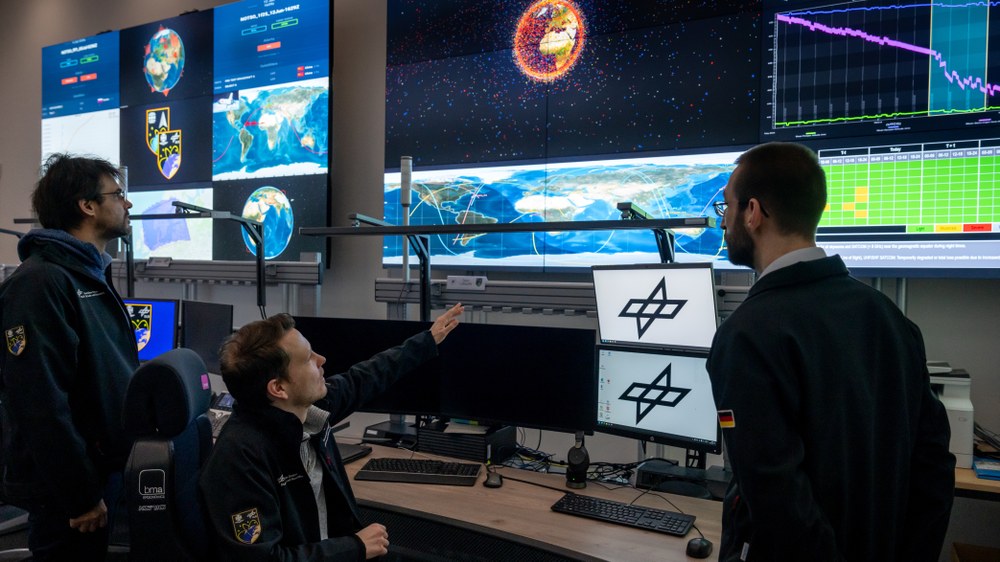
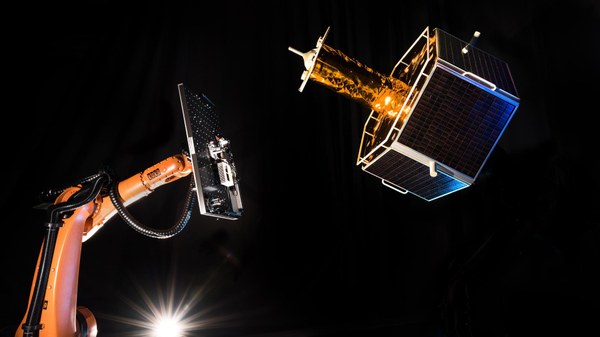
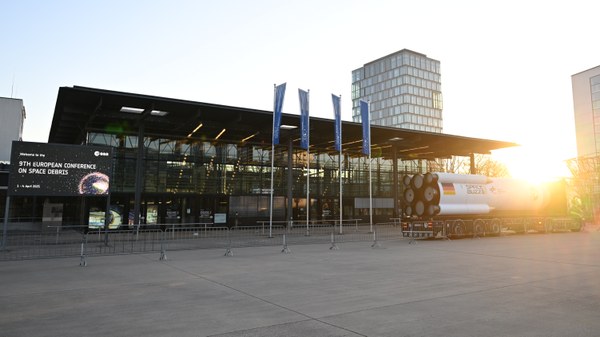
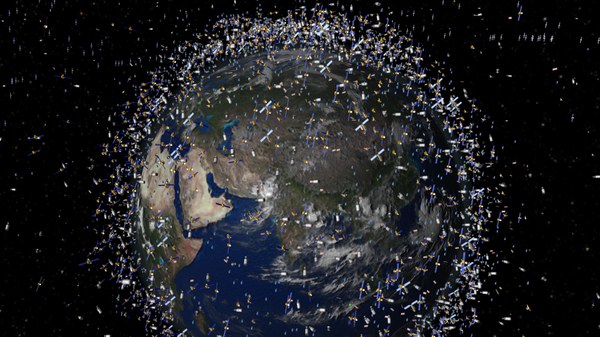
Navigation, satellite communications, the internet – satellite-based infrastructure is indispensable for today's information society. Sectors such as energy supply, banking and disaster management also rely on services from space. These services are now considered critical infrastructure and must be protected. The German Space Agency at DLR contributes to this protection, in collaboration with the Bundeswehr Space Command at the Space Situational Awareness Centre in Uedem.
Image: 1/2, Credit:
Bundeswehr/Jennifer Heyn
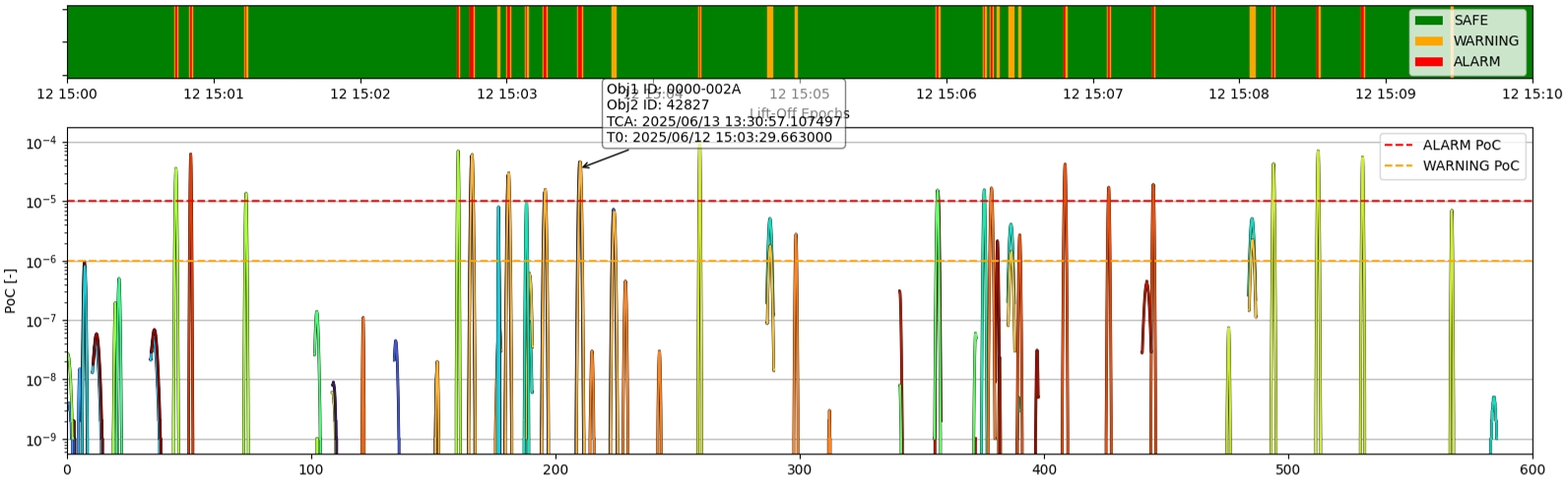
ASSET – DLR's collision avoidance service
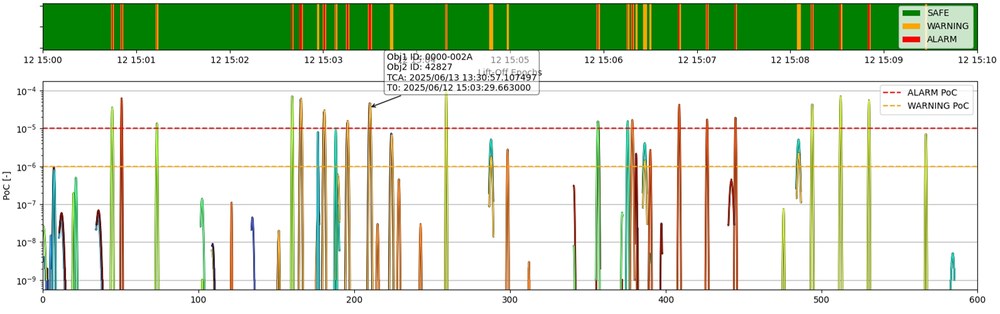
The graphic shows a safety assessment of a ten-minute launch window using the ASSET (AScent SafETy) software. The periods marked in orange and red indicate an increased collision risk for the rocket launch and payload deployment. The probabilities of collision (PoC) are shown in comparison with the tolerance thresholds for alert (red) and warning (orange).
Space infrastructure is the invisible backbone of our modern civilisation. Satellites not only enable global communication, navigation and weather forecasting, but also support areas such as disaster management, agriculture and transport. At the same time, the threat to this infrastructure from human-made and natural hazards is growing. Collisions with space debris, cyberattacks on satellite systems or the destructive effects of space weather events such as solar storms could severely damage this infrastructure – with serious consequences for the economy, security and society.
Why space safety and security is essential for DLR
Space safety and security encompasses all the measures necessary to protect this essential infrastructure and maintain its reliable performance. A key building block of this protection is a detailed and up-to-date space situational picture – because only by precisely tracking the movements of satellites and debris and monitoring natural phenomena, such as meteoroids or solar storms, can risks be identified early and mitigated in a targeted way.
However, the complexity of space safety and security demands more than just technical solutions. It requires close collaboration between government, industry and the scientific community to ensure the long-term functionality and availability of critical systems. Through interdisciplinary collaboration, we can set standards, develop new technologies and sustainably tackle global challenges such as space debris and cyberthreats.
With innovative technologies, international cooperation and forward-looking strategies, we help to preserve space as a safe and sustainable environment for future generations.
The Space Situational Awareness Centre in Uedem
The German Space Agency at DLR operates the Space Situational Awareness Centre in Uedem together with the Space Command of the Bundeswehr (German Armed Forces). Space surveillance sensors are used to continuously detect and catalogue objects in space, including active satellites and space debris such as spent rocket stages and fragments.
Using this data, the centre compiles the national space situational picture and analyses collision risks for space objects as well as hazards from atmospheric re-entries over Germany. The information from the situational picture is evaluated and passed on to public authorities and satellite operators.
Since 2015, the German Space Agency at DLR has also been involved in the European Union Space Surveillance and Tracking (EU SST) programme. EU SST monitors and tracks objects in Earth orbit to ensure the safe and sustainable use of space. The Space Situational Awareness Centre operates the European object and orbit data catalogue, thereby also contributing to space safety and security at the European level.
Safe operation of space infrastructure at the German Space Operations Center (GSOC)
At the German Space Operations Center (GSOC) in Oberpfaffenhofen, DLR controls and monitors national satellite missions, such as TerraSAR-X, TanDEM-X and EnMAP. The focus here is on the safe and reliable operation of these Earth observation satellites, including planning and performing avoidance manoeuvres when space debris comes too close to a satellite.
The Collision Avoidance (COLA) system has been in operational use for this purpose since 2009. We continuously adapt its underlying algorithms to keep pace with the rapidly growing number of objects in space and increasing operational complexity. The improved COLA system uses DLR's own catalogue, the Backbone Catalogue of Relational Debris Information, and the US Special Perturbations catalogue, which actively tracks more than 30,000 space objects.
Collision avoidance during a rocket launch
Given the rising number of launches and the growing number of satellites and pieces of space debris in very low Earth orbit – approximately 100 to 450 kilometres above Earth's surface – the risk of a collision during a rocket's launch has also increased in recent years. This applies both to the brief phase in which the rocket passes through airspace and to the phase of transition into space.
DLR is developing the following models and tools, among others, to avoid collisions:
With the ASSET (AScent SafETy) Launch Collision Avoidance (LCOLA) service, we calculate a safe launch window for a rocket launch by considering objects in low Earth orbit that could cross the rocket's trajectory during launch – the period in which the rocket transitions into space, the satellites are deployed and the early operational phase begins. In 2026, we will demonstrate the LCOLA service together with DLR's Mobile Rocket Base (MORABA). It will then be made available to the European launch vehicle market to ensure the safe operation of launch vehicles and satellites.
To integrate space launches into airspace, we are setting up the Launch Coordination Center (LCC) at the DLR site in Braunschweig. Software-supported procedures are intended to enable the safe, efficient and flexible conduct of spaceflight activities during launch and re-entry, particularly through airspace. As a rocket launch currently involves very extensive and extended airspace closures, our aim is therefore to achieve genuine integration.
Cybersecurity of space systems
Alongside collision avoidance strategies, DLR must also address the risks posed by cyberattacks on individual satellites, satellite constellations and space stations, as these can lead to disruptions or failures. This affects every area of a space mission: the ground station, the communication links and the satellites themselves. DLR is developing approaches to factor cybersecurity into the design process from the outset, across all segments of a space mission and in both software and hardware. In the RESILIENZ (Resilienz intelligenter cyber-physischer Systeme, or 'Resilience of Intelligent Cyber-Physical Systems' in English) project, for example, DLR devised methods to protect the integrity of intelligent cyber-physical systems. These methods identify instabilities arising from cyberattacks or other anomalies and restore the security of the overall system.
Effects of space weather
Space weather also has an impact on satellites and, in the worst case, can disable them and lead to the creation of space debris. It is therefore important to forecast space weather events, such as solar storms, and to switch systems into a safe mode in the event of danger. More information can be found in our 'Space weather' featured topic.
Overview of control centres, space catalogues and software
Space Situational Awareness Centre in Uedem
Together with the Space Command of the Bundeswehr, the German Space Agency at DLR operates the Space Situational Awareness Centre in Uedem. At this facility, objects in low Earth orbit are observed in order to protect German space-based civil and military systems and to produce an up-to-date space situational picture.
With its expertise in orbital mechanics, sensor technology, and data processing and analysis for producing situational pictures, DLR makes a significant contribution to protecting critical infrastructure.
German Space Operations Center (GSOC)
With the German Space Operations Center, DLR supports external customers such as space agencies, industry and academia in preparing for and operating both satellite and crewed missions. For satellite missions, the main tasks include controlling and monitoring spacecraft and communicating with them, mission planning and orbit determination and control. This includes the orbit corrections needed to avoid collisions with other objects in space. These operational tasks extend across the entire life cycle of a satellite.
Collision Avoidance (COLA) system
The Collision Avoidance (COLA) system has been in operational use since 2009 for satellites operated by DLR and as a service for external missions. To keep pace with the rapidly growing number of objects in space and increasing operational complexity, both the algorithms used and the interfaces are continuously modernised and improved.
The improved COLA system draws on DLR's own catalogue, the Backbone Catalogue of Relational Debris Information, as well as the US Special Perturbations catalogue, which actively tracks more than 30,000 space objects. The system has been extended to assess collision risks more accurately, particularly in the case of repeated close approaches. It takes into account the total collision risk across multiple encounters, which can be significantly higher than the risk from a single encounter. Approaches at low relative velocities are especially challenging. In addition, DLR is researching how artificial intelligence can improve risk assessment and support decisions on collision avoidance manoeuvres.
ASSET – Launch Collision Avoidance service
With the ASSET LCOLA service, DLR is developing a service that assesses collision risks during the rocket launch, while the satellites are being deployed and during their early operational phase. Compared with existing services, ASSET covers the entire launch window and enables a realistic assessment based on collision probabilities. At the same time, the necessary analyses can be carried out much more quickly. In this way, DLR aims to make rocket launches more flexible and safer.
A prototype of the DLR LCOLA service is being demonstrated together with MORABA in 2026. The technology will then be made available to the European launch vehicle market, contributing to safe access to space.
Launch Coordination Center
With the increasing commercialisation of space – often referred to as 'New Space' – the number of rocket launches is rising significantly. With the Launch Coordination Center (LCC), DLR aims to efficiently and flexibly support safe launches and re-entries. The DLR Institute of Flight Guidance is developing the LCC as part of the SpaceTracks innovation project. The LCC encompasses ground-based planning and coordination, as well as monitoring of flights through airspace up to the transition to space operations.
RESILIENZ fault detection system
As part of the RESILIENZ project, DLR is developing hardware and software systems that continue to function reliably even when disruptions occur. These systems are designed to detect faults autonomously, respond to them and restore their own functionality as fully as possible. To achieve this, DLR combines intelligent monitoring and control methods with a holistic view of the system. This approach considers both the interaction between technical components and the role of people in detecting and rectifying faults.