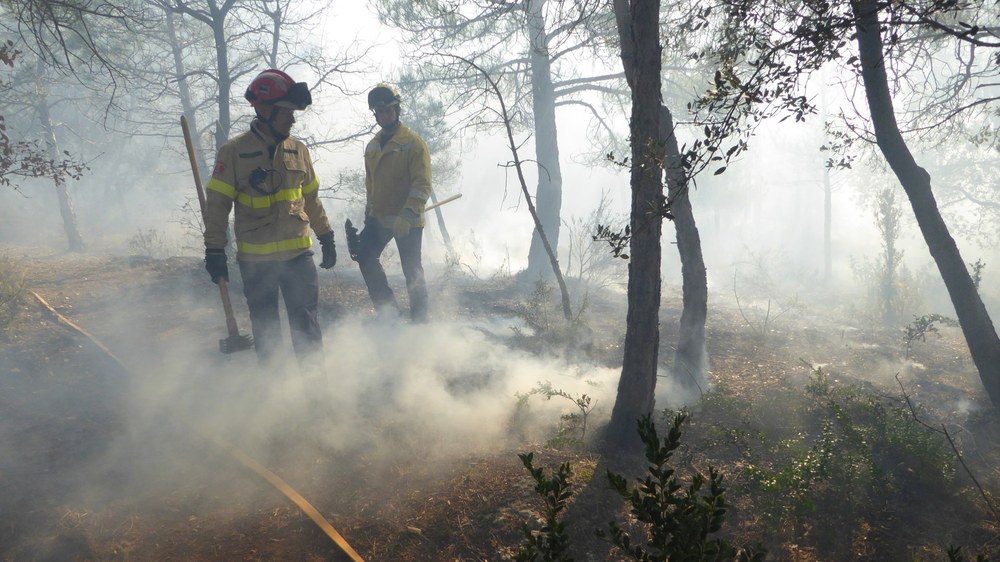
DLR combines technologies from space, aviation, AI and security to cover the many aspects of modern wildfire monitoring – from global detection and drone swarms to real-time support with satellite data and maps for effective, efficient and safe tactical operational planning on the ground.
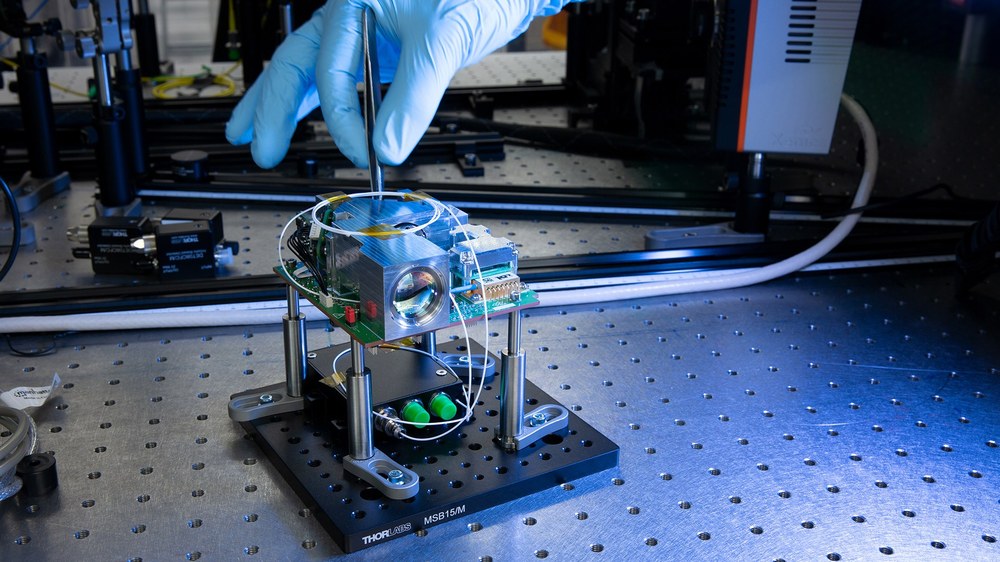
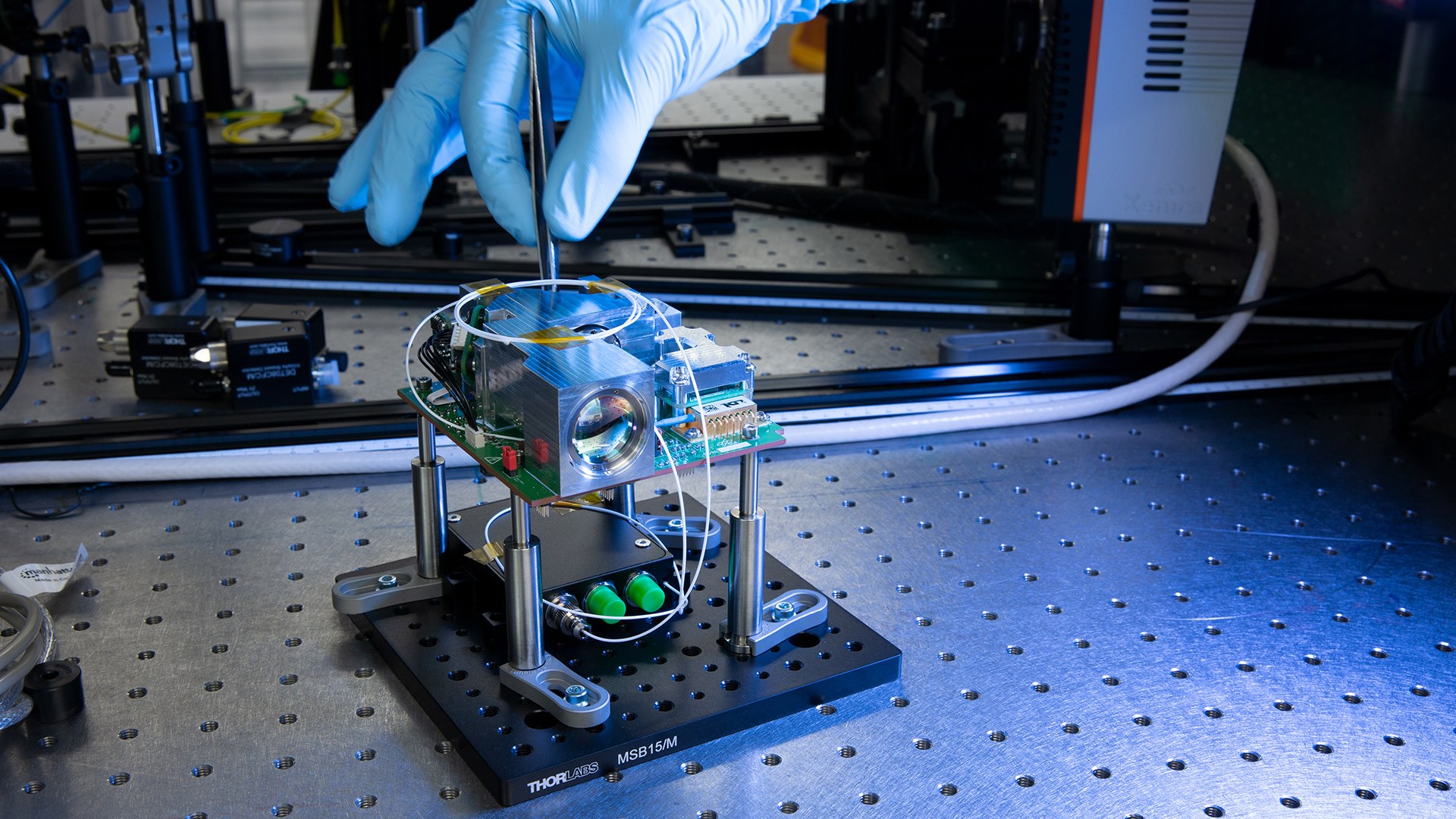
The fully integrated OSIRIS4CUBE laser communication terminal is a further development of the miniaturised OSIRIS4Cubesat terminal, specifically designed for use in quantum communication.
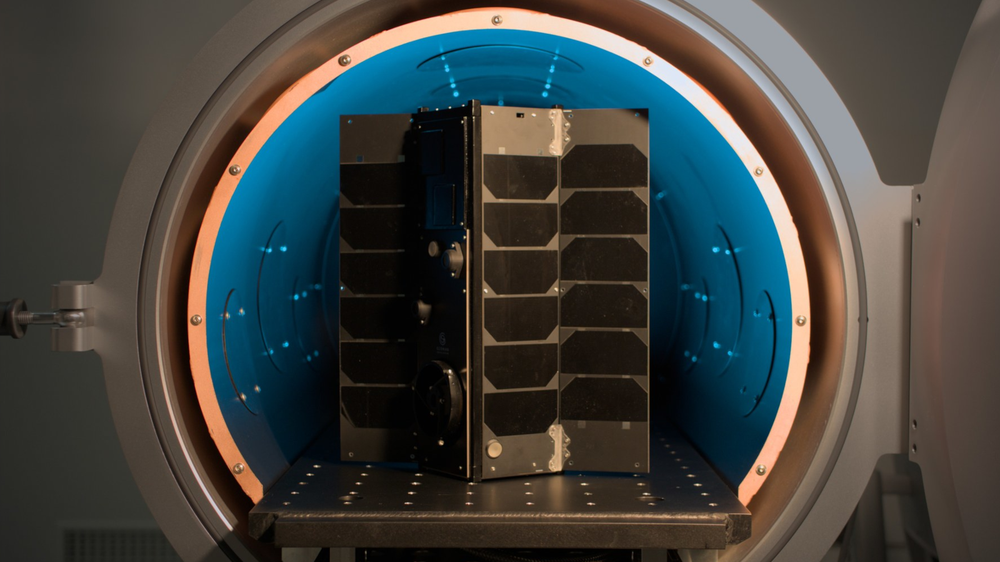
Small satellites open up new possibilities for a wide range of disciplines: mobility on land, at sea and in the air, communications, our security, and global climate and environmental monitoring. Fast to deploy, flexible in use and extremely cost-effective, they complement the infrastructure in space. At DLR, we are increasingly relying on these smart 'orbital assistants': on the one hand, we use their advantages as platforms for our engineering research and, on the other, to drive their technological development forward.
Miniaturisation for maximum autonomy and minimal resource use
Instead of years of development time on the ground, small satellites offer an agile opportunity to test new technologies or individual components at an early stage, gain insights and therefore significantly accelerate development. This means valuable technologies and services for industry and society can be made available more quickly.
Their reduced size demands particularly smart, tailored technology: both the satellite platforms and the payloads must be small, lightweight and highly energy-efficient – without compromising scientific or operational performance. Alongside miniaturisation combined with equal or even increased capability, the aim is always to advance standardisation and modularity.
Background information: Family ties – from small MiniSats to tiny PicoSats and FemtoSats
Not all small satellites are the same. In fact, there is a whole family of space systems that have an overall mass of under 500 kilograms. Each size is suited to specific applications and orbits. What defines the size is the number of units, with one standard unit (1U) measuring 10 x 10 x 10 centimetres. SmallSat dimensions depend on the use case, with some satellites featuring 0.25, 1.5, 2, 3, 6, 12 units or even more. Those with a mass of between 100 to 180 kilogrammes are known as minisatellites (MiniSats). As we go down the scale, there are microsatellites, nanosatellites, picosatellites (up to 1 kg) and finally femtosatellites, which only weigh between one and ten grams.
In all this, it is not only the components that are becoming smaller. New technologies such as artificial intelligence are increasingly being integrated, for example for onboard energy optimisation and data processing.
A demanding orbit – small satellites also operate in very low Earth orbits
Small and very small satellites are also very well suited for use in 'Very Low Earth Orbit' (VLEO), meaning extremely low orbits below roughly 300 kilometres. Classical satellites are typically transported to altitudes of 500 kilometres and upwards – where low Earth orbit (LEO) begins and where many Earth observation satellites, for example, operate. Navigation satellites fly from approximately 23,000 kilometres in medium Earth orbit (MEO), and communications satellites ‘stand’ fixed above one point on Earth at approximately 36,000 kilometres in geostationary orbit.
In VLEO, instruments benefit from better optical resolution and shorter signal paths back to Earth, among other things. However, the orbit also poses special challenges: the atmosphere still exerts significant drag (braking effect) on small satellites here, meaning they require powerful propulsion systems for regular orbit-raising manoeuvres. Materials must also be highly robust – and at the same time burn up as completely and as climate-compatibly as possible when the satellite re-enters Earth’s atmosphere at the end of its life. The lifetimes of small satellites in VLEO are very short compared with missions in higher orbits (sometimes only one month). Over time, this means more satellites are deployed in this region – creating a tension between efficiency and sustainability.
Small satellites for society, the environment, security and strengthening Europe's independence
In environmental observation, for example, small orbiters make it possible to closely monitor wildfires. While large satellites such as the Sentinel family from the European Copernicus programme often only pass over a region once per day, systems like OroraTech's 'Wildfire Solution Platform' – to which DLR contributed the AI-based analysis method – can fly over a region up to five times a day, thanks to its constellation of eight small satellites. This is a decisive advantage in highly dynamic crisis situations such as forest fires. Maritime observation also benefits: the OTTER nanosatellites will fly in formation and measure ship and wave movements on the oceans, from which three-dimensional representations can be generated.
In security and geopolitics, small satellites are becoming increasingly important in telecommunications. Global systems like SpaceX's Starlink constellation have shown in crisis regions how vital satellite-based communication can be. To strengthen its independence, Europe plans to follow suit with its own projects – for example by expanding the French Eutelsat fleet as a counter-model to the US system.
Applications for improving cybersecurity are also coming into focus: future networks of small satellites could, for example, support responses to targeted cyberattacks on energy infrastructure, restart systems, remove malware or upload system updates. In projects such as the QUBE-II research collaboration ('Quantum key distribution from a CubeSat to the ground'), DLR is working with research partners and OHB as industrial coordinator on technologies for tap-proof communication using satellite-based quantum encryption.
Small satellites could also support monitoring of global supply chains – for example, verifying compliance with human rights and environmental standards under the EU's directive on corporate sustainability due diligence. They track transport routes or help monitor the regions where raw materials originate. In this way, satellite-based services are emerging that go far beyond 'classic' Earth observation – taking the security and resilience of our complex, interconnected world to a whole new level.
Especially in a time of growing geopolitical uncertainty, resilient space systems are in higher demand than ever. Small satellites flying in swarms provide redundancy – meaning they back each other up if one fails – and operate in a decentralised way. They are therefore much more robust against disruptions. Their ability to be replaced or supplemented quickly makes them an important building block in a more resilient space infrastructure. As such, they not only open up new scientific horizons but also strengthen Europe's technological sovereignty.
Sustainability in orbit – responsible spaceflight
Another key pillar of DLR's space research strategy is the sustainability of tomorrow's spaceflight. The rapid rise in launch numbers, particularly by commercial New Space actors, increases the risk of collisions and thus the creation of space debris – a growing problem in Earth’s near-space environment.
We are therefore focusing on forward-looking development: for example, construction materials that burn up cleanly in the atmosphere, reliable end-of-life procedures to guide small satellites safely and precisely back to Earth in a targeted manner, and sensor technologies for precise position determination, orbit tracking and identification from the ground. Thanks to their low mass and rapid innovation cycles, small satellites offer excellent opportunities for new concepts in this field.